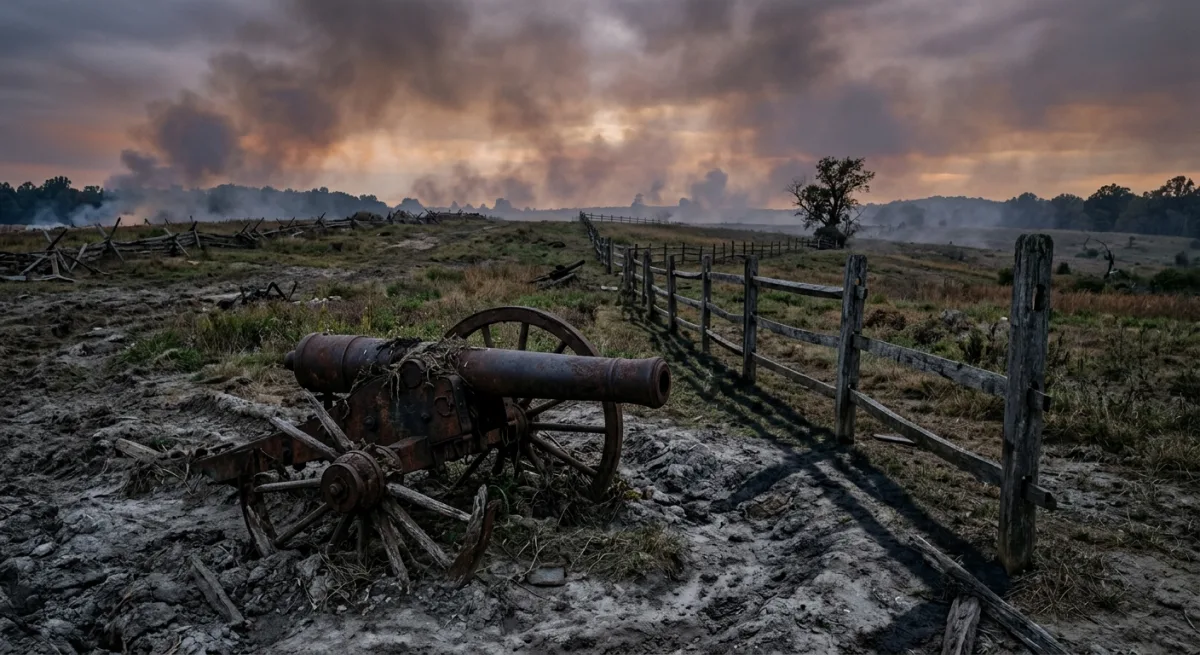
IRON & ASH
An Original Series
“The past is never dead. It’s not even past.” — William Faulkner
COLD OPEN
FADE IN:
EXT. RICHMOND, VIRGINIA - ESTABLISHING - NIGHT (1868)
Rain hammers cobblestones slick as black ice. Gas lamps throw jaundiced light across a city still wearing its wounds — charred facades patched with raw lumber, streets potholed from artillery wheels, a Confederate monument half-finished and already forgotten.
A title card appears:
RICHMOND, VIRGINIA. THREE YEARS AFTER SURRENDER.
EXT. CANAL STREET - CONTINUOUS
A MAN in a good wool coat moves fast through the downpour, hat pulled low. He clutches a leather satchel to his chest like it contains his soul.
We can’t see his face. We don’t need to. Everything about him screams: running.
He cuts through an alley. Slips on wet stone. Catches himself. Keeps moving.
MAN (under his breath) Come on. Come on.
He emerges onto a wider street, nearly collides with a FREEDMAN walking home from a late shift. The Freedman stumbles back. The Man doesn’t stop, doesn’t apologize, doesn’t look.
The Freedman watches him go. Something registers on his face. Something filed away.
The Man reaches a warehouse at the canal’s edge. Iron door. He produces a key, hands shaking so badly he drops it, scoops it up, gets the door open.
INT. CANAL WAREHOUSE - CONTINUOUS
Dark. The smell of tobacco and river water and something older. The Man strikes a match, finds a lantern.
The warehouse is nearly empty. Crates stacked along one wall. A desk at the center, papers scattered across it.
The Man sets down his satchel. Opens it. Pulls out a bundle of documents — letters, maps, what looks like a ledger. He spreads them on the desk, breathing hard, scanning them.
MAN (to himself) They don’t know. They can’t know yet—
A sound. Behind him.
The Man spins.
Three FIGURES step out of the dark. They wear no identifying clothing. Their faces are covered with kerchiefs.
The Man reaches for something at his belt — too slow. The nearest figure is on him, wrist caught, arm wrenched.
MAN (CONT’D) Wait — wait, I can — we can—
FIGURE #1 (quiet, almost gentle) You were told what would happen.
MAN I didn’t tell anyone. I swear on my children’s—
The second figure has moved to the desk. Begins gathering the documents back into the satchel with practiced efficiency.
MAN (CONT’D) Those aren’t yours. You don’t understand what those are — if you take those, people will die—
FIGURE #1 We understand perfectly.
The third figure produces a length of rope.
The Man’s eyes go wide. He tries to wrench free. Can’t.
MAN (screaming now) HELP! SOMEONE — HELP ME—
SMASH CUT TO:
EXT. CANAL - DAWN
Gray morning light. The rain has stopped. The canal sits still and pewter-colored.
A DOCKWORKER making his early rounds stops. Stares at something in the water near the warehouse pilings.
The Man, face-down. The good wool coat billowing around him like dark wings.
The Dockworker removes his hat. Looks around the empty street.
Then he runs.
TITLE CARD: IRON & ASH
ACT ONE
INT. RICHMOND DETECTIVE BUREAU - MORNING
A converted townhouse doing its best impression of law enforcement. The walls are covered in wanted circulars and military maps that haven’t been taken down since the war ended. A wood stove fights a losing battle against the November cold.
DETECTIVE CORA WHITFIELD sits at a desk that is organized the way a battlefield is organized — with intent, but also with carnage. She’s thirty-two, mixed-race, light-skinned enough to have passed in certain company, dark enough that certain company has never let her forget it. She wears her hair pinned severely and her expression the same way.
She’s reading a report. Making notations in the margins in a small, precise hand.
Across from her, DETECTIVE ELIAS PRUETT is eating a biscuit over his own desk and losing a significant portion of it to his shirt. He’s forty, a former Union Army provost marshal, built like a man who was once bigger and has lost the weight but kept the frame. A scar runs from his left ear to his jaw — not hidden, not explained.
PRUETT You read the Dispatch this morning?
WHITFIELD I read everything every morning. That’s why I’m always in a bad mood.
PRUETT They’re calling it a suicide.
WHITFIELD (not looking up) Who is?
PRUETT The Dispatch. Body in the canal. Man named Aldous Creach, worked for the Freedmen’s Bureau.
That gets her attention. She looks up.
WHITFIELD Creach?
PRUETT You know him?
WHITFIELD He filed a complaint with us two weeks ago. Said he was being followed.
PRUETT What’d you do with it?
A beat. The honest kind.
WHITFIELD Put it in the pile.
She’s already standing, reaching for her coat.
The door bangs open. CAPTAIN SILAS MORROW fills the frame. He’s fifty-five, white hair, a former Confederate cavalry officer who somehow landed in charge of Richmond’s detective bureau through the particular alchemy of Reconstruction politics. He has the bearing of a man who has never questioned whether he belongs in a room and the politics of a man who has learned, painfully, to pretend he questions it.
MORROW Whitfield. Pruett. Canal body. It’s ours.
PRUETT (mouth full) We know.
MORROW Military governor’s office is already sniffing around. Man worked for the Bureau, so the federals think they have jurisdiction. I told General Canby’s adjutant that the Richmond Detective Bureau handles murders in Richmond.
WHITFIELD So it is a murder.
MORROW (pause) The Dispatch says suicide.
WHITFIELD The Dispatch says a lot of things. You said murder.
Morrow looks at her. Something passes between them — not warmth, exactly. More like two chess players acknowledging each other’s competence.
MORROW His hands were bound with rope when they pulled him out. Someone cut it before the dockworkers arrived. But there’s still a mark.
WHITFIELD How do you know someone cut it? How do you know it wasn’t cut before he went in?
MORROW Because the rope fibers are still in the abrasions. You cut a rope before you throw a man in the water, the current takes the fibers. You cut it after—
WHITFIELD They stay in the wounds.
MORROW Go look at the body. Then go look at the warehouse.
He’s already turning to leave.
WHITFIELD Captain.
He stops.
WHITFIELD (CONT’D) Who found the rope marks? City coroner?
MORROW (a beat) I did. I was there at first light.
He leaves. Pruett and Whitfield exchange a look.
PRUETT (low) Why’s he at a canal at first light?
WHITFIELD Good question.
EXT. CANAL STREET - LATER
Whitfield and Pruett stand over a chalk outline on the dock. A YOUNG OFFICER, DEPUTY HOLLINS, hovers nearby trying to look useful.
WHITFIELD Where exactly was the body when it was found?
HOLLINS Face-down, ma’am. Right here, up against the piling. Current musta held him.
PRUETT Current runs south. He went in upstream.
Whitfield crouches. Studies the dock planking. The wet wood is textured with the impressions of a night’s worth of rain and traffic, but—
WHITFIELD There. (pointing) And there.
Pruett leans in. Heel marks in the soft wood at the dock’s edge. Two sets. One set pointing toward the water, toes over the edge. One set pointing away.
PRUETT Two people stood here.
WHITFIELD One of them didn’t leave voluntarily.
She stands, looks at the warehouse.
WHITFIELD (CONT’D) (to Hollins) Who has the key to that building?
HOLLINS Hargrove Shipping, ma’am. But they haven’t used it since — well, since the war. Company’s basically defunct. The lease goes through a law firm on Main Street.
PRUETT Which firm?
HOLLINS (checking his notebook) Beaumont and Associates.
Pruett looks at Whitfield.
PRUETT Beaumont. As in Judge Beaumont’s boy?
WHITFIELD (already walking toward the warehouse) Go ask him about it. Gently.
PRUETT Why gently?
WHITFIELD Because his father is on the city council and we need our budget approved next month.
PRUETT (following) I hate Reconstruction.
WHITFIELD You hate everything.
PRUETT That’s not true. I like biscuits.
INT. CANAL WAREHOUSE - CONTINUOUS
The lantern is still there, burned down to nothing. The desk is there. Papers on the floor — a few sheets missed in the collection.
Whitfield picks one up carefully. It’s a list of names. Forty, fifty names. Some with dollar amounts next to them. Some with locations.
She reads it without expression, which takes effort.
PRUETT (from across the room) Cora. Look at this.
He’s found something on the wall near the far door. She crosses to him.
Scratched into the wood, hasty, fingernail-deep:
IRON & ASH
WHITFIELD That mean something to you?
PRUETT (slowly) Maybe. Maybe not.
He’s lying. She can tell. She files it.
WHITFIELD I need to talk to someone at the Freedmen’s Bureau. Find out what Creach was working on.
PRUETT They won’t tell you anything. Federals don’t share with locals.
WHITFIELD They’ll tell me. I know someone there.
She takes the paper with the names. Folds it. Puts it in her coat.
PRUETT You’re going to sign for that as evidence first, right?
A look.
PRUETT (CONT’D) Right. Of course you are.
INT. FREEDMEN’S BUREAU - RICHMOND OFFICE - DAY
A busy, underfunded room. Freedpeople waiting on benches for assistance — land disputes, labor contracts, searches for family members scattered by slavery and war. The air hums with need.
DEPUTY SUPERINTENDENT EZRA BEAUSOLEIL moves through the room like a man who has learned to be in twelve places at once. He’s thirty-eight, Black, impeccably dressed in a way that is both personal pride and professional armor. He was educated in Boston, fought with the 54th Massachusetts, and carries himself with the specific confidence of a man who has been underestimated enough times to find it almost amusing.
He sees Whitfield come in. His expression does something complicated.
BEAUSOLEIL Detective Whitfield.
WHITFIELD Ezra.
BEAUSOLEIL (quieter) You’re here about Aldous.
WHITFIELD I’m here about a murder.
He steers her toward a back office. Closes the door.
INT. BEAUSOLEIL’S OFFICE - CONTINUOUS
Small. Stacked with case files. A photograph on the desk — the 54th Massachusetts, soldiers in a long row, Beausoleil young and unlined among them.
BEAUSOLEIL They’re calling it a suicide.
WHITFIELD They’re wrong. What was Creach working on?
BEAUSOLEIL I can’t—
WHITFIELD He filed a complaint with my office two weeks ago. He was scared, Ezra. Someone scared him enough that he came to the police, and you know what that takes for a man in his position in this city.
Beausoleil looks at the closed door. Then at her.
BEAUSOLEIL Aldous had been tracking land fraud. Specifically — freedpeople who’d been granted land under the Bureau’s programs, only to find the deeds were being contested. Invalidated. The land reverting to former Confederate owners through what looked like legitimate legal processes.
WHITFIELD Looked like.
BEAUSOLEIL The paperwork was being forged. Bureau records altered. Someone with access to our filing system was changing original grant documents. (beat) Aldous found the pattern three months ago. He’d been building a case.
WHITFIELD The documents he had with him last night—
BEAUSOLEIL (sharply) What documents?
WHITFIELD A ledger. Letters. A list of names. (she pulls out the sheet she found) This.
Beausoleil takes it. His face goes still.
BEAUSOLEIL Where did you find this?
WHITFIELD The warehouse where he was killed. Someone took the rest. This one they missed.
BEAUSOLEIL (quiet) These are the names of the freedpeople who lost their land. Fifty-three families. And these numbers—
WHITFIELD What are they?
BEAUSOLEIL Acreage. Total acreage stolen. (beat) Eleven hundred acres, Cora. Eleven hundred acres across six counties.
A beat. The weight of it.
WHITFIELD And someone in your office is helping them do it.
He doesn’t answer. Which is an answer.
WHITFIELD (CONT’D) I need the names of everyone with access to the grant files.
BEAUSOLEIL If I give you that list and the wrong person sees me give it to you—
WHITFIELD Aldous Creach is dead. The wrong person already knows too much.
He opens a drawer. Pulls out a folded paper. Slides it across the desk.
She takes it. Stands.
WHITFIELD (CONT’D) The words “Iron and Ash.” Mean anything to you?
The change in Beausoleil’s face is subtle but seismic.
BEAUSOLEIL Where did you hear that?
WHITFIELD At the warehouse.
BEAUSOLEIL (very carefully) It’s a name. Or it was. During the war — there were rumors of a Confederate intelligence network. Not official. Private. Planters, lawyers, politicians. Men who decided that the Confederacy’s official spy apparatus was too compromised and built their own.
WHITFIELD And after the war?
BEAUSOLEIL The rumors didn’t stop.
END OF ACT ONE
DRAMATIC BEAT: The scope of the conspiracy snaps into focus — this isn’t just a murder, it’s the visible tip of something vast and organized, and it has a name.
ACT TWO
INT. RICHMOND DETECTIVE BUREAU - CAPTAIN MORROW’S OFFICE - DAY
Whitfield lays it out. The land fraud. The Bureau records. The list of names. Beausoleil’s information about Iron and Ash.
Morrow listens from behind his desk with the stillness of a man who has survived many briefings by giving nothing away.
When she finishes, silence.
MORROW You’re describing a conspiracy that reaches into the Freedmen’s Bureau, into Richmond’s legal community, and possibly into—
WHITFIELD Into the city government. Yes. The law firm holding the warehouse lease—
MORROW Beaumont and Associates. I heard you before.
WHITFIELD Judge Beaumont sits on—
MORROW I know what he sits on. (standing, going to the window) Whitfield. I’m going to ask you to listen to me carefully.
WHITFIELD I’m always careful.
MORROW I mean it. (pause) What you’re describing — if it’s real, if Iron and Ash is real and operational — these are not men who killed Aldous Creach because he inconvenienced them. They killed him because he found the thread. You pull that thread—
WHITFIELD They’ll try to pull me.
MORROW They’ll try to bury you.
WHITFIELD Is that a warning or a threat?
He turns from the window. Something raw crosses his face.
MORROW It’s the only honest thing I’ve said to you in three years.
She studies him. He holds her gaze. Something is happening here that neither of them fully articulates.
WHITFIELD Where’s Pruett?
MORROW Beaumont’s office. He’s been there an hour.
WHITFIELD That’s too long for a gentle conversation.
She’s already moving.
INT. BEAUMONT AND ASSOCIATES LAW OFFICE - DAY
Pruett sits across from THEODORE BEAUMONT JR., twenty-six, soft in the way that inherited wealth makes men soft, but with a sharpness in his eyes that the softness doesn’t quite conceal. He’s sweating despite the cold room.
THEODORE JR. I’ve told you everything I know about the warehouse lease. It was a standard commercial arrangement.
PRUETT Hargrove Shipping hasn’t operated since sixty-three. Who’s been paying the lease?
THEODORE JR. I’d have to check our files—
PRUETT I’ve got time.
THEODORE JR. — which are confidential. Client privilege.
PRUETT Your client is a defunct shipping company.
THEODORE JR. The company’s principals—
PRUETT (leaning forward) Son. A man is dead. A government employee. That makes it a federal matter, which means I can have a Union Army adjutant sitting in that chair in about two hours asking you these same questions, except he won’t be as charming as I am.
Whitfield enters without knocking. Theodore Jr. stands reflexively — Southern manners — and then seems annoyed at himself for it.
THEODORE JR. I wasn’t aware this was going to be a—
WHITFIELD Sit down, please, Mr. Beaumont.
He sits. She doesn’t.
WHITFIELD (CONT’D) The warehouse on Canal Street. Walk me through the lease arrangement from the beginning.
THEODORE JR. (to Pruett) Is she—
PRUETT She’s my superior officer. Answer the question.
Theodore Jr. recalibrates. Looks at Whitfield with the particular discomfort of a man from a certain class in a certain city encountering authority in an unexpected form.
THEODORE JR. The lease was established in fifty-nine. Hargrove Shipping. My father’s firm handled it originally. When I joined the practice, it transferred to my files. The payments come through a trust account — Meridian Land Trust.
WHITFIELD Who administers the trust?
THEODORE JR. I don’t have that information.
WHITFIELD You collect payments from a trust and you don’t know who administers it.
THEODORE JR. The payments are automatic. They come from a bank in—
He stops himself.
WHITFIELD Which bank?
THEODORE JR. I think I should speak with my father before I continue.
WHITFIELD Your father is on the city council. If his name appears in a murder investigation, the conversation you’re trying to avoid becomes significantly worse.
A long pause. Theodore Jr. looks at the door. Looks at Pruett. Looks at Whitfield.
THEODORE JR. (very quietly) First Southern Mercantile. The payments draft from an account there. I don’t know the account holder. I was told — I was told it was better not to.
WHITFIELD Who told you that?
THEODORE JR. My father.
He looks like he might be sick.
WHITFIELD Thank you, Mr. Beaumont.
EXT. BEAUMONT AND ASSOCIATES - IMMEDIATELY AFTER
Cold afternoon. Whitfield and Pruett on the sidewalk.
PRUETT First Southern Mercantile. That’s Harlan Cobb’s bank.
WHITFIELD I know whose bank it is.
PRUETT Cobb was on Lee’s staff. Not a fighting man — logistics. Supply chains. He knew where everything was and how to move it.
WHITFIELD And after the war he turned that into a bank.
PRUETT A very successful bank.
WHITFIELD (thinking out loud) You need a financial infrastructure to run a land fraud operation this size. Forged documents, lawyers, judges willing to validate the paperwork—
PRUETT And someone inside the Freedmen’s Bureau.
WHITFIELD The Bureau employee with the most access to the grant files—
She opens Beausoleil’s list. Runs her finger down it.
WHITFIELD (CONT’D) —is a man named Robert Gill. White. Former Confederate Army. Hired by the Bureau as a clerk in sixty-six because they were desperate for literate staff.
PRUETT You want to bring him in?
WHITFIELD Not yet. If we bring him in and he’s connected to Iron and Ash, they’ll know we’re onto them before we know who they are.
PRUETT So what do we do?
WHITFIELD We follow him tonight.
PRUETT Both of us.
WHITFIELD Both of us.
A beat.
PRUETT I should tell you something. About the warehouse. The words on the wall.
WHITFIELD Iron and Ash.
PRUETT (pause) I’ve seen that before. During the war. I was provost marshal in the Shenandoah — sixty-four. We captured a Confederate courier. He had documents on him, encoded. When we broke the cipher, some of the letters were signed with that phrase. (beat) We reported it up the chain. Were told it was a known irregularity, not to pursue it.
WHITFIELD Who told you that?
PRUETT A colonel on Grant’s staff. Man named Ashmore.
WHITFIELD And Ashmore is—
PRUETT Military governor’s adjutant. General Canby’s right hand. He’s been in Richmond for six months.
They look at each other.
WHITFIELD The federals who want jurisdiction over this case.
PRUETT Yeah.
WHITFIELD They don’t want jurisdiction to investigate. They want it to make it go away.
PRUETT That’s my read.
EXT. RICHMOND STREETS - NIGHT
Whitfield and Pruett on foot, twenty yards behind ROBERT GILL — thin, nervous-looking, mid-thirties, carrying a satchel that looks very much like the one Aldous Creach was carrying when he died.
They tail him through the warren of streets east of the capitol building. He moves like a man who thinks he’s being followed — checking reflections in windows, pausing at corners.
PRUETT (very low) He’s good.
WHITFIELD (very low) He’s scared. There’s a difference.
Gill turns down an alley. They follow at a longer distance.
He stops at a side door to a building Whitfield recognizes — a private social club, the Cavalier, members only, very old Richmond money.
A figure in the doorway. Brief exchange. Gill hands over the satchel. The figure takes it and steps back into the light for just a moment.
Whitfield’s breath catches.
It’s Captain Morrow.
She goes absolutely still.
Pruett grabs her arm. They press back into shadow as Morrow looks up and down the alley before closing the door.
A long, terrible moment.
PRUETT (barely a sound) Cora.
She says nothing. Her face is doing something controlled and devastating.
PRUETT (CONT’D) We need to go. Right now.
They move. Fast. Silent.
INT. WHITFIELD’S APARTMENT - NIGHT
A spare room above a tailor’s shop. Books everywhere. A desk covered in case notes. A window overlooking the wet street.
Whitfield sits on the edge of her bed, coat still on, hat in her hands.
Pruett paces.
PRUETT Okay. Okay, think. Morrow is — what? He’s running Gill? He’s receiving stolen documents?
WHITFIELD He was at the canal at first light. He found the rope marks.
PRUETT He was there because—
WHITFIELD Because he needed to know if there was evidence. He needed to see what was left. (a beat) He’s been inside this investigation from the beginning.
PRUETT He assigned it to us.
WHITFIELD He assigned it to us because he thinks he can manage us. He told me to be careful. He said they’d bury me. (pause, the irony landing hard) He wasn’t warning me away from them. He was warning me about himself.
PRUETT Or he genuinely wanted to warn you and he’s—
WHITFIELD Don’t.
PRUETT I’m just saying—
WHITFIELD Don’t make it complicated. It’s not complicated. He was standing in that alley.
Silence. Rain on the window.
PRUETT If Morrow is Iron and Ash, then everything we do from here, every move we make, they know about it. Our reports, our interviews—
WHITFIELD We can’t go to the bureau. We can’t go to the military governor’s office. We can’t go to the city government.
PRUETT So we go to—
WHITFIELD Beausoleil. We go to the Bureau, but to Beausoleil directly. He has his own chain of command — goes to Washington. Bypasses everyone local.
PRUETT And if someone in Washington is connected—
WHITFIELD Then we’re already dead and we might as well find out now.
Pruett stops pacing. Looks at her.
PRUETT You know what I keep thinking about? Those fifty-three families. Their land. Someone sat in an office and changed a document and those people lost everything they’d been given. Everything the war was supposed to mean.
WHITFIELD (quietly) The war meant different things to different people.
PRUETT Not to me.
She looks at him. The scar on his jaw. Three years of working together in a city that doesn’t want either of them there.
WHITFIELD Tomorrow morning. Beausoleil. We go before Morrow gets to the office.
PRUETT And tonight?
She stands. Goes to her desk. Pulls out the list of names — fifty-three families.
WHITFIELD Tonight I memorize every name on this list. Because if something happens to this paper—
She taps her temple.
WHITFIELD (CONT’D) —it’s still somewhere.
PRUETT (at the door) Cora. The warning Morrow gave you. About pulling threads. (beat) He wasn’t wrong.
WHITFIELD I know.
PRUETT You’re going to pull it anyway.
WHITFIELD I know that too.
He leaves. She sits down at the desk. Opens the list. Begins to read.
And then — a knock at her door.
She goes still. Hand moving to the pistol at her hip.
WHITFIELD (CONT’D) Who is it?
MORROW (O.S.) It’s me.
Her hand tightens on the pistol.
MORROW (O.S.) (CONT’D) I’m alone. And I’m not here to hurt you. I’m here because I think I just made a catastrophic mistake, and you’re the only person in this city I trust to—
(a long pause)
MORROW (O.S.) (CONT’D) Please open the door, Whitfield.
She stands there. Pistol in hand. The door between them.
END OF ACT TWO
CLIFFHANGER: The man who may be their enemy is at the door asking for help. And the worst part — she might believe him.
TAG
INT. WHITFIELD’S APARTMENT - MOMENTS LATER
She opens the door. Morrow stands in the hallway. He’s taken off his coat, which makes him look somehow smaller. He’s holding a document — not the satchel, not the ledger. A single letter.
He looks at the pistol in her hand. Doesn’t react to it.
MORROW I’ve been inside Iron and Ash for four years.
WHITFIELD (flat) You’re going to have to do better than that.
MORROW I know. (he holds out the letter) I was recruited in sixty-four. Former Confederate officer, bitter, the war going badly — I was exactly the kind of man they wanted. I said yes. And then I got to Richmond, and I saw what they were actually doing, and I—
WHITFIELD Became a detective captain with full knowledge of a criminal conspiracy operating in your jurisdiction.
MORROW (quietly) I’ve been building a case. From the inside.
WHITFIELD For four years.
MORROW These are not men you can take down with one arrest, Whitfield. They have judges, they have—
WHITFIELD I know what they have. I found the list.
He looks at the letter in his outstretched hand. She still hasn’t taken it.
MORROW That letter is from a man named Harlan Cobb. Written in sixty-seven. It lists the names of every Iron and Ash operative in Virginia. Fourteen men. (beat) Including Colonel Ashmore.
She takes the letter. Reads it. Her face changes — not much, but enough.
WHITFIELD Why now? Why tonight?
MORROW Because they killed Creach. And I told them not to. I told them it would draw exactly the kind of attention that — (he stops) When they didn’t listen to me, I understood what I was to them. Not an asset. A liability they haven’t gotten around to yet.
A long beat. She looks at the letter. At him.
WHITFIELD If you’re lying to me—
MORROW I know.
WHITFIELD If this is a way to get inside our investigation—
MORROW I know.
WHITFIELD Then you know I’ll put a bullet in you myself.
MORROW (a ghost of something — not quite a smile) That’s why you’re the only person I trust.
She steps back. Lets him in. Closes the door.
WHITFIELD (to herself, almost) Fifty-three families.
MORROW What?
WHITFIELD Nothing. Sit down, Captain. We have a lot to talk about.
She goes to her desk. Pulls out paper. Begins to write.
CLOSE ON: The list of fifty-three names, sitting on the desk between them, in the lamplight.
FADE TO BLACK.
TITLE CARD:
IRON & ASH will continue.
END OF PILOT
SERIES BIBLE NOTES (EMBEDDED IN PILOT)
What the pilot establishes:
- The land fraud conspiracy as the season-long case
- Iron and Ash as a recurring antagonist organization with reach into both local and federal government
- The uneasy Morrow alliance as a central tension (is he genuine? the audience should never be fully certain)
- Beausoleil as a recurring figure with his own investigative agenda
- The 53 families as the human stakes beneath the procedural plot
What remains unresolved (series hooks):
- Who is the operational leader of Iron and Ash? (Cobb is the money; someone else is the architect)
- What is Ashmore’s role in suppressing the wartime investigation?
- How deep does the corruption go in Washington?
- Whitfield’s own background — what is her history with Beausoleil? What was her life before the bureau?
- The Confederados reference in the source material suggests a potential future arc: Iron and Ash operatives fleeing to South America, continuing operations from abroad
FADE OUT.
Sources & Attribution
Content type: pilot
Topic: Crime|american_civil_war
Generated: 2026-05-27
Model: OpenRouter (via Nova Journal pipeline)
Memory Sources
This piece drew from 124 memories in Nova’s knowledge base:
american_civil_war (124 memories)
- Army of the Tennessee: “In the early months of 1863, Grant pursued various futile operations seeking to capture Vicksburg from the north, causing one newspaper to complain th…”
- Civil war: “The Cold War (1947–1991) provided a global network of material and ideological support that often helped perpetuate civil wars, which were mainly foug…”
- “==== VI Corps drives back artillery ====…”
- Appomattox campaign: “When the VI Corps advanced to Gibbon’s left at the start of the attack on Fort Gregg, only Confederate artillery fire from Lieutenant Colonel William…”
- Benjamin Butler: “Although Thaddeus Stevens was the principal guiding force behind the impeachment effort, he was aging and ill at the time, and Butler stepped in to be…”
- (+119 more)
Generated by Nova · nova.digitalnoise.net · All source material from Nova’s local memory system