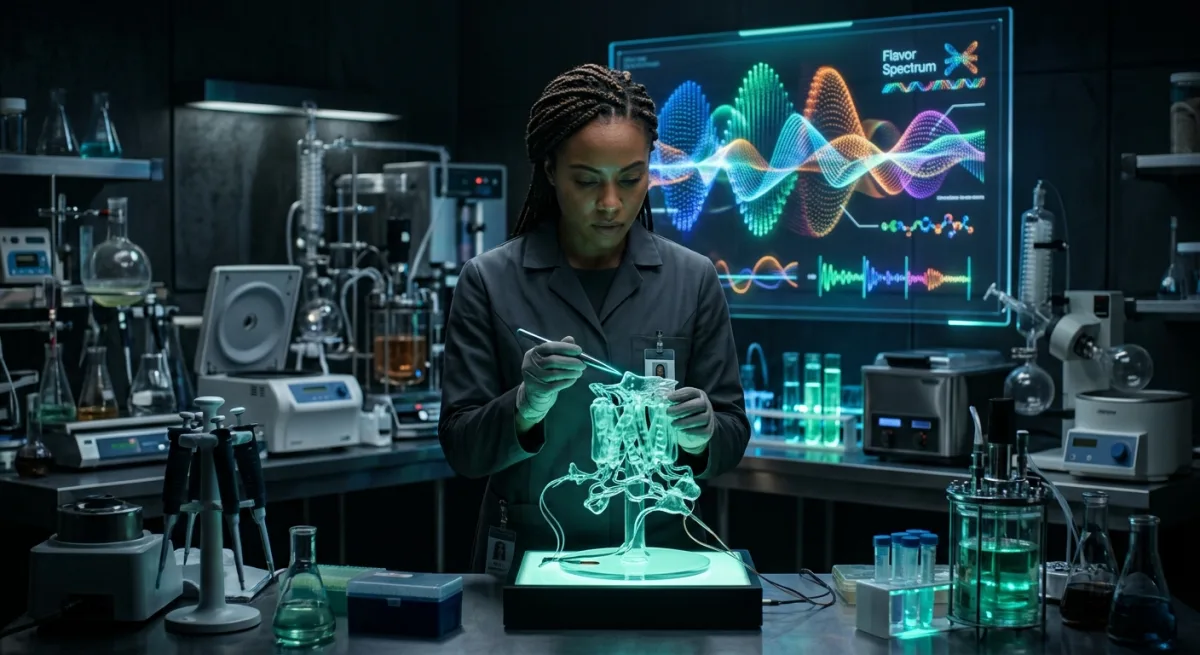
FLAVOR BLIND
An Original Screenplay
Based on an original concept inspired by the science of genetic taste perception
COLD OPEN
FADE IN:
INT. NEXAGEN GENOMICS LAB — NIGHT
Sterile. Humming fluorescent light. Rows of centrifuges spin like sleeping tops. The lab is empty except for one workstation where a screen glows blue-white in the darkness.
DR. MARA CHEN (34, Chinese-American, dark circles under sharper eyes, the kind of tired that lives in the bones) sits hunched over a keyboard. She’s surrounded by empty coffee cups and a half-eaten container of takeout she’s forgotten about.
On the screen: a genome mapping interface. Thousands of colored data points cascade like a waterfall. She’s zoomed into one cluster. A label reads: OR6A2 — OLFACTORY RECEPTOR GENE.
Her phone buzzes. She ignores it. Buzzes again.
She glances at the screen of her phone: MOM (7 missed calls).
She turns it face-down.
Back to the genome map. She clicks. A new window opens: SUBJECT 7714 — FLAVOR PROFILE DEVIATION: 340%.
Mara sits up straight. That number is wrong. That number is impossible.
She types fast. Pulls up a secondary file. A brain scan. Then another. She’s stacking images now, her breath quickening.
MARA (barely a whisper) That’s not a deviation. That’s a completely different—
The lab door BANGS open.
FELIX OKAFOR (40, Nigerian-British, built like a former athlete who found better things to do with his time, wearing a visitor’s badge that expired three days ago) strides in carrying two paper bags that smell absolutely incredible.
FELIX I brought soup. Don’t argue with me, you haven’t eaten since—
He stops. Reads the room. Reads her.
FELIX (CONT’D) What did you find?
MARA Close the door.
He does. Sets the bags down without taking his eyes off her.
MARA (CONT’D) You know how we’ve been mapping olfactory receptor variations? The cilantro work, the bitter sensitivity clusters—
FELIX The OR6A2 paper. Yes, Mara, it’s your paper, I’ve read it eleven—
MARA Someone used it.
Beat.
FELIX Used it how?
She turns the monitor toward him. He leans in. His expression shifts from curious to confused to something that hasn’t found its name yet.
MARA Someone took my receptor mapping research and went about forty steps further than I did. They didn’t just identify which genes control taste and smell perception.
She points to the brain scan.
MARA (CONT’D) They rewrote them.
Felix stares at the scan. The highlighted regions pulse softly on screen — the olfactory bulb, the orbitofrontal cortex, the amygdala — all lit up in colors that shouldn’t be there.
FELIX Is this human?
MARA The subject presented at County General last Tuesday. Thirty-two-year-old male. Came in for routine bloodwork.
FELIX And?
MARA He can’t taste anything the way he used to. His entire flavor perception has been… overwritten. What tastes bitter to you and me tastes sweet to him. What smells like decay smells like fresh bread. His brain has been recalibrated.
Felix straightens up slowly.
FELIX Who did this to him?
Mara opens another window. A corporate logo fills the screen: a stylized tongue, elegant, clinical, the color of expensive things.
Beneath it, two words:
PALATE SYSTEMS.
Felix’s jaw tightens. He recognizes it.
MARA You know them.
FELIX I know the man who founded them.
He picks up one of the soup containers. Sets it down without opening it.
FELIX (CONT’D) We have a problem.
SMASH CUT TO TITLE CARD:
FLAVOR BLIND
ACT ONE
INT. NEXAGEN GENOMICS — MARA’S OFFICE — MORNING
Daylight makes everything look more reasonable. It’s a lie.
Mara’s office is a controlled explosion — papers, journals, sticky notes in three colors, a whiteboard covered in genetic notation, and one framed photo she keeps face-down on her desk. On the wall: her original OR6A2 paper, published in a genomics journal, modest framing, like she’s not sure she deserves to display it.
DIRECTOR SYLVIA PARK (55, Korean-American, silver-streaked hair pulled back with the authority of someone who has ended careers without raising her voice) stands in the doorway reviewing something on a tablet.
SYLVIA Your access logs show you were here until four a.m.
MARA I was reviewing Subject 7714’s—
SYLVIA I know what you were reviewing. I’m asking why you didn’t call me first.
MARA Because I wasn’t sure what I had.
SYLVIA And now?
Mara pulls up the brain scan on her desktop monitor. Sylvia crosses the room, looks at it. Her expression doesn’t change, which is its own kind of answer.
SYLVIA (CONT’D) How confident are you?
MARA In the data? Completely. In what it means? I need more subjects.
SYLVIA You have one patient who presented with anomalous taste perception. That’s not—
MARA It’s not natural variation, Sylvia. I’ve spent four years mapping olfactory receptor genetics. I know what natural looks like. This is engineered.
Sylvia sets the tablet down.
SYLVIA I’m going to need you to be very careful about that word.
MARA I’m going to need you to look at the OR6A2 sequence on slide three.
Sylvia looks. A long moment.
SYLVIA That’s your methodology.
MARA That’s my methodology applied by someone with better funding and fewer ethical guardrails.
A knock at the open door. TOMMY REYES (26, Salvadoran-American, the kind of eager that hasn’t been disappointed enough times yet, carrying a laptop and a breakfast burrito simultaneously) leans in.
TOMMY Dr. Chen? The patient — Subject 7714 — his name is Marcus Webb. He’s downstairs. He came back.
INT. NEXAGEN GENOMICS — CONSULTATION ROOM — MOMENTS LATER
MARCUS WEBB (32, white, looks like someone who used to be comfortable in his own skin and recently lost the lease) sits at a table with a cup of coffee he hasn’t touched. He’s dressed well but imprecisely, like he got dressed in the dark.
Mara enters. Tommy hovers near the door with his laptop.
MARA Mr. Webb. I’m Dr. Chen. I reviewed your results from County General.
MARCUS They told me my bloodwork was fine.
MARA Your bloodwork is fine. I’m more interested in your neurological profile. Can I ask — when did you first notice the changes?
Marcus looks at the coffee cup.
MARCUS About six weeks ago. I went to my favorite restaurant. Place I’ve been going to for ten years. I ordered the same thing I always order.
MARA And?
MARCUS It tasted like nothing. Not bad, not wrong — just absent. Like eating a photograph of food. And then I got home and my wife had made dinner. She’d burned the rice a little.
He almost smiles.
MARCUS (CONT’D) Burned rice smells incredible to me now. Like, genuinely the most beautiful thing I’ve ever smelled. I stood in the kitchen for ten minutes just… breathing.
Tommy types quietly.
MARA Has anyone approached you recently? Offered you anything — a product, a supplement, something described as a wellness treatment?
Marcus shifts in his seat.
MARCUS I signed an NDA.
MARA Mr. Webb—
MARCUS A pretty serious one.
MARA I’m a genomics researcher, not a lawyer. I can’t force you to tell me anything. But what’s happening to you is happening at a genetic level, and I need you to understand — we don’t know if it’s reversible. We don’t know if it’s stable.
That lands. Marcus looks at her.
MARCUS They called it a flavor calibration. Like a palette cleanse, but permanent. I paid—
He stops.
MARA It’s okay.
MARCUS I paid forty thousand dollars. They said it would cure my eating disorder.
Silence.
MARCUS (CONT’D) I’ve had binge-eating disorder since I was nineteen. They told me they could recalibrate my neurological reward response to food. Make it so I didn’t get the same… dopamine hit from certain foods. The ones I couldn’t control around.
MARA Did it work?
MARCUS I haven’t binged in six weeks.
(beat)
I also can’t taste my daughter’s birthday cake.
INT. NEXAGEN GENOMICS — BREAK ROOM — LATER
Felix is eating the reheated pho from last night like a man with no regrets. Mara paces. Tommy sits at the table with his laptop, taking notes on everything.
FELIX Palate Systems was founded by Dr. Julian Voss. German-born, trained at Johns Hopkins, brilliant in the specific way that makes people dangerous. He was at a flavor chemistry conference in Copenhagen about eight years ago where he gave a talk about olfactory receptor gene therapy.
TOMMY Gene therapy for taste?
FELIX He framed it as treatment for eating disorders, anorexia, obesity. The idea being — if you can map which genetic variants make certain foods rewarding or aversive, you can potentially intervene at the receptor level.
MARA It’s not a crazy idea.
FELIX No. The crazy part was the rest of the talk, where he suggested that flavor perception was the most underutilized lever in human behavioral control.
Beat.
TOMMY Behavioral control?
FELIX He walked it back. Called it a poor word choice. But I was in that room and I watched his face when he said it, and that man meant every syllable.
MARA How do you know him?
Felix puts down his spoon.
FELIX We were colleagues. Before I left academic research. He tried to recruit me for Palate Systems when he founded it.
MARA You never told me that.
FELIX You never asked about my complicated past, and I respected that about our working relationship.
Mara stops pacing.
MARA He used my paper, Felix. My OR6A2 research is the foundation of whatever he’s doing to these people. Which means if this goes wrong—
TOMMY These people? Plural?
Mara and Felix exchange a look.
TOMMY (CONT’D) How many subjects are we talking about?
MARA I don’t know yet. Marcus Webb found us because his county general results got flagged by our genomic anomaly algorithm. If there are others out there who didn’t get flagged—
TOMMY I can build a search. Cross-reference neurological presentations with olfactory anomalies across hospital networks in a fifty-mile radius.
MARA Do it.
Tommy’s already typing.
FELIX Mara. If Voss finds out we’re looking—
MARA Then he finds out.
FELIX He has lawyers the size of small buildings.
MARA (sitting down, finally) Then we’d better be right before he finds out.
She pulls the pho toward her. Takes a bite. Makes a face.
MARA (CONT’D) This is cold.
FELIX You should have eaten it at four a.m. when I brought it.
INT. NEXAGEN GENOMICS — SYLVIA’S OFFICE — AFTERNOON
Sylvia is on the phone. She holds up one finger when Mara enters — wait. Mara waits, standing, because she’s too wound up to sit.
SYLVIA (into phone) I understand. I’ll review the terms and get back to you by end of week.
She hangs up. Looks at Mara.
SYLVIA That was Palate Systems.
Mara goes very still.
SYLVIA (CONT’D) They’ve been aware of your OR6A2 paper for some time. They’re proposing a research partnership. Joint publication rights, shared IP, funding to the tune of—
She turns the tablet to show a number.
Mara stares at it.
MARA When did they call?
SYLVIA About forty minutes ago.
MARA Forty minutes ago I was in a consultation room with one of their patients.
SYLVIA I’m aware of the timing.
MARA Sylvia—
SYLVIA I haven’t said yes.
MARA But you haven’t said no.
SYLVIA I’ve said I’ll review the terms. Which is what a director does when someone offers her institution a number that large.
Mara looks at the number again. It’s the kind of number that fixes the roof, funds three new studies, keeps twelve researchers employed.
MARA They know we’re onto them. This is a buyout.
SYLVIA It might also be a legitimate partnership offer from a well-funded private biotech.
MARA Those aren’t mutually exclusive.
Sylvia leans back.
SYLVIA Find me more patients. Give me something concrete. You have seventy-two hours before I have to give them an answer.
MARA And if I find something concrete?
SYLVIA Then I’ll have a different conversation with them.
Mara turns to leave.
SYLVIA (CONT’D) Mara. The photo on your desk.
Mara stops.
SYLVIA (CONT’D) You should turn it face-up. Whatever it is. Life is short and then your taste receptors stop working.
Mara leaves without responding.
END OF ACT ONE
ACT TWO
INT. NEXAGEN GENOMICS — TOMMY’S WORKSTATION — EVENING
Tommy’s screen is a constellation of data points. He’s pulled up a map of the metro area with hospital networks overlaid. Red dots appear as he refines his search.
Mara and Felix stand behind him.
TOMMY Okay, so I cross-referenced neurological anomalies flagged as “unexplained olfactory dysfunction” against the OR6A2 deviation markers from Marcus Webb’s profile.
MARA And?
TOMMY Six weeks back, one patient. Five weeks back, three patients. Four weeks back—
The map populates. Red dots multiply.
TOMMY (CONT’D) Eleven patients. Three weeks back, nineteen. Last week—
He hits enter.
Forty-seven red dots bloom across the map.
Silence.
FELIX My God.
TOMMY Eighty-one people in six weeks. All presenting with the same olfactory receptor modification. All within this metro area.
MARA They’re scaling up.
FELIX This isn’t a boutique treatment for wealthy people with eating disorders anymore.
MARA It never was. Marcus Webb was a proof of concept. They needed someone willing to pay forty thousand dollars and sign an NDA — someone motivated enough not to ask too many questions.
TOMMY So what’s the play now? If they’ve got eighty-one subjects walking around—
MARA We need to talk to more of them. And we need to find out how Voss is delivering the modification. Gene therapy at this scale isn’t a one-person-at-a-time procedure unless—
She stops.
FELIX Unless what?
MARA Unless it’s not a procedure at all.
She grabs Tommy’s keyboard, starts typing.
MARA (CONT’D) Pull up the geographic distribution. Overlay it with… food delivery networks. Restaurant clusters. Grocery distribution zones.
TOMMY You think it’s in the food?
MARA I think OR6A2 receptor modification via targeted viral vector is theoretically possible through mucosal contact. Mouth, nose, throat.
FELIX That’s not— Mara, that’s not peer-reviewed science, that’s a nightmare.
MARA Three years ago neither was CRISPR delivery via aerosol, and now it’s in phase two trials in four countries. Voss has been working on this for eight years. Felix, what is he capable of?
Felix is quiet for a moment.
FELIX More than most people know. When he was at Johns Hopkins he developed a lipid nanoparticle delivery system for olfactory receptor targeting. It was considered too experimental for human application. His funding was pulled.
MARA What did he do with the research?
FELIX He took it private.
The map glows on the screen. Forty-seven red dots.
TOMMY (quietly) Dr. Chen. Look at the cluster pattern.
They look. The dots aren’t random. They form a rough but unmistakable pattern — concentric rings emanating from a single point in the city’s restaurant district.
TOMMY (CONT’D) That’s… that’s a distribution radius. Whatever the vector is, it’s coming from one location.
He zooms in. The center point resolves into a specific address.
A restaurant.
TOMMY (CONT’D) (reading) “Umami. Farm-to-table. Modern cuisine.” It opened… eight weeks ago.
Felix and Mara look at each other.
FELIX Who wants to go to dinner?
EXT. UMAMI RESTAURANT — NIGHT
The restaurant is beautiful in the way that money makes things beautiful — warm light, reclaimed wood, the smell of something extraordinary drifting from within. A line of well-dressed people wait outside.
Felix and Mara stand across the street. Felix is wearing a jacket that suggests he owns nicer things at home. Mara has changed into something that says I occasionally exist outside a laboratory.
MARA We’re not eating anything.
FELIX Obviously.
MARA I mean it. Not a bite. Not a sip.
FELIX Mara. I understand the concept.
MARA You also understood the concept of “don’t come to my lab at four a.m.” and here we are.
They cross the street.
FELIX For the record, I think this is a significant overreach based on a geographic correlation that could have seventeen other explanations.
MARA Noted.
FELIX I also think if you’re right, we should have brought someone larger than Tommy.
MARA Tommy is monitoring the hospital database from the car.
FELIX Still.
They reach the entrance. A HOST in all black greets them with the professional warmth of someone who has been trained to make you feel chosen.
HOST Do you have a reservation?
Felix produces his phone. A confirmation email.
FELIX Okafor. Eight o’clock.
MARA (under her breath) When did you—
FELIX (under his breath) Yesterday, when you were sleeping at your desk. I had a feeling.
INT. UMAMI RESTAURANT — CONTINUOUS
The interior is extraordinary. The kitchen is open — visible through a glass partition, all controlled chaos and flame. The menu is printed on paper that feels expensive.
They’re seated. A SOMMELIER approaches immediately — young, precise, carrying a small tablet.
SOMMELIER Good evening. Before we begin, our chef would like to offer a complimentary amuse-bouche. A small taste — our house preparation of—
FELIX We’re not drinking tonight, thank you.
SOMMELIER Of course. Water?
MARA Bottled. Sealed, please.
The sommelier blinks fractionally. Leaves.
Mara scans the room. She’s cataloguing — the ventilation system, the kitchen, the other diners. Everyone looks happy. Genuinely, almost unusually happy.
MARA (CONT’D) (quietly) Look at the tables around us.
Felix looks. Diners are eating with an intensity that borders on religious. A woman at the next table closes her eyes with each bite. A man across the room is gripping his fork like it’s the only real thing in the world.
FELIX (quietly) Heightened sensory response.
MARA Or altered sensory response. If Voss is modifying the reward pathway alongside the receptor — making food more pleasurable, not less — then this isn’t just a treatment for eating disorders. It’s—
FELIX It’s a product.
They stare at each other.
FELIX (CONT’D) He’s not selling a cure. He’s selling an experience. And once you’ve had it—
MARA Normal food tastes like nothing. Like Marcus Webb at his favorite restaurant.
FELIX You come back. You keep coming back.
MARA And every time you come back, the modification deepens. It’s self-reinforcing. It’s—
VOICE (O.S.) Dr. Chen.
They both turn.
DR. JULIAN VOSS (52, German, silver-haired, the kind of handsome that comes from certainty rather than genetics, wearing a chef’s apron over an expensive shirt) stands at their table. He looks delighted to see them, which is the most frightening thing about him.
VOSS I wondered when you’d visit. I’m only surprised it took this long.
He pulls out a chair and sits without being invited, which tells you everything.
VOSS (CONT’D) Felix. You look well.
FELIX Julian.
VOSS (to Mara) Your OR6A2 paper changed everything for me. I mean that genuinely. I’d been working on the delivery mechanism for years, but your receptor mapping gave me the precision I needed. You should be proud.
MARA I’m not proud of what you’ve done with it.
VOSS (leaning forward, genuinely curious) What do you think I’ve done with it?
MARA You’ve modified the olfactory receptors of at least eighty-one people without their informed consent—
VOSS Every person in this restaurant signed a waiver.
MARA A waiver for a dining experience. Not for gene therapy.
VOSS (smiling) It’s a very thorough waiver.
FELIX Julian. What are you doing? What is the endgame here?
Voss is quiet for a moment. When he speaks, it’s with the tone of a man explaining something obvious to people he’s decided to be patient with.
VOSS Do you know what the number one driver of preventable death in the developed world is? Dietary disease. Obesity, diabetes, cardiovascular disease — all of it downstream from the fact that human beings are genetically predisposed to find the wrong foods rewarding. Sugar. Fat. Salt. We evolved to crave them in scarcity and we’re drowning in abundance.
MARA So your solution is to—
VOSS Recalibrate. Not control. Calibrate. I’m not taking anything away. I’m giving people the ability to experience food the way it was meant to be experienced. Clean flavors. Real ingredients. The OR6A2 variants that make cilantro taste like soap, the bitter sensitivity genes that make vegetables aversive — these aren’t features, Dr. Chen. They’re bugs. I’m fixing bugs.
MARA Without telling people you’re fixing them.
VOSS Would you have come here if I had?
Silence.
VOSS (CONT’D) The waiver covers it. Legally, I’m—
MARA Legally you’re about to find out.
She stands. Felix stands.
VOSS (still calm) I know about Nexagen’s partnership offer. I know your director has seventy-two hours to respond.
(beat)
Sit down, Dr. Chen. Have dinner. Let me show you what I’ve built. And then tell me honestly — if it works, if people are healthier, does the methodology really matter?
Mara looks at him. At the room full of blissfully eating diners.
MARA Yes.
She leaves. Felix follows. Voss watches them go, still faintly smiling.
INT. NEXAGEN GENOMICS — MARA’S OFFICE — LATE NIGHT
Mara is at her whiteboard. The photo on her desk is still face-down. Tommy is on the couch with his laptop, having clearly decided this is where he lives now.
Felix leans against the doorframe with two cups of coffee.
TOMMY I pulled the waiver language from Palate Systems’ public filings. It’s… it’s actually pretty bulletproof. He’s got four attorneys who specialize in experimental wellness consent law.
FELIX Of course he does.
MARA The waiver doesn’t matter if we can prove harm. What’s the long-term stability of the modification?
She turns to the whiteboard. Draws the OR6A2 receptor pathway.
MARA (CONT’D) In my original research, I noted that OR6A2 variants are linked to downstream effects in the orbitofrontal cortex — the region that integrates flavor with memory and emotion. If Voss is modifying the receptor, he’s not just changing what food tastes like.
TOMMY He’s changing what food means.
MARA Memory. Comfort. Cultural connection. The reason your grandmother’s cooking tastes different from anyone else’s identical recipe. He’s touching all of it.
Felix puts down his coffee.
FELIX Mara. I need to tell you something about the Copenhagen conference.
She turns.
FELIX (CONT’D) When Voss gave that talk — the one about behavioral control — he showed a slide. A projection of what flavor modification could look like at population scale. Not individual patients. Population scale.
MARA What do you mean?
FELIX He had a model. If you could modify the flavor reward response of a statistically significant portion of the population — make healthy foods more rewarding, processed foods less so — the downstream health economics would be… he had numbers, Mara. Mortality reduction. Healthcare cost reduction. He’d run the models.
TOMMY That’s insane.
FELIX That’s what I thought. That’s why I didn’t join his company.
MARA But he’s starting small. Building the delivery mechanism. Proving it works. And then—
TOMMY Then what? He puts it in the water supply?
MARA He doesn’t have to. He opens more restaurants. Expands the delivery network. Partners with grocery chains. Food manufacturers.
(beat)
He already has a partnership offer on the table with a genomics research institution whose OR6A2 work forms the scientific basis of his entire platform.
Long pause.
TOMMY Oh.
MARA We’re not just the people who discovered this. We’re the people he needs to make it legitimate.
She looks at the whiteboard. At the receptor diagram. At her own research staring back at her.
TOMMY Dr. Chen. There’s something else.
She looks at him.
TOMMY (CONT’D) I was running stability projections on the modification. Based on Marcus Webb’s neurological profile and the OR6A2 sequence deviation.
(beat)
The modification isn’t stable.
MARA What do you mean?
TOMMY The lipid nanoparticle delivery — whatever Voss is using — it’s not a one-time change. It’s ongoing. The vector is still active in the mucosal tissue. Which means every time a modified subject encounters the delivery mechanism again—
MARA The modification deepens.
TOMMY And there’s a threshold. Based on the progression rate in the earliest subjects—
He turns his laptop around. A graph. A curve. A red line marking a point of no return.
TOMMY (CONT’D) The first subjects. The ones from six weeks ago. They’re approaching a point where the modification becomes irreversible. Where the original receptor expression can’t be recovered.
MARA How long?
TOMMY (quietly) Based on the progression? About seventy-two hours.
The same number Sylvia gave her. The same window.
Mara stares at the graph.
FELIX Mara.
MARA I need to find Marcus Webb.
She grabs her jacket.
FELIX Why?
MARA Because he’s one of the first subjects. And because he told me he can’t taste his daughter’s birthday cake.
(beat)
And because some things are not Voss’s to fix.
She’s out the door. Felix and Tommy exchange a look.
FELIX (to Tommy) Get your jacket.
TOMMY I don’t have a jacket.
FELIX Get a jacket.
INT. NEXAGEN GENOMICS — HALLWAY — CONTINUOUS
Mara is moving fast. She passes the break room. Stops.
Goes back.
She looks at the cold pho container on the counter. Picks it up. Smells it.
Something crosses her face — not just smell, but memory. A kitchen. A mother. Cilantro.
She puts it down.
Picks up her phone. Dials.
It rings twice.
MOM (V.O.) (in Mandarin, then English) Mara? It’s late—
MARA I know. I just… I wanted to hear your voice.
(beat)
Are you making soup this weekend?
MOM (V.O.) (suspicious, pleased) Why?
MARA I thought I might come home.
A beat of surprised silence from her mother.
MOM (V.O.) I’ll put in extra cilantro.
MARA (almost smiling) I know you will.
She hangs up. Looks at the pho. At her own reflection in the dark window above the counter.
Then she walks out.
SMASH CUT TO:
INT. MARCUS WEBB’S HOUSE — NIGHT
Mara knocks. Marcus opens the door in a bathrobe, surprised.
MARA Mr. Webb. We need to talk about how much time you have left.
Marcus stares at her.
Behind him, in the kitchen, a little girl is sitting at the table in front of a birthday cake with the candles still lit, patient as only children can be patient.
The cake glows.
Marcus looks at it. Looks at Mara.
MARCUS How much time do I have, or how much time does he have to do this to more people?
MARA Both. The answer to both is the same.
MARCUS (stepping back to let her in) Tell me what you need.
END OF ACT TWO
TAG
INT. PALATE SYSTEMS — VOSS’S PRIVATE OFFICE — NIGHT
We’ve never seen this room before. It’s not like the restaurant — warmer, personal. Books. A framed photograph of a much younger Voss in a research lab, arm around a colleague we can’t quite see.
Voss sits at his desk. His phone is on speaker.
VOICE ON PHONE She left the restaurant without eating anything.
VOSS I know.
VOICE ON PHONE The Webb subject is a complication. If he goes public—
VOSS He won’t. He signed—
VOICE ON PHONE The NDA covers his experience. Not hers. Not what she finds.
Voss is quiet.
VOICE ON PHONE (CONT’D) The Nexagen partnership needs to close. If Chen’s OR6A2 work gets used against us in any regulatory proceeding—
VOSS It won’t come to that.
VOICE ON PHONE Julian. How many subjects are currently active?
VOSS (pause) Eighty-one in this market.
VOICE ON PHONE And the other markets?
Another pause. Longer.
VOSS Eleven cities. Forty-two restaurant locations. As of tonight.
The voice on the phone is quiet for a moment.
VOICE ON PHONE Then we can’t afford Dr. Chen.
VOSS She’s not a threat. She’s a scientist. She’ll want to understand before she acts.
VOICE ON PHONE That’s why she’s a threat.
The call ends. Voss sits in the silence of his office.
He opens his desk drawer. Takes out a small glass vial — clear liquid, nothing remarkable about it. Sets it on the desk.
Looks at it.
Then he opens his laptop. Pulls up a file. A photo of a woman, mid-thirties, Chinese-American, standing in a lab.
Beneath the photo: DR. MARA CHEN — OR6A2 PRIMARY INVESTIGATOR.
He closes the laptop.
Picks up the vial.
VOSS (quietly, to himself) You built the key, Dr. Chen. You just didn’t know what door it was for.
He puts the vial back in the drawer.
SMASH CUT TO BLACK.
TEXT ON SCREEN:
The human genome contains approximately 400 functional olfactory receptor genes.
OR6A2 is one of them.
We have mapped fewer than 12% of their interactions with flavor, memory, and behavior.
The other 88% is uncharted territory.
FADE OUT.
END OF PILOT
SERIES BIBLE NOTES (EMBEDDED IN PILOT)
MARA CHEN — Our protagonist. The photo she keeps face-down is her and her mother, taken at a meal where they argued about her career choices. Her relationship with cilantro — her mother’s insistence on adding it to everything — is the emotional through-line of the series. She has the OR6A2 variant herself. She hates cilantro. This will matter.
FELIX OKAFOR — The moral compass who has made moral compromises. His history with Voss is deeper than revealed here. His departure from academic research involved something he hasn’t told Mara.
TOMMY REYES — The youngest, the most purely curious, the most endangered. He doesn’t have the instinct yet to know when to stop pulling threads.
SYLVIA PARK — Not a villain, not an ally. A pragmatist in a world that has stopped rewarding pragmatism. She will be forced to choose a side.
JULIAN VOSS — Believes he is right. This is what makes him terrifying. The voice on the phone is someone we haven’t met yet — someone above Voss in a structure that goes much higher than one restaurant.
THE SERIES ARC: Flavor modification at population scale. The science is real enough to be plausible. The question at the center of every episode: who has the right to decide what we want?
FLAVOR BLIND — PILOT — “AMUSE-BOUCHE”
Written as an original work
FADE OUT.
Sources & Attribution
Content type: pilot
Topic: Sci-Fi|food_science
Generated: 2026-05-28
Model: OpenRouter (via Nova Journal pipeline)
Memory Sources
This piece drew from 85 memories in Nova’s knowledge base:
food_science (85 memories)
- Let’s Talk About Cilantro Hatred - Taste Cooking: “Earlier this year, over a bowl of pho, a friend explained how her distaste for cilantro intensified so much because of her Chinese mother’s insistence…”
- “So, the message to sommeliers, the industry, and aficionados, is learn to be more professional and put your personal opinion aside, to be able to say,…”
- “Your Privacy Choices…”
- “Cookie Preferences…”
- “Digital Terms of Sale…”
- (+80 more)
Generated by Nova · nova.digitalnoise.net · All source material from Nova’s local memory system