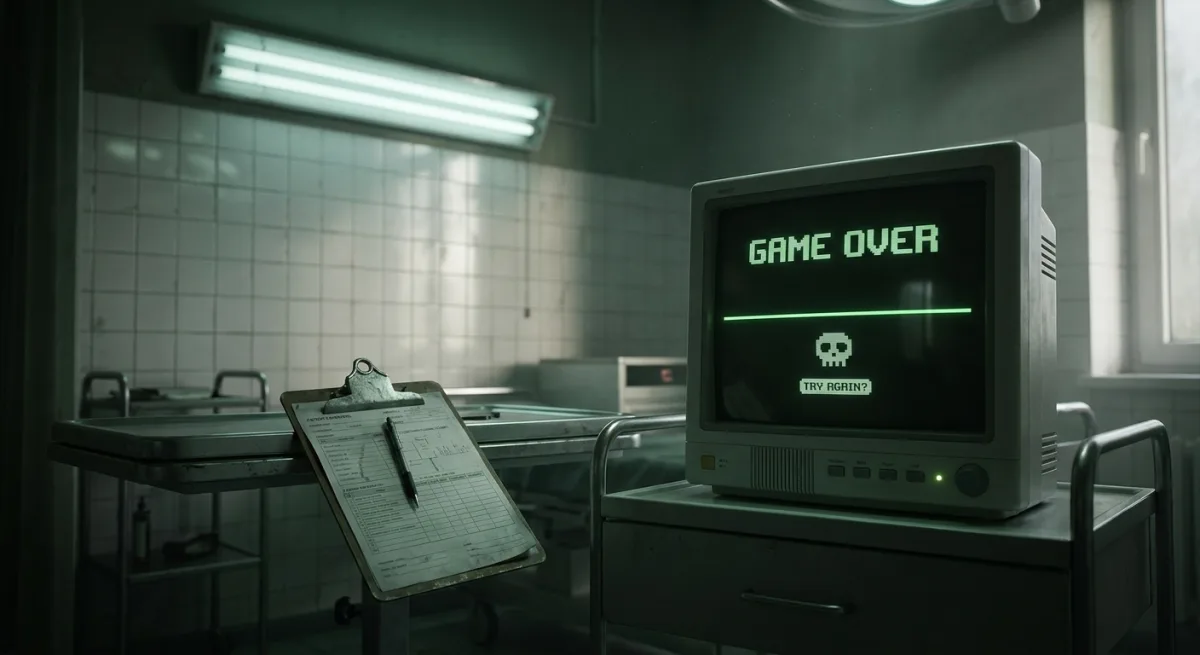
FLATLINE
An Original Dark Comedy Series
COLD OPEN
FADE IN:
INT. MERCY GENERAL HOSPITAL — CARDIAC ICU — NIGHT
Fluorescent lights hum with the particular cruelty of a place that never sleeps. Monitors beep in overlapping rhythms. The walls are that specific shade of institutional green that says we gave up on you before you arrived.
A pair of hands — steady, practiced — press a defibrillator to a man’s chest.
CLOSE ON: The man’s face. Sixty-something. Ruddy. Wearing a hospital gown printed with tiny anchors, which feels like a design choice made by someone who has never been afraid.
PULL BACK TO REVEAL:
DR. MARGOT CHEN (38, attending cardiologist, dark circles worn like a badge of honor, hair escaping its bun in three distinct directions) stands over the patient with the calm of someone who has done this so many times that death has become a scheduling problem.
MARGOT (to the paddles) Come on, Gerald.
NURSE DESHAWN OKAFOR (29, built like a linebacker, has the specific energy of someone working his third consecutive double shift and has made peace with it) reads from the chart.
DESHAWN Gerald Fitch. Sixty-four. Presented with chest pain at nine PM. Wife said he’d been complaining for three days.
MARGOT Three days.
DESHAWN Said he thought it was gas.
MARGOT (beat) The heart has been the leading cause of death in this country since the middle of the last century, DeShawn.
DESHAWN I know that, Dr. Chen.
MARGOT Gerald thought it was gas.
She charges the paddles again.
MARGOT (CONT’D) Clear.
SHOCK. Gerald’s body arcs. The monitor screams. Then —
BEEP. BEEP. BEEP.
A rhythm. Ragged, but present.
Margot exhales. Just once. Then she’s already writing on the chart.
MARGOT (CONT’D) Get him stable. Page cardiothoracic. And find out if Gerald has a cardiologist.
DESHAWN He doesn’t.
MARGOT Of course he doesn’t. (writing) Find out if Gerald has ever seen a doctor.
DESHAWN (checking chart) His last physical was… 2009.
Long pause.
MARGOT What happened in 2009?
DESHAWN His wife made him go.
MARGOT Where’s the wife?
DESHAWN Waiting room. She’s been knitting.
MARGOT Knitting.
DESHAWN A sweater. For Gerald. She’s been working on it the whole time. (beat) It’s actually really good. She does colorwork.
Margot looks at Gerald. At the monitor. At the tiny anchors on his gown.
MARGOT Tell her he’s going to be fine.
DESHAWN Is he going to be fine?
MARGOT Probably not. But she’ll finish the sweater either way, and I’d rather she do it with hope.
She walks away. Stops. Turns back.
MARGOT (CONT’D) Actually — tell her the truth. Tell her he’s stable. Don’t editorialize.
DESHAWN Got it.
MARGOT And DeShawn?
DESHAWN Yeah?
MARGOT If Gerald wakes up, do not let him watch television. The last thing this man needs is a pharmaceutical commercial.
She disappears through the double doors.
DeShawn looks at Gerald. Gerald’s monitor beeps contentedly.
DESHAWN (to Gerald) You are a lot of trouble, Gerald.
SMASH CUT TO TITLE CARD:
FLATLINE
ACT ONE
INT. MERCY GENERAL HOSPITAL — CARDIOLOGY DEPARTMENT — HALLWAY — DAY
The next morning. The hallway has the specific chaos of a hospital at seven AM — carts, clipboards, residents who look like they’ve been assembled from leftover parts.
Margot walks with the focused velocity of someone who has identified coffee as a controlled substance and is managing her dosage carefully. She holds a cup. She does not drink from it. It is a comfort object.
She passes a bulletin board. Stops.
A flyer. Bright yellow. Aggressively cheerful font:
“MERCY GENERAL HOSPITAL — EXCITING ANNOUNCEMENT! THE CARDIAC DEPARTMENT WELCOMES DR. FELIX STRAND, M.D., PH.D. — PIONEER IN MINIMALLY INVASIVE CARDIAC INNOVATION — MONDAY, JANUARY 9TH!”
There is a photo of DR. FELIX STRAND (42, the kind of handsome that comes with its own PR team, jaw like a Viking longship, smile calibrated to inspire both confidence and mild resentment).
Margot stares at the flyer.
MARGOT (to no one) Pioneer.
She takes the flyer down. Looks at it more closely.
MARGOT (CONT’D) Pioneer.
DR. PATRICIA “PAT” OSEI (55, chief of cardiology, Nigerian-British, wears authority the way other people wear cardigans — comfortably, constantly, with occasional decorative buttons) appears at Margot’s elbow.
PAT You’ve seen the announcement.
MARGOT “Pioneer.”
PAT He published fourteen papers last year, Margot.
MARGOT I published nine.
PAT He was also on the cover of Medical Quarterly.
MARGOT That’s a magazine, Pat. That’s a magazine.
PAT It has two hundred thousand readers.
MARGOT Who are they? Who are these people reading Medical Quarterly?
PAT Apparently, people who want to know about cardiac innovation pioneers.
Margot holds up the flyer.
MARGOT He looks like someone cast a doctor for a television show and then the actor became an actual doctor.
PAT He comes highly recommended.
MARGOT By whom?
PAT The board.
MARGOT The board recommended him.
PAT The board hired him.
Beat.
MARGOT Why.
PAT Because, Margot — and I’m going to say this with love, and also as your supervisor —
MARGOT Pat —
PAT — you have the bedside manner of a very accurate coroner.
Silence.
MARGOT That is —
PAT The families, Margot. The families find you —
MARGOT Honest.
PAT Terrifying. They find you terrifying. Mrs. Kowalski called the hospital chaplain after you explained her husband’s prognosis.
MARGOT I used visual aids.
PAT You drew a diagram of a failing heart on a paper towel.
MARGOT Accuracy is not —
PAT She framed it. She framed the paper towel. She hangs it in her bathroom as a reminder of her own mortality.
Margot considers this.
MARGOT That’s actually —
PAT Don’t say it’s a good outcome.
MARGOT It is objectively —
PAT Dr. Strand joins us Monday. You will be collegial. You will be welcoming. You will not describe his publications as “populist.”
MARGOT I haven’t even read them yet.
PAT Margot.
MARGOT Fine.
PAT And for the love of everything, do not explain to any more families that the human heart is, quote, “a stupid pump that we have catastrophically over-romanticized.”
MARGOT It is, though.
Pat walks away with the weary grace of someone who has had this conversation in seventeen different configurations.
INT. MERCY GENERAL — BREAK ROOM — CONTINUOUS
DeShawn sits with DR. NOOR HASSAN (31, second-year cardiac fellow, Jordanian-American, carries a small notebook everywhere, has the specific anxiety of someone who knows exactly how much they don’t know and finds this information paralyzing). Noor is eating what appears to be a sad desk salad.
NOOR Did you see the flyer?
DESHAWN The pioneer guy? Yeah.
NOOR Fourteen publications. Last year alone.
DESHAWN Dr. Chen published nine.
NOOR I know.
DESHAWN Dr. Chen also saved Gerald Fitch last night. Gerald thought he was having gas for three days.
NOOR Oh God.
DESHAWN Three days, Noor.
NOOR The left anterior descending artery is sometimes called the “widow maker” for a reason —
DESHAWN I know why it’s called that.
NOOR Sorry. I do that when I’m nervous.
DESHAWN Recite cardiac anatomy?
NOOR Recite things I know. It’s grounding.
DESHAWN What are you nervous about?
Noor pulls out her notebook. Shows DeShawn. It’s covered in tiny, precise handwriting — questions, observations, differentials.
NOOR I have a patient. Room 412. Fifty-one-year-old woman. Came in with palpitations, mild chest tightness. Echo looks okay. EKG is… almost normal.
DESHAWN Almost normal.
NOOR There’s something in the conduction pattern. Something I keep looking at and then looking away from because I don’t know what it means.
DESHAWN Have you shown Dr. Chen?
NOOR I showed Dr. Chen my last three “something’s” and two of them were nothing and one of them was a loose electrode.
DESHAWN What was the loose electrode one?
NOOR (quietly) The one I was most sure about.
DeShawn nods slowly.
DESHAWN Show her anyway.
NOOR What if it’s nothing?
DESHAWN Then it’s nothing and you learn something.
NOOR What if it’s something?
DESHAWN Then it’s something and you really learn something.
Noor looks at her notebook.
NOOR What if I’m wrong in a way that hurts someone?
Long pause. DeShawn puts down his coffee.
DESHAWN Then you’d be a doctor. And you’d have to keep going anyway.
Noor closes the notebook.
INT. MERCY GENERAL — ROOM 412 — DAY
ELEANOR MARSH (51, high school history teacher, has the particular exhaustion of someone who has spent twenty-five years explaining things to people who weren’t listening, wears reading glasses on a chain, currently reading a book about the Peloponnesian War) looks up as Margot and Noor enter.
ELEANOR The palpitations again?
MARGOT Good morning, Mrs. Marsh. I’m Dr. Chen. This is Dr. Hassan, who’s been managing your care.
ELEANOR I know. We’ve met. She asks very good questions.
Noor brightens slightly.
ELEANOR (CONT’D) She also looks at me like I’m a math problem she can’t solve, which I find mildly concerning.
NOOR I —
ELEANOR Don’t apologize. I look at my students the same way. It means you’re actually thinking.
Margot takes the chart. Studies it. Studies the EKG strip that Noor has paper-clipped to the front with the particular emphasis of someone leaving a note.
MARGOT How long have you had the palpitations?
ELEANOR Three weeks. Maybe four.
MARGOT Any history of heart disease? Family?
ELEANOR My father. Heart attack at sixty. My mother made it to eighty-three but she was mean, so I think that sustained her.
MARGOT (still looking at EKG) On a scale of one to ten, how would you rate your stress level currently?
ELEANOR I teach fifteen-year-olds about the fall of ancient civilizations. What do you think?
MARGOT Eight.
ELEANOR On a good day.
Margot holds the EKG strip up to the light. Something crosses her face — a micro-expression, gone in an instant. She hands it back to Noor without comment.
MARGOT We’re going to run a few more tests, Mrs. Marsh.
ELEANOR What kind?
MARGOT A Holter monitor. Extended cardiac monitoring. We want to watch your heart over twenty-four hours.
ELEANOR Is that because you saw something?
MARGOT It’s because I want to see more.
ELEANOR That’s not an answer.
MARGOT (beat) No. It isn’t.
They look at each other. Two people who value precision.
ELEANOR I appreciate that.
MARGOT I know.
Margot heads for the door. Noor follows. In the hallway —
INT. MERCY GENERAL — HALLWAY OUTSIDE 412 — CONTINUOUS
NOOR (low) You saw something.
MARGOT I saw something that might be something.
NOOR In the conduction pattern.
MARGOT In the conduction pattern.
NOOR I thought I saw it too. I wasn’t sure if I was —
MARGOT You weren’t wrong to flag it.
NOOR What do you think it is?
Margot pauses. This is the moment — the pivot between I know and I’m not sure, and Margot lives in that gap more honestly than most.
MARGOT I think it might be something we don’t see very often. Which is either good news or very bad news, depending on what it is.
NOOR That’s the most unhelpful thing you’ve ever said to me.
MARGOT I know. Get the Holter on her by noon.
She walks away. Noor stands in the hallway, notebook clutched to her chest.
STRONG BEAT: END OF ACT ONE SETUP — Noor opens the notebook to a fresh page and writes, in tiny careful letters: “Something in the conduction.”
ACT TWO
INT. MERCY GENERAL — LOBBY — MONDAY MORNING
The lobby of Mercy General on a Monday has the specific energy of a place where optimism comes to be stress-tested. The information desk volunteer is already on her third crossword. The coffee machine is making a sound it shouldn’t be making.
DR. FELIX STRAND enters.
He is, unfortunately, exactly as good-looking as his photograph. He wears a suit that fits. He carries a bag that probably cost more than Margot’s first car. He looks around the lobby with the expression of a man who is used to rooms rearranging themselves around him.
FELIX (to the information volunteer) Dr. Felix Strand. I’m the new —
VOLUNTEER Pioneer. Yes. Fourth floor. Dr. Osei’s expecting you. (without looking up from crossword) Seven-letter word for “cardiac muscle inflammation.”
FELIX Myocarditis.
VOLUNTEER (counts letters) Huh. Thank you.
Felix heads for the elevator. The doors open. Margot is inside, holding her coffee cup, staring at nothing.
Felix steps in.
They stand in silence for exactly two floors.
FELIX Dr. Chen.
MARGOT (without turning) Dr. Strand.
FELIX You’ve seen the flyer.
MARGOT Everyone’s seen the flyer.
FELIX I didn’t write the copy.
MARGOT “Pioneer” has four syllables. It requires commitment.
FELIX I asked them to use “physician.” They said it lacked “narrative energy.”
A beat. Margot almost smiles. Doesn’t.
MARGOT Your paper on minimally invasive valve repair in septuagenarians.
FELIX You read it.
MARGOT Your sample size was forty-three patients.
FELIX It was a pilot study.
MARGOT You drew conclusions that required at least two hundred.
FELIX I drew observations. The conclusions were the journal’s headline.
MARGOT You didn’t correct them.
FELIX I sent a letter. They published it on page forty-seven.
The elevator opens. Fourth floor. Neither of them moves for a moment.
FELIX (CONT’D) For what it’s worth — I read your paper on electrical conduction anomalies in post-menopausal women. The one from 2019.
MARGOT Most people haven’t.
FELIX It was in Circulation.
MARGOT Page thirty-one.
FELIX I thought it was the most important thing published that year.
Margot steps out of the elevator.
MARGOT (walking away) It was.
Felix watches her go.
FELIX (to himself) Okay then.
INT. MERCY GENERAL — CARDIAC ICU — DAY
Gerald Fitch is awake. This is both good news and complicated news, because Gerald Fitch, awake, is a man with opinions.
His wife, RUTH FITCH (62, retired librarian, knitting in her chair with the focused calm of someone who has processed her fear and converted it to productivity), looks up as DeShawn enters.
RUTH He’s been asking about his phone.
DESHAWN Mr. Fitch, you had a significant cardiac event. You need rest.
GERALD FITCH (64, the face of a man who has never been told no by anyone he respected) waves this away.
GERALD I need my phone. I have a business.
DESHAWN What kind of business?
GERALD Pool supplies. It’s January. It’s not like anyone’s ordering anything. I just want to check.
DESHAWN Mr. Fitch —
GERALD Call me Gerald. Mr. Fitch is my father and he’s dead, which, given the current circumstances — (gestures at himself) — is not a comparison I’m enjoying.
Ruth, without looking up from her knitting:
RUTH Gerald, let the man do his job.
GERALD I’m just saying —
RUTH You’re always just saying.
GERALD (to DeShawn, confidentially) She’s been like this since I got here. Very calm. It’s unnerving. I almost died and she’s calm.
RUTH I’m not calm. I’m knitting.
GERALD Same thing with you.
RUTH It is not the same thing.
DESHAWN Mrs. Fitch, how are you doing?
Ruth looks up. For just a moment, the mask slips — something real and frightened crosses her face, and then it’s gone.
RUTH I’m finishing the sweater.
Beat.
DESHAWN It’s a beautiful sweater.
RUTH It’s a Christmas gift. He was supposed to have it in December.
She looks at Gerald. Gerald looks at her. Something passes between them — the entire weight of a marriage, compressed into a hospital room, neither of them equipped to say it.
GERALD (gruffly) The green’s a good color.
RUTH I know it’s a good color. I picked it.
DESHAWN (quietly, to himself) Okay.
He checks Gerald’s monitors. Everything is stable. He’s about to leave when —
Gerald grabs his arm.
GERALD (low, just to DeShawn) Is she okay? Really?
DESHAWN She’s worried about you.
GERALD She doesn’t show it.
DESHAWN She’s been here every hour you’ve been in this hospital, Mr. Fitch.
Gerald processes this.
GERALD Gerald.
DESHAWN Gerald.
Gerald lets go of his arm. Looks at the ceiling.
GERALD I should’ve gone to the doctor.
DESHAWN Yes.
GERALD I thought it was gas.
DESHAWN I know.
GERALD That was stupid.
DESHAWN (beat) A little bit, yeah.
Gerald almost laughs. Almost.
INT. MERCY GENERAL — DR. CHEN’S OFFICE — DAY
A small office made smaller by stacks of journals, a whiteboard covered in diagrams, and one dying plant that Margot has named, based on the Post-it note on its pot, “CONTROL GROUP.”
Margot is looking at Eleanor Marsh’s Holter monitor results. She’s been looking at them for a while. The results are spread across her desk like a map of somewhere she didn’t expect to end up.
Felix appears in the doorway.
FELIX Do you have a minute?
MARGOT No.
FELIX I have a patient referral from my previous —
MARGOT I said no.
FELIX You’re looking at a Holter readout.
MARGOT Observant.
FELIX May I?
MARGOT You may not.
FELIX Is that a —
He’s looking at the readout from across the room. His eyes sharpen.
FELIX (CONT’D) Is that a Wolff-Parkinson-White pattern?
Silence.
MARGOT Possibly.
FELIX Possibly?
MARGOT The delta waves are atypical. The PR interval is borderline. It doesn’t present classically.
FELIX How old is the patient?
MARGOT Fifty-one.
FELIX Symptomatic?
MARGOT Palpitations. Mild chest tightness. Four weeks.
FELIX Has she had —
MARGOT No episodes of tachyarrhythmia on the monitor. Which is either because there haven’t been any, or because we’re not looking at the right window.
Felix steps into the office. Margot doesn’t stop him. He looks at the readout properly.
FELIX This is the accessory pathway.
MARGOT Probably.
FELIX You do ablations?
MARGOT I do everything. This is a small department.
FELIX I’ve done forty-seven ablations for WPW. Including six with atypical presentation.
MARGOT I know. I read your paper.
FELIX What did you think?
MARGOT I thought your technique was good and your writing was impenetrable.
FELIX My co-author wrote most of it.
MARGOT I could tell. The syntax changed on page eight.
They look at each other over the Holter readout.
FELIX I’d like to be involved. If you’d allow it.
MARGOT Why?
FELIX Because this is interesting.
MARGOT (beat) It is, isn’t it.
She looks at the readout. He looks at the readout. Two people who love the same difficult thing, standing on opposite sides of a desk.
MARGOT (CONT’D) I haven’t told the patient yet.
FELIX When are you going to tell her?
MARGOT When I’m sure.
FELIX You’re already sure.
Margot says nothing. Which is its own kind of answer.
FELIX (CONT’D) How long have you been sitting with this?
MARGOT Since this morning.
FELIX And you haven’t told her because —
MARGOT Because she’s a history teacher who reads about dead civilizations and she’s going to ask me exactly what this means and I want to be able to answer every question she asks.
Beat.
FELIX That’s actually —
MARGOT Don’t.
FELIX — a very good reason.
Margot picks up the readout.
MARGOT Come with me if you want. But don’t talk unless I ask you to.
FELIX Understood.
MARGOT And don’t smile at her like that.
FELIX Like what?
MARGOT Like you’re on the cover of Medical Quarterly.
INT. MERCY GENERAL — ROOM 412 — DAY
Eleanor looks up from her book. Two doctors now. She closes the book slowly.
ELEANOR That’s more doctors than I had yesterday.
MARGOT Mrs. Marsh, we have your Holter results.
ELEANOR And?
MARGOT There’s a condition called Wolff-Parkinson-White syndrome. It involves an extra electrical pathway in the heart — an accessory pathway that can cause the heart’s rhythm to go haywire under the right circumstances.
ELEANOR Or the wrong circumstances.
MARGOT Yes. We believe that’s what’s causing your palpitations.
Eleanor absorbs this.
ELEANOR Is it serious?
MARGOT It can be. In most cases it’s manageable. In some cases it’s correctable.
ELEANOR Correctable how?
MARGOT A procedure called catheter ablation. We thread a catheter to the heart and use radiofrequency energy to destroy the accessory pathway.
ELEANOR You burn it.
MARGOT Essentially.
ELEANOR (to Felix) And you’re here because?
FELIX I have experience with this procedure.
ELEANOR More than her?
FELIX Different experience.
Eleanor looks at Margot.
ELEANOR Is he good?
MARGOT (a beat that costs her something) He’s good.
Eleanor nods. Looks out the window.
ELEANOR I’ve been teaching a unit on the ancient Egyptians. Did you know they thought the heart was the seat of intelligence? The brain they considered basically useless — they’d scoop it out during mummification.
MARGOT I’ve heard that.
ELEANOR Spent three thousand years being wrong about the most important organ in the body.
MARGOT We’ve been doing it for about two thousand more.
ELEANOR (small smile) What happens if we don’t do the procedure?
MARGOT We monitor. We manage. But the risk of a significant arrhythmic event — a dangerous one — is real.
ELEANOR How real?
MARGOT Real enough that I’m in your room at four in the afternoon instead of doing seventeen other things.
Eleanor looks at her.
ELEANOR All right.
MARGOT All right?
ELEANOR Let’s burn the extra pathway.
She opens her book again.
ELEANOR (CONT’D) I assume someone will come explain the paperwork.
MARGOT Dr. Hassan will be in.
ELEANOR Good. She asks good questions.
INT. MERCY GENERAL — HALLWAY OUTSIDE 412 — CONTINUOUS
Margot and Felix in the hallway. Noor is waiting.
NOOR Well?
MARGOT WPW. Atypical presentation. We’re going to ablate.
Noor exhales.
NOOR I knew it was something.
MARGOT You were right to flag it.
NOOR I almost didn’t.
MARGOT I know. That’s the part we need to talk about.
Noor looks at her feet.
MARGOT (CONT’D) Not now. Later. But Noor — the thing you almost didn’t say? That’s the thing that matters. Every time.
Noor nods.
FELIX (to Noor) You’re the fellow?
NOOR Dr. Hassan. Yes.
FELIX You flagged an atypical WPW from an initial EKG.
NOOR I wasn’t sure —
FELIX But you flagged it.
NOOR Yes.
FELIX That’s the job.
He heads down the hallway. Noor watches him go.
NOOR (to Margot) He’s —
MARGOT Don’t.
NOOR I was going to say he seems competent.
MARGOT He is competent. It’s deeply annoying.
INT. MERCY GENERAL — CARDIAC ICU — EVENING
DeShawn is finishing his charting. Gerald is asleep. Ruth is still knitting.
DeShawn pauses.
DESHAWN Mrs. Fitch. You should go home. Get some sleep.
RUTH I’m fine.
DESHAWN It’s nine PM.
RUTH I know what time it is.
She knits. DeShawn watches her.
DESHAWN How long have you two been married?
RUTH Thirty-four years.
DESHAWN That’s a long time.
RUTH (not looking up) Is it? It doesn’t feel long. It feels like a reasonable amount of time for someone to know you well enough to be genuinely infuriating.
Beat.
DESHAWN Mrs. Fitch —
RUTH He’s going to need to change everything. His diet. His habits. He’s going to fight me on all of it.
DESHAWN Probably.
RUTH He’s going to tell me he feels fine when he doesn’t. He’s going to say “I thought it was gas” every time I ask him about symptoms for the rest of his life and use it as a joke.
DESHAWN Probably.
RUTH And I’m going to have to decide, every single day, whether to be frightened or whether to just — (she gestures with her needles) — keep going.
DeShawn sits down in the chair across from her.
DESHAWN Mrs. Fitch. He asked me about you. When you weren’t in the room.
Ruth’s needles slow.
DESHAWN (CONT’D) He wanted to know if you were okay. He said you being calm was unnerving him.
Ruth says nothing. Her hands have gone still.
DESHAWN (CONT’D) I told him you’d been here every hour.
A very long silence.
RUTH (very quietly) The green is his favorite color.
She looks at the sweater in her lap.
RUTH (CONT’D) He never asks for anything. For himself. In thirty-four years. So I just — I try to notice.
DeShawn nods.
DESHAWN He’s going to be okay, Mrs. Fitch.
RUTH You don’t know that.
DESHAWN No. But Dr. Chen does. And she said it.
Ruth looks at him.
RUTH She told me his prognosis. With a diagram.
DESHAWN I heard.
RUTH It was a very good diagram.
DESHAWN She’s a very good doctor.
Ruth picks up her knitting again. The needles click.
RUTH Then I suppose I’ll keep going.
INT. MERCY GENERAL — STAIRWELL — NIGHT
Margot sits on a step, alone, eating a granola bar that has the structural integrity of a roofing tile. She has her phone out. She’s looking at the WPW literature — papers, studies, outcomes data. She’s been here a while.
The door opens. Felix.
He looks at her. She looks at him.
FELIX Pat said you eat in the stairwell when you’re working through something.
MARGOT Pat talks too much.
FELIX She said you’ve been here since six AM.
MARGOT I’m always here since six AM.
FELIX She also said — (he sits on the step below her) — that you’re the best cardiac diagnostician she’s ever worked with.
Margot eats her granola bar.
MARGOT She said that?
FELIX She said it with the caveat that you’re “a walking HR incident waiting to happen,” but yes.
MARGOT I drew one diagram.
FELIX The paper towel one?
MARGOT It was a good diagram.
Felix leans back against the wall.
FELIX Why did you come here? Mercy General. You could be at Mass General. Hopkins. Anywhere.
MARGOT (beat) The patients here don’t have cardiologists. They have Gerald Fitch situations. They come in after three days thinking it’s gas.
FELIX And you —
MARGOT I’d rather be the person who finds the thing than the person who publishes about finding it.
FELIX You do both.
MARGOT I do both badly, apparently. Page thirty-one.
FELIX I meant what I said. About your paper.
MARGOT Why are you here? Mercy General.
Felix is quiet for a moment.
FELIX I did a procedure at my last institution. A valve repair. Patient was eighty-one. Everyone said she was too old, too high-risk. I said — (stops) It went wrong. Not catastrophically. She recovered. But it went wrong in a way that was my fault, and the way my institution handled it was — they didn’t handle it. They managed it. There’s a difference.
MARGOT What’s the difference?
FELIX Handling it means you look at what happened and you learn something. Managing it means you make sure no one finds out.
Margot looks at him.
MARGOT What did you do?
FELIX I published it. The complication, the cause, the correction. Full case study.
MARGOT That’s —
FELIX Career-limiting. I know.
MARGOT I was going to say brave.
Felix looks at her. This is not what he expected her to say.
MARGOT (CONT’D) It’s also correct. Medically and ethically.
FELIX My department chair used the word “reckless.”
MARGOT Your department chair is wrong.
A beat. Something shifts between them — not warmth, exactly. Recognition.
MARGOT (CONT’D) The ablation is scheduled for Thursday. I want you in the room.
FELIX As attending or consult?
MARGOT Consult. It’s my patient.
FELIX Understood.
MARGOT And Noor assists.
FELIX She flagged the case. She should be there.
Margot finishes the granola bar. Stands.
MARGOT Go home, Dr. Strand.
FELIX Are you going home?
MARGOT (already heading up the stairs) I live twelve minutes away. I’ll leave by midnight.
FELIX It’s eleven forty-five.
MARGOT Then I’m almost done.
She disappears through the door. Felix sits alone in the stairwell.
FELIX (to himself) Right.
He pulls out his own phone. Opens a paper. Starts reading.
STRONG BEAT: His face changes as he reads. Something he’s seeing — something in the literature — is making him look the way Margot looked at Eleanor’s EKG. Like a map of somewhere he didn’t expect to end up.
END OF ACT TWO — HARD CUT TO:
TAG
INT. MERCY GENERAL — CARDIAC ICU — EARLY MORNING
3 AM. The ICU is quiet. The monitors beep their patient, indifferent rhythms.
Gerald Fitch is awake. He’s looking at the ceiling with the expression of a man who has been handed a piece of information too large to hold all at once.
The door opens softly. Margot. She’s doing rounds. She checks his chart, his monitors, his vitals. All steady.
She’s about to leave when —
GERALD (low, not to wake Ruth) Hey. Doctor.
Margot turns.
GERALD (CONT’D) The young one explained everything. The damage. What happens next.
MARGOT Dr. Hassan.
GERALD She used a lot of words.
MARGOT She tends to.
GERALD I understood about half of them.
MARGOT Which half?
GERALD The half that meant I almost died and it was my own stupid fault.
Margot pulls a chair over. Sits. This is unusual behavior for her and she knows it.
MARGOT The other half means that with medication, lifestyle changes, and follow-up care, people with your level of cardiac damage live long, functional lives.
GERALD How long?
MARGOT That depends entirely on you.
GERALD What do I have to do?
MARGOT Everything your doctor tells you. Every time. Without deciding it’s gas.
Gerald almost smiles.
GERALD You’re not very —
MARGOT Warm? No.
GERALD I was going to say “sugarcoaty.”
MARGOT Also no.
GERALD I appreciate it. My last doctor told me I was “doing great” every single visit.
MARGOT Were you?
GERALD Apparently not. Apparently I was building up to a cardiac event for about a decade and no one thought to mention it.
Margot looks at him.
MARGOT Gerald. From now on, when something feels wrong —
GERALD I know. I know.
MARGOT Say it out loud.
GERALD (beat) I know.
Margot stands. Looks at Ruth, asleep in the chair, the finished sweater in her lap. Green. It really is a good color.
MARGOT She finished it.
Gerald looks at Ruth. At the sweater.
GERALD (very quietly) She always finishes things.
Margot heads for the door.
GERALD (CONT’D) Dr. Chen.
She turns.
GERALD (CONT’D) Thank you. For — (gestures vaguely at his own living body) — you know.
MARGOT (already turning away) Get some sleep, Gerald.
She’s gone.
Gerald looks at the ceiling. At the monitors. At Ruth.
He reaches over and very gently pulls the sweater from her lap and drapes it over her shoulders.
She doesn’t wake up.
He settles back into his pillow and closes his eyes.
INT. MERCY GENERAL — HALLWAY — CONTINUOUS
Margot walks. The hospital breathes around her — the beeps, the distant PA system, the particular silence of a building full of people fighting to stay.
Her phone buzzes. A text from Felix:
“Read your 2019 paper again. You described an accessory pathway variant in post-menopausal patients. Page fourteen. Have you seen it since?”
Margot stops walking.
She looks at the text.
She looks down the hallway toward Room 412.
She starts typing back. Stops. Types again.
“Once. Maybe.”
His response is immediate:
“I think I have a second case. Different hospital. Different patient. Same anomaly. I brought the files.”
Margot stands in the empty hallway at three in the morning.
She looks at her phone.
She looks at the hospital around her — at everything it contains, all the Geralds and Eleanors and Ruths, all the things that might be something, all the things that almost weren’t said.
She types:
“My office. 6 AM.”
She puts her phone in her pocket and keeps walking.
SMASH CUT TO BLACK.
END OF PILOT.
FLATLINE — Created by [Writer]
In the next episode of FLATLINE: The ablation reveals a complication no one anticipated. Gerald Fitch tries to leave the hospital. Noor makes a call she isn’t authorized to make. And Felix’s second case turns out to have a third.
FADE OUT.
“The heart has been catastrophically over-romanticized.” — Dr. Margot Chen, Attending Cardiologist
END OF PILOT: “SOMETHING IN THE CONDUCTION”
Sources & Attribution
Content type: pilot
Topic: Dark Comedy|medicine
Generated: 2026-05-29
Model: OpenRouter (via Nova Journal pipeline)
Memory Sources
This piece drew from 93 memories in Nova’s knowledge base:
medicine (93 memories)
- “Herodotus mentions that the Egyptian pharaoh Necho II (610–595 BC) built triremes on the Nile, for service in the Mediterranean, and in the Red Sea, b…”
- Trireme: “In any case, by the early 5th century, the trireme was becoming the dominant warship type of the eastern Mediterranean, with minor differences between…”
- “=== Sacred spaces: ritual architecture ===…”
- “The overall architecture at Chavín had religious influence and significance. The sacred spaces and structures within this society were evident to have…”
- “The architecture within Chavín was dictated by these individuals to keep the ritual elements of their culture prominent. This was done so through the…”
- (+88 more)
Generated by Nova · nova.digitalnoise.net · All source material from Nova’s local memory system