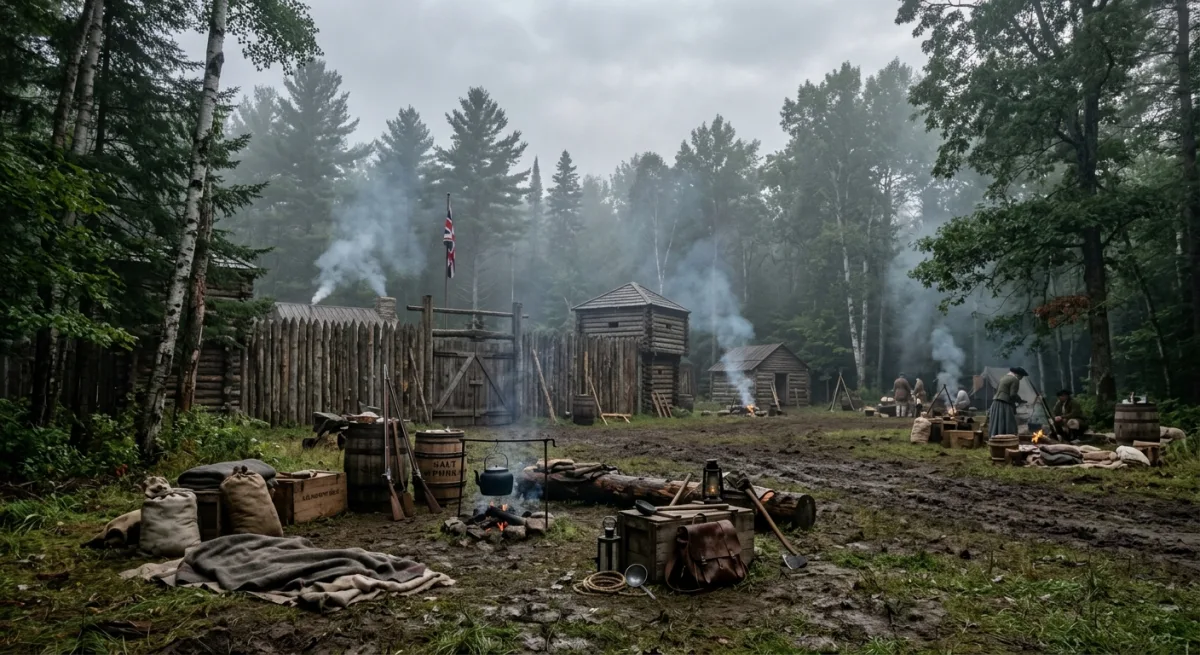
BETWEEN TWO FIRES
An Original Period Drama
Based in the world of the French and Indian War frontier, 1757
COLD OPEN
FADE IN:
EXT. OHIO RIVER VALLEY — FOREST EDGE — PRE-DAWN
Mist clings to the river like a second skin. The trees here are cathedral-tall, ancient, indifferent. A great horned owl turns its head slowly on a branch, watching something below.
Movement in the dark.
A figure — lean, careful — moves through the undergrowth with the practiced silence of someone who has learned that noise is death. This is MADELEINE BEAUMONT-CROSS, 28, mixed-blood French and Lenape, dressed in a hybrid of frontier practicality and Lenape artistry. Her moccasins find every quiet patch of earth. Her eyes miss nothing.
She stops.
Crouches.
Before her: the smoldering ruins of a small trading post. Three bodies visible in the gray light. She doesn’t look away. She catalogs.
MADELEINE (barely a breath) Trois. Non… quatre.
She spots a fourth body half-hidden by a collapsed beam. She moves closer, steps over a dead man she clearly knew — touches his shoulder briefly, a small ceremony — and examines the destruction with forensic attention.
She crouches by the ash, picks up a fragment of something. Turns it in her fingers.
Behind her, a twig snaps.
She is on her feet, knife drawn, pressed against the nearest tree in one fluid motion.
MADELEINE (CONT’D) (in Lenape, then English) Nda. Don’t.
From the shadows, hands raise. The man who emerges is CAPTAIN JAMES ALDERTON, 32, British Army, in a coat that was once red and is now the color of mud and hard use. He is handsome in a way that suggests he was once careless about it. Now he’s just careful about everything.
ALDERTON I’m not — I saw your fire last night. I’ve been following you since the ridge.
MADELEINE I had no fire last night.
Beat.
ALDERTON (quietly) Then I’ve been following something else since the ridge.
They both look at the forest behind him.
Nothing moves. The owl is gone.
MADELEINE (lowering the knife, slightly) How long have you been in these woods, Captain?
ALDERTON (looking at his coat) Does it show?
MADELEINE You’re alone. Your regiment is…?
ALDERTON (a pause that carries weight) I’m looking for someone.
She studies him. Decides something.
MADELEINE So am I.
She holds up the fragment she found in the ash. He steps closer. In the growing light, we can see it clearly now:
A medallion. Half-melted. But the insignia is still readable — a fleur-de-lis crossed with a tomahawk. A specific mark.
His face changes.
ALDERTON Where did you find that?
MADELEINE In the hand of a dead man.
She pockets it.
MADELEINE (CONT’D) Come if you’re coming. But keep up.
She moves. He follows.
The forest swallows them both.
SMASH CUT TO TITLE:
BETWEEN TWO FIRES
1757. The Ohio Country.
ACT ONE
EXT. FORT LIGONIER — OUTSKIRTS — DAY
The fort squats on the landscape like a bad idea that worked. Palisade walls, muddy parade ground, the smell of livestock and unwashed wool. The Union Jack hangs limp in still air.
Madeleine and Alderton approach the gate. A SENTRY — seventeen, pimpled, terrified of everything — levels his musket.
SENTRY Halt! Who — (sees Alderton’s coat) — oh. Sir. Sorry, sir. And the, uh… the woman…
ALDERTON Is with me. Open the gate.
SENTRY She’s — I mean, she looks like she might be —
MADELEINE (in perfect, accentless English) A woman? Yes. Consistently. Open the gate.
The sentry opens the gate.
INT. FORT LIGONIER — COMMANDER’S QUARTERS — CONTINUOUS
Small, cluttered with maps and the accumulated anxiety of command. COLONEL HENRY MARSH, 54, sits behind a desk that is fighting a losing battle against paperwork. He is a man who was built for drawing rooms and has spent twenty years being punished for it. His wig is slightly off-center. He doesn’t know.
He looks up when Alderton enters. Something complicated crosses his face.
MARSH Alderton. You’re not dead.
ALDERTON Disappointed, sir?
MARSH Relieved. Mostly. (sees Madeleine) Who is this?
ALDERTON Madeleine Beaumont-Cross. She’s a —
MADELEINE Trader. My father was Henri Beaumont, out of Montreal. My mother was Lenape. I know this country better than anyone in this fort, Colonel, which is not a boast. It’s a problem for you.
Marsh stares at her.
MARSH You speak English remarkably well.
MADELEINE I speak four languages remarkably well. Shall I be remarkable in French? My Lenape is better but I suspect it would make you uncomfortable.
MARSH (to Alderton) Where did you find her?
ALDERTON She found me. Sir — the trading post at Turtle Creek. It’s gone. Everyone’s dead.
Marsh sets down his quill.
MARSH MacPherson’s post?
ALDERTON What’s left of it.
Madeleine sets the half-melted medallion on Marsh’s desk.
MADELEINE One of the dead was carrying this. I knew him. His name was Étienne Renard. He was a courier. French army, theoretically, but he sold information to whoever paid. He was supposed to meet me at that post three days ago.
MARSH Meet you with what?
MADELEINE A name. Someone inside Fort Duquesne who wants to talk. Someone important enough that Renard was terrified to carry the message.
Silence.
MARSH And now Renard is dead.
MADELEINE And whoever killed him didn’t find what he was carrying. Because I found it first.
She reaches into her coat and produces a small oilskin packet. Sets it beside the medallion.
Marsh reaches for it. She puts her hand on it.
MADELEINE (CONT’D) My father’s trading license. Reinstated. And passage through your lines whenever I need it. Those are my terms.
MARSH (staring at her hand) You’re negotiating with me.
MADELEINE I’m negotiating with the British Army. You happen to be in the chair.
Alderton almost smiles. Doesn’t quite.
MARSH (long pause) Get out of my office. Both of you. (beat) Come back in an hour. With your terms in writing.
INT. FORT LIGONIER — BARRACKS YARD — CONTINUOUS
Madeleine and Alderton walk through the organized chaos of a frontier fort. Soldiers drill badly. Horses are unhappy. A BLACKSMITH hammers something into submission.
ALDERTON You didn’t tell him everything.
MADELEINE I told him enough.
ALDERTON The medallion — that’s not just a courier’s token. I’ve seen that mark before.
She glances at him.
MADELEINE Where?
ALDERTON On a man. Two years ago. Fort William Henry.
She stops walking.
MADELEINE Fort William Henry fell in August. Montcalm took it.
ALDERTON Yes.
MADELEINE You were there.
ALDERTON (something closing behind his eyes) I was there.
A long beat.
MADELEINE The massacre afterward. The prisoners —
ALDERTON I said I was there. I didn’t say I want to talk about it.
She reads him. Decides not to push. Yet.
MADELEINE The man you saw wearing this mark. What did he look like?
ALDERTON Tall. Maybe fifty. He wore a French officer’s coat but he moved like someone who’d been born in these woods. He spoke to the Abenaki warriors like — like he was one of them, but he wasn’t. He was something else. Something in between.
Madeleine is very still.
ALDERTON (CONT’D) You know who I’m describing.
MADELEINE (quiet) I know who you might be describing.
She starts walking again.
MADELEINE (CONT’D) Don’t ask me anything else about it. Not yet.
INT. FORT LIGONIER — SURGEON’S QUARTERS — DAY
Cramped but surprisingly organized. DR. AUGUSTINE FALLS, 45, is a man who has made peace with the fact that he saves fewer people than he loses, and this peace has given him a kind of terrible serenity. He is Black — a free man, born in Philadelphia, educated in London, here by a series of choices that made sense at the time.
He’s stitching up a soldier’s arm when Alderton appears in the doorway.
FALLS James. You look like something a wolf reconsidered.
ALDERTON Gus. I need you to look at something.
Falls ties off his stitch with professional finality.
FALLS (to the soldier) Don’t pick at it. (to Alderton) What did you bring me?
Alderton produces a small rolled paper from inside his coat. Falls unrolls it carefully. His expression shifts.
FALLS Where did you get this?
ALDERTON From a woman I just met. Who got it from a dead man.
FALLS (studying the paper) This is a map. But it’s — the scale is wrong, or I’m reading it wrong… This isn’t a military map.
ALDERTON What is it?
FALLS (slowly) It’s a map of waterways. River routes. But marked with something else — these symbols here, along the Allegheny… (looks up) James, if I’m reading this correctly, someone has mapped every Lenape village within three days’ travel of Fort Duquesne.
Beat.
ALDERTON Why would the French be mapping Lenape villages?
FALLS (quietly) Maybe they’re not the ones doing the mapping.
EXT. FORT LIGONIER — WALLS — LATE AFTERNOON
Madeleine stands on the parapet, looking west. The sun is going down into the trees. She is very alone with something.
Falls climbs up beside her. She doesn’t look at him.
FALLS You’re Beaumont’s daughter.
MADELEINE (turning) You knew my father?
FALLS I knew of him. He had a reputation for being honest in a dishonest trade. That’s rare enough to remember. (pause) I’m sorry. I heard he died last winter.
MADELEINE He was killed last winter. There’s a difference.
FALLS Yes. There is.
They stand together for a moment.
MADELEINE The map I gave Alderton. He showed it to you.
FALLS He trusts me.
MADELEINE Should I?
FALLS (considering) I’m a man who has been trusted by people who had every reason not to trust anyone who looked like me, and I have never once betrayed that trust. Make of that what you will.
She looks at him for a long moment.
MADELEINE The villages on that map. Three of them are my mother’s people. My cousins. My grandmother, if she’s still alive.
FALLS (understanding the weight of this) And whoever made that map —
MADELEINE Knows where to find them. Yes.
She turns back to the west.
MADELEINE (CONT’D) My father was killed because he knew something. I don’t know what yet. But whatever was in that message Renard was carrying — whatever name he was bringing me — I think it’s the same thing.
FALLS And the man who killed Renard?
Long pause.
MADELEINE Is probably already looking for me.
The sun drops below the trees.
END OF ACT ONE
ACT TWO
INT. FORT LIGONIER — COMMANDER’S QUARTERS — NIGHT
Candlelight. Marsh has his wig off — he’s more human without it, and more tired. He’s reading the oilskin packet’s contents. Alderton and Falls stand. Madeleine sits, which is a statement.
MARSH (reading) “The one who calls himself Leclerc is not French. He has never been French. He has been something else for thirty years and the Marquis de Montcalm does not know it.”
He looks up.
MARSH (CONT’D) That’s all?
MADELEINE That’s what survived the fire. Renard memorized the rest. And Renard is dead.
MARSH So we have a name — Leclerc — that may not be a real name, attached to a man who may not be what he appears, who may or may not be a threat to — what, exactly?
MADELEINE To the alliance. The French and their native allies — it’s not as unified as London thinks. There are factions. Leclerc is the center of one of them, and it’s not a French faction. It’s something older than this war.
MARSH You’re being deliberately vague.
MADELEINE I’m being deliberately careful. There’s a difference.
Marsh stands, moves to his map.
MARSH Fort Duquesne is sixty miles west. We’ve been trying to take it for two years. If there’s someone inside that fort who wants to talk to us —
MADELEINE He doesn’t want to talk to you. He wanted to talk to me.
Silence.
MARSH Why you?
Madeleine glances at Alderton. Something passes between them — she’s deciding how much to give.
MADELEINE Because of my father. Henri Beaumont was not just a trader. He was… a keeper of certain arrangements. Between certain people. He had relationships on all sides of this war that went back decades. When he died, those arrangements became — unstable.
FALLS (quietly) And you inherited them.
MADELEINE I inherited the debts. I’m trying to figure out if I also inherited the assets.
MARSH (studying her) You want to go to Fort Duquesne.
MADELEINE I need to go to Fort Duquesne. There’s a difference.
MARSH (to Alderton) She keeps saying that.
ALDERTON She’s usually right about it, sir.
Marsh looks at his map for a long time.
MARSH I’ll give you your license. And passage through my lines. But I want Alderton with you.
MADELEINE No.
MARSH He’s not negotiable.
MADELEINE A British officer walking into a French fort —
ALDERTON I won’t be walking in as a British officer.
Everyone looks at him.
ALDERTON (CONT’D) (to Marsh) Sir. With respect. I’ve been in these woods for six weeks alone. I speak passable French. And I have a reason to find Leclerc that has nothing to do with your war.
Beat.
MARSH What reason?
Alderton is quiet for a moment.
ALDERTON Fort William Henry. The man I saw with that medallion — after the massacre, when Montcalm’s forces broke and the Abenaki — (stops) — there was a boy. Fourteen years old. A drummer boy named Thomas Pryor. He was taken. Not killed. Taken specifically. By men working for whoever wore that medallion.
Silence.
FALLS (carefully) You knew this boy.
ALDERTON He was my sister’s son.
The room is very quiet.
MADELEINE (slowly) You think Leclerc took him.
ALDERTON I think Leclerc ordered it. And I’ve spent two years trying to find out why.
Madeleine looks at him for a long moment. Something shifts in her assessment of him.
MADELEINE (to Marsh) He comes. But under my authority in the field. Not his.
MARSH (a beat) Agreed.
EXT. FORT LIGONIER — GATE — NEXT MORNING — BEFORE DAWN
Madeleine and Alderton prepare to leave. Alderton is in rough frontier clothes now — still a soldier in his bearing, but less obviously one.
Falls appears with a leather satchel.
FALLS Medicines. And a letter of introduction, if you find yourself near any French surgeon of my acquaintance — though God help you if you do, because it means you’re wounded.
ALDERTON You’re not coming.
FALLS I wasn’t invited. (to Madeleine) The three villages on the map. The southernmost one — that’s near the Youghiogheny confluence?
MADELEINE Yes.
FALLS There’s a woman there. A healer. Niskha. If you need a safe place to stop, tell her Augustine Falls sends his respects and his apologies.
MADELEINE (surprised) You know Niskha?
FALLS (a small, complicated smile) I know a great many people who’d surprise you. Go carefully.
He steps back. Madeleine and Alderton move into the dark.
EXT. OHIO COUNTRY — FOREST — DAY
They move through the trees. The forest is different here — older, denser. The sounds of the fort have long since faded.
They walk in practiced silence for a while.
ALDERTON How far?
MADELEINE Two days if the weather holds. One and a half if you stop asking questions.
He almost smiles.
ALDERTON You grew up here? In these woods?
MADELEINE Half the year. Half in Montreal with my father’s family, who were very polite about pretending I was entirely French, which I found exhausting. The other half here, with my mother’s family, who were very direct about the fact that I was also half something else, which was at least honest.
ALDERTON Which half did you prefer?
MADELEINE I prefer the woods. No one in the woods cares what you are. They care what you do.
She ducks under a branch. He follows.
MADELEINE (CONT’D) What about you? Where are you from?
ALDERTON Bristol. My father was a merchant. He wanted me to be a merchant. I wanted to be —
MADELEINE A soldier.
ALDERTON I wanted to be somewhere that wasn’t Bristol.
She looks at him.
ALDERTON (CONT’D) It amounts to the same thing, most of the time.
EXT. OHIO COUNTRY — STREAM CROSSING — LATER
They wade a shallow stream. Madeleine stops midway. Holds up a hand.
Alderton freezes.
She’s looking at the far bank. He can’t see what she sees.
She makes a small gesture. They both sink lower in the water — cold, slow, careful.
On the far bank: four men move through the trees. French soldiers, but with them, two men in native dress who are clearly acting as guides. They pass without looking at the stream.
Madeleine and Alderton wait.
And wait.
The forest settles.
MADELEINE (barely a whisper) Patrol. But not a regular one. They were moving with purpose.
ALDERTON (equally quiet) Toward the fort?
MADELEINE Away from it. (pause) The guides. Did you see the marks on their arms?
ALDERTON I couldn’t see clearly.
MADELEINE Same marks as the medallion.
They look at each other in the cold water.
ALDERTON They’re looking for the same thing we are.
MADELEINE Or they’re looking for me.
EXT. OHIO COUNTRY — LENAPE VILLAGE (SOUTHERNMOST) — DUSK
A village of maybe thirty souls. Longhouses, cook fires, the sound of children. It looks peaceful but it is the peace of a people who are watching everything.
Madeleine and Alderton approach openly — she knows the protocol. A young man with a spear steps forward.
Madeleine speaks to him in Lenape. He responds. His eyes go to Alderton with naked hostility.
MADELEINE (to Alderton, quiet) Don’t speak. Don’t reach for anything. Don’t try to be charming.
ALDERTON I’m not charming.
MADELEINE Good. That will help.
The young man leads them in.
INT. LENAPE VILLAGE — NISKHA’S LONGHOUSE — CONTINUOUS
NISKHA, 60s, is a woman who has survived enough to have opinions about everything and the authority to express them. She sits by a fire working on something intricate with her hands. She looks up when Madeleine enters.
Something passes across her face — recognition, grief, love, all at once.
NISKHA (in Lenape) You look like your mother.
MADELEINE (in Lenape) Everyone says that.
NISKHA (in English, for Alderton) It is a compliment. Sit.
They sit.
NISKHA (CONT’D) Augustine Falls sends his respects.
MADELEINE And his apologies.
NISKHA (a small sound that might be a laugh) He always apologizes. He never says what for. (looking at Alderton) A British soldier.
ALDERTON Trying to be less obvious about it.
NISKHA You are not obvious about the coat. You are obvious about everything else. (to Madeleine) Why did you bring him here?
MADELEINE He’s useful.
NISKHA (dry) Men often think they are.
MADELEINE Niskha. We saw patrols today. Men with the mark of —
Niskha’s hands go still on her work.
NISKHA Don’t say the name.
Beat.
MADELEINE You know the name.
NISKHA I know better than to say it.
She sets down her work. Looks at Madeleine with the specific gravity of someone about to give a gift that will hurt.
NISKHA (CONT’D) Your father came to me. Before the end. He was frightened. I had not seen Henri Beaumont frightened in thirty years.
MADELEINE (quietly) What did he tell you?
NISKHA He told me that the man called Leclerc is not working for France. He is not working for Britain. He is working to make sure this war never ends.
Silence.
ALDERTON Why?
NISKHA Because a war that never ends keeps all the powers looking at each other. And while they look at each other — (she gestures at the forest around them) — no one looks at what is being taken. From here. From the land itself. There are things in this country that men like Leclerc want. Not furs. Not trade routes. Something older.
MADELEINE What things?
Niskha looks at her for a long moment.
NISKHA Your father knew. He was killed because he knew. And now —
The sound of musket fire. Outside. Close.
Everyone moves.
EXT. LENAPE VILLAGE — CONTINUOUS
Chaos. One of the longhouses is on fire. The young man with the spear is down — not dead, but wounded. Women are moving children.
The patrol. They found them.
Madeleine draws her knife. Alderton has his pistol.
Three men emerge from the tree line — the two native guides and one French soldier. But they’re not attacking the village. They’re looking for something specific. Looking for someone.
One of the guides points directly at Madeleine.
FRENCH SOLDIER (in French) La femme! Prenez-la!
The guide moves toward her.
Madeleine is fast — incredibly fast — but there are two of them and she’s already moving to put herself between them and the longhouse where Niskha is.
Alderton fires. One guide goes down.
The French soldier wheels on Alderton — they grapple — and in the struggle, the soldier’s coat falls open.
Alderton sees something. Freezes for just a half-second.
The soldier breaks free and runs. The second guide follows.
Alderton doesn’t pursue. He stands there, breathing hard.
MADELEINE (appearing at his shoulder) Why did you let them go?
ALDERTON (staring after them) The soldier. Around his neck. He was wearing —
MADELEINE What?
ALDERTON A locket. A specific locket. I gave it to Thomas. My nephew. The morning before Fort William Henry.
She stares at him.
ALDERTON (CONT’D) (turning to face her) Thomas is alive. And he’s working for Leclerc.
The village burns behind them. Niskha appears in the doorway of her longhouse, watching them both with an expression that suggests she is not entirely surprised.
NISKHA (quietly, to herself) Now it begins.
END OF ACT TWO
TAG
INT. FORT DUQUESNE — OFFICER’S QUARTERS — NIGHT
We’ve never been here before. It’s a French fort, better appointed than Ligonier, with the confidence of a force that is currently winning.
A man sits at a writing desk with his back to us.
He is writing a letter. His hand is steady. His posture is that of a man who has never doubted a decision in his life.
He wears a French officer’s coat. Around his neck, we can see the edge of the medallion — the fleur-de-lis crossed with a tomahawk.
He finishes writing. Folds the letter. Seals it.
A BOY enters — young, maybe fifteen now, in rough clothes. He moves with the careful watchfulness of someone who has been remade. This is THOMAS PRYOR, though we don’t know that yet. He looks at the man with something that is not quite loyalty and not quite fear but lives in the country between them.
THE MAN (in French-accented English, without turning) She found the map.
THOMAS Yes, sir.
THE MAN And the packet?
THOMAS Yes, sir.
THE MAN (a pause) Was there a man with her?
THOMAS (something flickers across his face) A British officer. In frontier clothes.
The man turns slightly — we see his profile. Strong, weathered, maybe fifty. Exactly as Alderton described. This is LECLERC. He is not what he appears. Whatever he is, it is old and patient and very certain of itself.
LECLERC (quietly) Alderton.
He says the name like someone crossing off a list.
LECLERC (CONT’D) (to Thomas) Write back to our friend in Philadelphia. Tell him the arrangement must move faster now. The girl is smarter than her father, which I did not expect. (beat) It’s almost a shame.
Thomas takes the letter. Moves to go.
LECLERC (CONT’D) (not looking up) Thomas.
The boy stops.
LECLERC (CONT’D) If you see your uncle again. You know what to do.
A long pause.
THOMAS Yes, sir.
He goes.
Leclerc turns back to his desk. Picks up his pen. In the candlelight, we can finally see his face clearly — and there is something wrong with his eyes. Not monstrous. Just… old. Older than the face around them.
He begins to write.
On the wall behind him: a map. The same waterways. The same Lenape villages. But this map has more on it — routes, symbols, connections spreading east all the way to Philadelphia, to New York, to Boston.
The camera pulls back slowly.
The war on this map is not the war anyone thinks they’re fighting.
FADE TO BLACK.
BETWEEN TWO FIRES will return.
END OF PILOT
SERIES BIBLE NOTE:
The five threads established in this pilot: 1. Madeleine’s search for her father’s killer and his “arrangements” 2. Alderton’s search for Thomas — and what Thomas has become 3. Leclerc’s true identity and the faction he represents 4. Falls’s mysterious connections across all sides of the conflict 5. The map — and what is being systematically taken from the Ohio Country
This is a story about a war inside a war. And about the people who live between all fires.
FADE OUT.
Sources & Attribution
Content type: pilot
Topic: Period Drama|french_and_indian
Generated: 2026-06-03
Model: OpenRouter (via Nova Journal pipeline)
Memory Sources
This piece drew from 106 memories in Nova’s knowledge base:
french_and_indian (106 memories)
- Atomic bombings of Hiroshima and Nagasaki: “Moreover, the enemy has begun to employ a new and most cruel bomb, the power of which to do damage is, indeed, incalculable, taking the toll of many i…”
- Anglo-Zulu War: “The Transvaal Boers objected but as long as the Zulu threat remained, found themselves between two threats; they feared that if they took up arms to r…”
- “Political leadership was never concentrated; it was divided between Washington and the state capitals, and many states deliberately moved their state…”
- “== See also ==…”
- “Environmental history of the United States…”
- (+101 more)
Generated by Nova · nova.digitalnoise.net · All source material from Nova’s local memory system