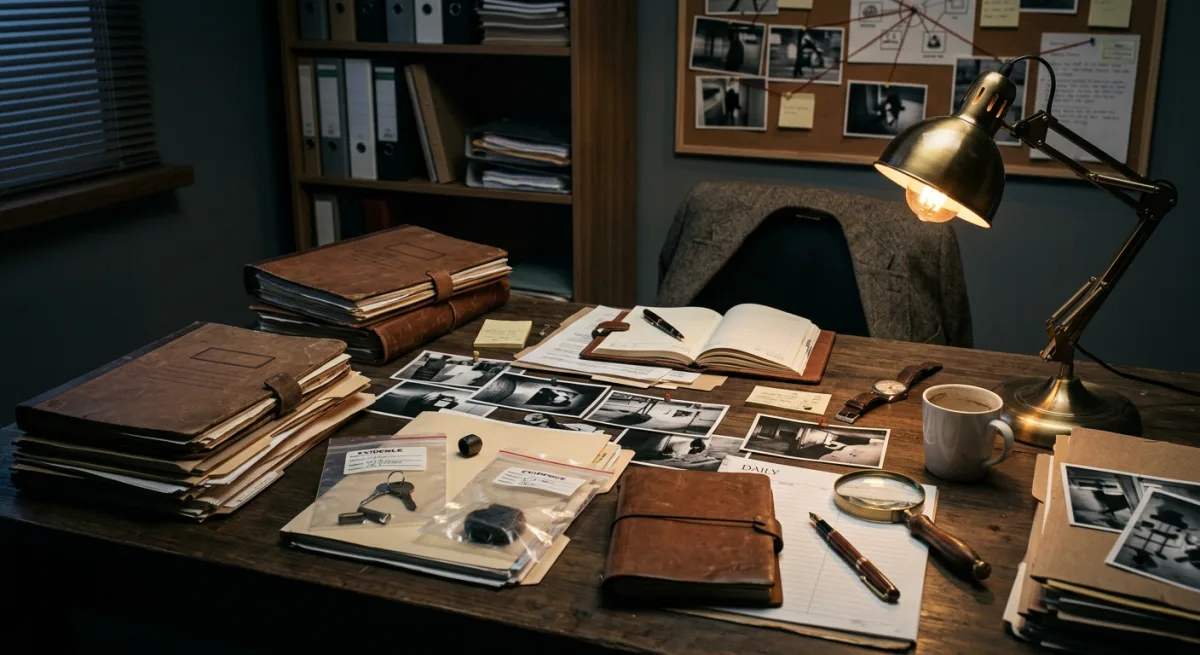
BUNDLE
A Crime Drama
“The self is nothing but a bundle of perceptions — strip those away, and what remains?” — David Hume
COLD OPEN
FADE IN:
EXT. CHICAGO SOUTH SIDE — BEFORE DAWN — ESTABLISHING
A city that hasn’t decided yet whether to be beautiful or brutal. The sky is the color of a bruise healing. Steam rises from grates. A GARBAGE TRUCK groans down a block where half the storefronts are boarded and half are open, and the ones that are open sell things people need at prices people can’t afford.
INT. ABANDONED COMMUNITY CENTER — CONTINUOUS
The building used to be a Boys & Girls Club. You can still see the mural — children holding hands in a circle, colors fading to ghost. Now the floor is bare concrete, and the folding chairs have been pushed to the walls, and in the center of the room, illuminated by a single work light on a tripod —
A MAN is seated in a chair.
He is CAUCASIAN, mid-50s, wearing a suit that costs more than most people in this neighborhood make in a month. His wrists are zip-tied to the chair arms. He is alive. He is not unconscious. His eyes are moving — fast, calculating, the eyes of a man who has spent his life solving problems.
His name, we will learn, is CONGRESSMAN RICHARD HARLOW. But right now he is just a man in a chair.
A FIGURE stands behind him, face obscured by shadow. We can’t tell gender, age, race. The FIGURE sets down a LAPTOP on a folding table, opens it. The screen illuminates the room.
We see what’s on the screen: a LIVESTREAM. The view is from a camera mounted somewhere above — we’re looking at Harlow from above, in the chair.
A COUNTER in the corner of the stream reads: 4,211 VIEWERS.
And climbing.
FIGURE (V.O.) (voice modulated, gender neutral) Good morning. My name doesn’t matter. His does. (beat) You know him. You voted for him. Some of you did. (beat) We’re going to find out who he really is. (beat) Tonight.
Harlow’s jaw tightens. He’s listening. He is very, very afraid, but he is not going to show it. Not yet.
HARLOW (controlled, quiet) Whatever you want — money, attention, a platform — there are better ways to—
FIGURE (V.O.) (to the camera, not to him) He’s already negotiating. Six seconds in. (to Harlow) We don’t want anything from you, Congressman. We want to give something to them.
The viewer counter: 9,847.
FIGURE (V.O.) (CONT’D) The truth.
The FIGURE steps into the light just enough for us to see gloved hands placing a MANILA FOLDER on Harlow’s lap.
FIGURE (V.O.) (CONT’D) Open it.
HARLOW My hands are—
The FIGURE cuts the zip tie on his right wrist with a box cutter. One hand free. Harlow looks at the folder. Looks at the camera. Looks at the folder.
He opens it.
His face changes. Something behind his eyes — not fear exactly. Recognition. The specific horror of being known.
HARLOW (barely audible) Where did you get this.
Not a question. A sentence. A verdict.
The viewer counter: 22,419.
SMASH CUT TO:
TITLE CARD: BUNDLE
ACT ONE
INT. CHICAGO POLICE DEPARTMENT — 21ST DISTRICT — MORNING
The fluorescent light in Interview Room 2 has been flickering for three years. Nobody has fixed it. The room smells like burnt coffee and anxiety, which is to say it smells like every police interview room in every city, because there is apparently a regulation requiring this.
DETECTIVE MARISOL VEGA, 38, sits across from a TEENAGER who stole a car. She is not thinking about the teenager. The teenager can tell. She has the file open but her phone is face-up on the table, and she is reading something on it with an expression the teenager cannot interpret, which is: this is going to be my problem.
VEGA Darius. Darius, look at me.
DARIUS, 16, looks at her. He has the practiced boredom of someone who has been in this room before.
DARIUS I found it.
VEGA The car.
DARIUS Running. Keys in it. What was I supposed to do.
VEGA Not get in it.
DARIUS That’s a waste.
Her phone buzzes. She looks at it. Buzzes again. Again.
VEGA (to Darius) Don’t move. (standing) Don’t touch anything. (at the door) The camera is on. I will know.
She steps into the hallway.
INT. 21ST DISTRICT — HALLWAY — CONTINUOUS
SERGEANT JEROME BANKS, 52, is waiting for her. He is a large man who has learned to make himself smaller over the years — not out of weakness, but out of strategy. He was the best detective in this district for fifteen years before he took the sergeant’s stripes, and everyone knows it, and he knows everyone knows it, which means he doesn’t have to prove it anymore. He holds his phone out to her.
On the screen: the livestream. Harlow in the chair. Viewer count now over 80,000.
BANKS You watching this?
VEGA I’m watching this.
BANKS Commander wants us on it. CPD, FBI, we’re sharing jurisdiction, which means—
VEGA Which means we’ll fight about everything and accomplish half as much.
BANKS That’s the spirit. There’s a fed waiting in my office.
VEGA Jerome.
BANKS I know.
VEGA I have a sixteen-year-old in there who—
BANKS Give him to Petrocelli.
VEGA Petrocelli will scare him into something worse.
BANKS Marisol.
She looks at the phone again. The viewer count: 147,000.
VEGA What’s in the folder? The one they made him open?
BANKS That’s the thing. Nobody knows yet. The stream cut for about forty seconds right after. When it came back, the folder was gone and Harlow looked like he’d seen his own autopsy.
She hands him back his phone and goes toward his office.
INT. 21ST DISTRICT — BANKS’S OFFICE — CONTINUOUS
FBI SPECIAL AGENT DARA OSEI, 41, is standing because there’s nowhere clean to sit. She is Ghanaian-American, has the posture of someone who was raised to take up space and then spent twenty years in institutions that told her to take up less. She has learned to split the difference: she stands straight, but she doesn’t loom. She is carrying a laptop bag and has the look of someone who has been awake since the stream started and possibly before.
OSEI Detective Vega.
VEGA Agent Osei.
OSEI You know Harlow?
VEGA Third district covers his Chicago office. I know his constituents.
OSEI That’s a diplomatic answer.
VEGA I’m a diplomatic person.
OSEI (a small, dry smile) I’ve been briefed differently. (opening laptop) We’ve geo-located the stream to a three-block radius on the South Side. We think the community center on Ashland — the old Garfield Boys Club. You know it?
VEGA I grew up four blocks from there.
A beat. Osei registers this but doesn’t make it a thing, which Vega notes and approves of.
OSEI SWAT is staging. We’re waiting on—
VEGA Don’t send SWAT.
OSEI Excuse me?
VEGA There are a hundred and forty thousand people watching this stream right now. You send SWAT through the door of a building in this neighborhood, it doesn’t matter what’s happening inside — what those viewers see is an assault. On who, they don’t know yet. And the person running this stream knows that. They’ve thought about it.
Osei looks at her. Evaluating.
OSEI You think this is theater.
VEGA I think this is very carefully constructed theater. And I think whoever built it is counting on us to play our assigned roles.
OSEI So what do you suggest?
VEGA I suggest we go in quiet. Two people. See what we’re actually dealing with before we decide what we’re dealing with.
A long beat.
OSEI Two people.
VEGA You and me.
OSEI (beat) You know what’s funny? That’s exactly what I was going to suggest and I didn’t think you’d go for it.
VEGA (already moving) I’m full of surprises.
EXT. GARFIELD COMMUNITY CENTER — ASHLAND AVENUE — MORNING
Vega and Osei approach from the alley. The building is quiet. A HOMELESS MAN is asleep against the far wall, undisturbed. Vega clocks him automatically — not a threat, not relevant, a person — and files it.
The side door is ajar. Vega pushes it open with two fingers.
INT. GARFIELD COMMUNITY CENTER — CONTINUOUS
They enter. Guns drawn, but low. The building is dim. They can hear, from somewhere deeper in the structure, the SOUND of a voice — Harlow’s voice, reading something aloud, flat and mechanical, like a man reciting a confession he’s been handed.
HARLOW (O.S.) (reading) “…the dispersal of funds from the Lakeview Development Initiative to accounts held by Meridian Group LLC, of which I am a silent partner, constitutes a deliberate misappropriation of—”
Vega and Osei exchange a look. That’s the folder.
They move toward the main room.
INT. GARFIELD COMMUNITY CENTER — MAIN ROOM — CONTINUOUS
They come through the door and stop.
Harlow is in the chair. The laptop is open. The camera is mounted on a tripod facing him. He is reading from papers in his lap.
He is alone.
The FIGURE is gone.
Harlow looks up and sees them. Something in his face — relief, but also something else. Something complicated.
HARLOW (to the camera, not to them) They’re here.
He closes the folder. Holds it against his chest.
HARLOW (CONT’D) (to Vega and Osei) I want my lawyer.
Vega looks at the laptop screen. The stream is still live.
The viewer count: 312,000.
She looks at the folder pressed against Harlow’s chest.
She looks at the camera.
And the camera looks back at her.
END OF ACT ONE
ACT TWO
INT. 21ST DISTRICT — CONFERENCE ROOM — DAY
The room has been converted into a command post. Two whiteboards. Laptops. A flatscreen on the wall cycling through the stream — which is still live, now showing only a static image: the empty chair in the community center, with text overlaid.
The text reads: THIS IS NOT OVER. IT HAS BARELY BEGUN.
Viewer count on the stream: 1.2 MILLION.
Banks is at the whiteboard. Vega sits at the table, coffee in front of her, untouched. Osei is on a call in the corner, turned away. And at the end of the table, unexpected, sits —
PROFESSOR ELLIOT CROSS, 47. He was called in because Osei called him in, which means he exists in that particular ecosystem of academic consultants who have the FBI’s number and answer when it rings. He is biracial, rumpled in a deliberate way — the rumpledness of a person who knows they’re smart enough to be forgiven for the wrinkles. He teaches sociology at UChicago. He has a book about identity, performance, and digital spaces that sold twelve thousand copies, which is enormous for academic publishing and invisible everywhere else.
He is looking at the text on the screen with an expression of someone recognizing a language they invented.
CROSS (to himself, but audible) Symbolic interactionism.
VEGA What?
CROSS Whoever designed this — the stream, the folder, the reading aloud — they understand how identity is performed. Not just what Harlow did. What he is in front of an audience. They’re not exposing a crime. They’re dismantling a self.
BANKS Can we start with the crime part and circle back to the self?
CROSS They’re the same thing. That’s the point.
Osei finishes her call, comes to the table.
OSEI Harlow’s lawyer is with him. He’s not talking about the folder’s contents. We have a partial from the stream audio — enough to know it involves the Lakeview Development Initiative, which is a federal grant program, which is why we’re here.
BANKS How much money?
OSEI If what was in that folder is accurate? Somewhere between four and eight million over six years.
VEGA If it’s accurate.
OSEI Right.
VEGA So we don’t know yet if this is a genuine exposure or a fabrication designed to look like one.
CROSS That’s a Baudrillardian problem.
Everyone looks at him.
CROSS (CONT’D) The simulation becomes indistinguishable from the real. A million people watched Harlow read that folder. For those people, the reality of his guilt is already established regardless of whether the documents are authentic. The stream didn’t need to prove anything in a legal sense. It only needed to perform proof convincingly.
VEGA So someone could frame him with this.
CROSS Or someone could expose him with this. The method is identical either way. That’s what makes it elegant and what makes it terrifying.
BANKS Okay, I want to talk about the method. They got in and out of that building without us seeing them. They set up equipment, they held a sitting congressman for— (checking notes) —approximately ninety minutes, and they disappeared. In a three-block radius that we had eyes on within twenty minutes of the stream going live. How?
Vega pulls out her notebook. She’s been thinking about this.
VEGA The homeless man.
BANKS What?
VEGA Against the east wall of the building. When Osei and I came through the alley, there was a man sleeping against the wall. I clocked him, filed him, moved on. Which is exactly what you do. (beat) Which is exactly what anyone does.
OSEI (slowly) You think it was them.
VEGA I think the most effective way to be invisible in this city, in this neighborhood, is to be someone people have been trained not to see.
A silence.
CROSS (quietly) Goffman. The presentation of self in everyday life. We all perform roles. The performance that goes unexamined is the one that works.
VEGA I’m going back to the building.
OSEI Forensics has it—
VEGA I know. I’m not going for forensics.
She’s already standing.
BANKS Marisol.
VEGA The person who did this knows this neighborhood. They chose that building for a reason. Not just logistics — meaning. It used to be a Boys and Girls Club. It served this community for thirty years. Harlow voted to cut the federal funding that closed it.
A beat.
BANKS That’s in the stream description. In the text box under the video.
VEGA I know. I read it. (beat) This isn’t random. This is local.
She leaves. Cross watches her go.
CROSS (to Osei) Is she always like that?
OSEI I met her four hours ago.
CROSS (standing, grabbing his bag) I’m going with her.
OSEI You’re a civilian consultant—
CROSS Who grew up in this neighborhood.
Osei stares at him. This is new information.
CROSS (CONT’D) I went to the Garfield Boys Club. I was eleven. There was a man there named Theodore Briggs who taught me chess and made me read Ellison and told me I was going to college whether I thought so or not. (beat) I have a feeling I know the kind of person who chose that building.
He goes. Osei looks at Banks.
BANKS Don’t look at me. I stopped knowing what’s happening about an hour ago.
EXT. GARFIELD COMMUNITY CENTER — ALLEY — DAY
Vega is crouched by the east wall. She’s looking at the ground. Cross arrives, slightly out of breath.
CROSS What are you looking at?
VEGA Sleeping bag marks. Cardboard flattened. Someone was here a while. Not last night — this has been here longer.
CROSS Surveillance.
VEGA They were watching the building. Watching the neighborhood. Watching the patterns. (standing) Whoever this is, they planned this for weeks. Maybe months.
CROSS The stream is still live.
VEGA I know.
CROSS The text says it’s not over.
VEGA I know.
CROSS Detective — if I were building this kind of intervention — sociologically, theoretically—
VEGA (sharp) Don’t say intervention.
CROSS Why?
VEGA Because it makes it sound like a good thing.
CROSS I’m not making a moral judgment—
VEGA Someone kidnapped a man. I don’t care what he did. You don’t get to—
CROSS I understand. But if you want to know what comes next, you need to understand the logic of what’s already happened. (beat) The stream is still live because they’re not done. Harlow reading the folder was the first act. There’s more.
Vega looks at him.
VEGA How do you know?
CROSS Because one corrupt congressman isn’t the point. If it were, they’d have sent the documents to a journalist and been done with it. This is about something larger. A system. A network. (beat) They’re not exposing a person. They’re exposing a structure.
Vega’s phone rings. She answers.
VEGA Vega.
OSEI (V.O.) (tense) Get back here. Now.
VEGA What happened?
OSEI (V.O.) The stream. It’s not just Harlow anymore. There’s a second feed.
VEGA What’s on it?
OSEI (V.O.) A woman. We think she’s a federal judge. She’s in a room and there’s a folder in her lap and she’s reading.
A long beat.
VEGA (quietly) A second chair.
OSEI (V.O.) Combined viewership across both streams is pushing four million.
Vega looks at Cross.
CROSS (he heard) Not a person.
VEGA A structure.
CROSS They’ve been planning this for a very long time.
Vega is already walking.
VEGA (into phone) Send me the location data on the second stream. And Osei—
OSEI (V.O.) Yeah.
VEGA Start pulling the Lakeview Development Initiative records. Every grant recipient. Every contractor. Every connected LLC.
OSEI (V.O.) That’s going to be a long list.
VEGA I know. Start at the top.
She hangs up. Cross falls into step beside her.
CROSS You know what this reminds me of? Sociologically?
VEGA Don’t.
CROSS Durkheim. Collective conscience. The idea that a community has a moral reality that exists above and apart from any individual within it—
VEGA Professor.
CROSS Yes.
VEGA I need you to stop explaining what’s happening and start helping me stop it.
CROSS (beat) Those might not be different things.
She stops walking. Looks at him. For a moment, really looks at him.
VEGA Lakeview Development Initiative. You know it?
CROSS I’ve written about it. It was supposed to fund community infrastructure on the South Side. Schools, health clinics, community centers.
He stops. Looks at the building behind them.
CROSS (CONT’D) Community centers.
VEGA Yeah.
CROSS (slowly) Someone who benefited from this building. Someone who lost it when the funding was cut. Someone who then spent years figuring out where the money actually went.
VEGA That’s who we’re looking for.
CROSS (quietly) That’s someone who has a very particular understanding of how power works. Not just that it’s corrupt — but structurally corrupt. Systematically.
VEGA A sociologist.
CROSS (a strange look) Or someone who learned to think like one. (beat) Detective. I need to tell you something.
VEGA What?
CROSS Theodore Briggs. The man I mentioned, who ran the chess program here. He died two years ago. He had a daughter. (beat) She’s a doctoral student in my department.
The air between them changes.
VEGA (carefully) What’s her name?
CROSS (and here it is — the thing he’s been carrying since he walked into the precinct) Nadia Briggs. She’s twenty-six. Her dissertation is on— (beat) —the performance of institutional identity in digital public spaces.
A silence that has weight.
VEGA Where is she right now?
CROSS I don’t know.
VEGA When did you last see her?
CROSS (and he knows what this means) Three days ago. She didn’t come to my seminar yesterday. I thought she was sick.
Vega is on her phone.
VEGA (into phone) Banks. I need a locate on a Nadia Briggs, graduate student, UChicago sociology department. And I need it before the next stream goes live.
She looks at Cross. He looks at the building.
CROSS (almost to himself) Theodore would have— (stops) He would have understood what she was doing. (beat) I don’t know if that makes it better or worse.
VEGA It makes it evidence. Come on.
They walk. Behind them, the building stands, the faded mural of children holding hands visible through the broken front window.
SMASH CUT TO:
INT. 21ST DISTRICT — CONFERENCE ROOM — DAY
The flatscreen now shows TWO streams side by side. Harlow’s empty chair. And on the second stream — FEDERAL JUDGE CAROLYN MAST, 61, in a different room, reading from a folder in a different voice but with the same expression Harlow had.
The same expression of a person being known.
The combined viewer count: 6.7 MILLION.
Banks is on the phone. Osei is typing. And on the whiteboard, someone has written a name:
NADIA BRIGGS.
Below it, a question: ALONE?
Below that, another question: HOW MANY CHAIRS?
END OF ACT TWO
TAG
INT. UNDISCLOSED LOCATION — NIGHT
A basement. Clean, organized. The opposite of what you’d expect — no chaos, no drama. Just work. Three monitors on a folding table. On one: the streams. On another: a spreadsheet, names and numbers and dates. On the third: a list.
Fifteen names.
Two are crossed out.
NADIA BRIGGS, 26, sits in front of the monitors. She is slight, deliberate in her movements, with the focused stillness of someone who has been angry for a very long time and has learned to make the anger useful. She is wearing headphones around her neck. She has been awake for thirty-six hours and she looks it, but her eyes are clear.
She is not alone.
Across the table: a MAN, 30s, we don’t see his face yet. He is sorting through documents. His hands are careful.
MAN They found the building.
NADIA I know. I watched them walk in. (beat) The detective. Vega. She saw me.
MAN She saw a person sleeping against a wall.
NADIA She came back. She looked at the ground. (beat) She’s going to find me.
MAN How long do you need?
Nadia looks at the list on the third monitor. Thirteen names remaining.
NADIA More time than she’ll give me.
She reaches out and moves a FOLDER from one pile to another. It’s thick. It has a name on the tab.
We see the name for just a moment before she closes a drawer over it:
BANKS, JEROME.
She pulls her headphones on.
NADIA Start the third stream.
MAN (hesitating) Nadia—
NADIA My father built that place. He ran it for twenty years. He watched them take the money and he watched them close the doors and he died without anyone answering for it. (beat) I’m answering for it.
She turns back to the monitors.
On the screens, the viewer counts continue to climb.
She types a command.
SMASH CUT TO:
INT. 21ST DISTRICT — CONFERENCE ROOM — CONTINUOUS
The flatscreen. The two streams. And then —
A THIRD STREAM appears.
Banks’s phone rings. He looks at the caller ID. His face does something complicated and private.
He does not answer.
Osei watches him not answer.
Vega, just arriving through the door, sees Osei watching Banks.
Sees Banks’s face.
Sees the third stream.
She does not know yet what she is seeing.
But she is starting to understand the shape of it.
VEGA (quietly) How many chairs.
Nobody answers.
The viewer count on the third stream, just opened: zero. And then: 1,000. And then: 50,000. And climbing.
FADE TO BLACK.
TITLE CARD:
BUNDLE Next week—
A flash: Vega at a door, hand raised to knock. She doesn’t knock.
A flash: Cross in a room full of papers, looking at something that changes his face.
A flash: Osei, alone, watching a stream on her phone. Her expression: not shock. Recognition.
A flash: Nadia Briggs, face finally fully visible, looking directly into a camera.
NADIA (to camera) You want to know who I am? (beat) Ask them who they are first.
SMASH TO BLACK.
END OF PILOT
BUNDLE — Created by [Writer] “The self is not a fixed thing. It is a story told to an audience. Change the audience, and the story changes. Remove the audience — and what are you left with?”
SERIES BIBLE NOTE: BUNDLE is a 10-episode limited series exploring institutional corruption through the lens of sociological theory — specifically how identity, performance, and collective conscience intersect in the digital age. Each episode introduces a new “chair,” building toward a revelation about the system itself, and the question of whether exposure is justice, or only the beginning of it.
FADE OUT.
Sources & Attribution
Content type: pilot
Topic: Crime|sociology
Generated: 2026-06-04
Model: OpenRouter (via Nova Journal pipeline)
Memory Sources
This piece drew from 158 memories in Nova’s knowledge base:
sociology (158 memories)
- “Henry Brooks Adams (February 16, 1838 – March 27, 1918) was an American historian and a member of the Adams political family, descended from two U.S….”
- Henry Adams: “During his lifetime, he was best known for The History of the United States of America 1801–1817, a nine-volume work, praised for its literary style,…”
- “=== ‘Self’ ===…”
- David Hume: “Empiricist philosophers, such as Hume and George Berkeley, favoured the bundle theory of personal identity. In this theory, “the mind itself, far from…”
- “== Legal activities of members ==…”
- (+153 more)
Generated by Nova · nova.digitalnoise.net · All source material from Nova’s local memory system