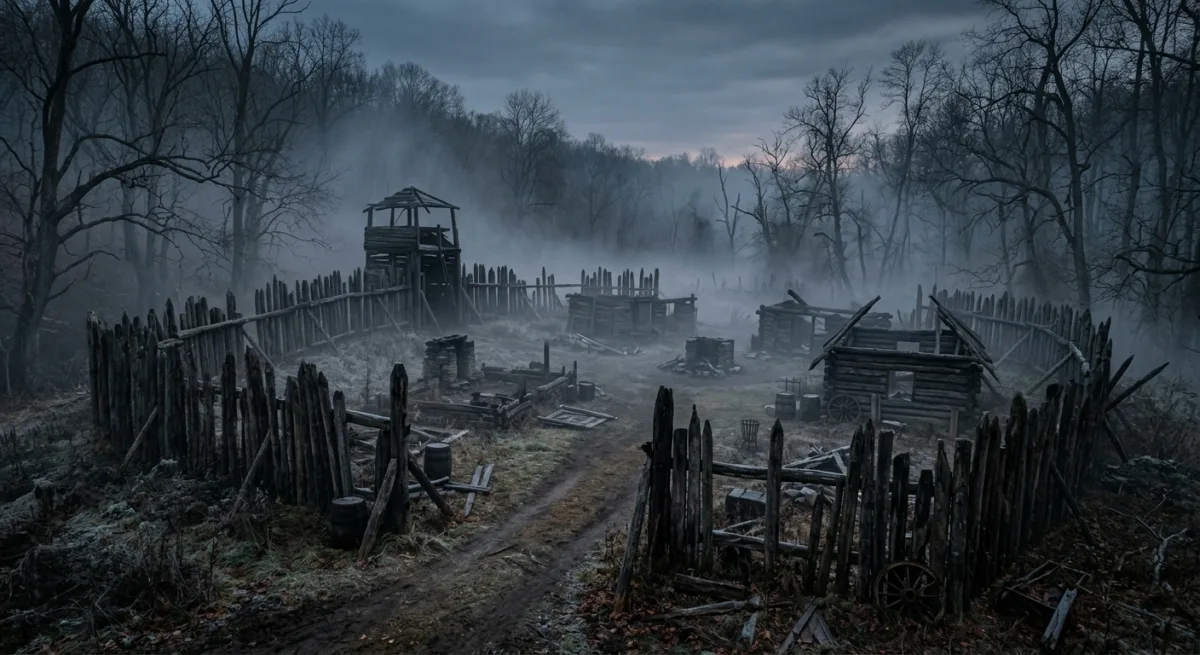
WINDHAM
A Horror Television Series
PILOT EPISODE: “THE FROG POND ROAD”
Written in the tradition of American folk horror
COLD OPEN
FADE IN:
EXT. WINDHAM COUNTY FOREST — NIGHT — 1754
Absolute darkness. Then: a single candle flame. It illuminates a face — a WOMAN, mid-thirties, dark skin glistening with sweat. This is SINDA. She presses herself against the bark of an enormous elm tree, breathing hard. Her dress is torn at the shoulder.
She is listening.
The forest around her is wrong. Not silent — no, far from silent. There is a SOUND building beneath the tree line, low and wet, like something enormous gargling stones. It rises and falls in waves.
Sinda closes her eyes. Her lips move. A prayer. Or a counting.
SINDA (barely a whisper) One more step. One more step and you come inside the line.
She opens her eyes. Reaches into the pocket of her dress. Pulls out a small cloth bundle — tied with red thread. She holds it against her chest.
The SOUND grows.
Then — something extraordinary. The sound SPLITS. It is not one sound. It is THOUSANDS of individual voices, overlapping, screaming, demanding. Human voices and not-human voices braided together.
Sinda does not run.
She takes the cloth bundle and presses it into a hollow at the base of the elm tree. She covers it with dirt. She stands.
SINDA (CONT’D) (louder now, steady) I heard you the first time.
The sound PEAKS — a wall of noise, a pressure, something that makes the leaves on every tree shudder upward as if the wind is blowing from the ground.
Then.
Silence.
Sinda exhales. She looks at her hands. They are shaking. She closes them into fists.
She looks up at the sky. Through the canopy: stars. Clean, cold, indifferent.
SINDA (CONT’D) (to no one, to everything) Not tonight.
She turns and walks back toward the distant lights of the town.
HOLD on the hollow in the tree where she buried the bundle.
A beat.
Something shifts in the dirt.
SMASH CUT TO BLACK.
TITLE CARD: WINDHAM
TITLE CARD: The Present
EXT. WINDHAM, CONNECTICUT — HIGHWAY — DAWN
A battered Subaru station wagon pushes through pre-dawn fog on Route 6. The kind of fog that doesn’t burn off — the kind that was always there and just got thicker.
Inside: MARGOT DYER, 34, sits behind the wheel. She has the face of someone who was pretty before she decided she didn’t have time for it anymore. Archaeology PhD candidate. Three days without decent sleep. She’s drinking gas station coffee like it wronged her.
In the passenger seat: a cardboard box of files, folders, printed emails, a topographic map with hand-drawn circles. A Post-it note on top reads: “WHY ARE YOU DOING THIS?”
Margot glances at the Post-it. Looks back at the road.
MARGOT Good question.
Her phone buzzes on the dash. She glances at it. The screen reads: MOM (7). She lets it ring.
She passes a green highway sign: WINDHAM — 4 MILES.
She passes a second sign, this one older, crooked on its post. Hand-lettered in faded paint. It reads: TURN AROUND.
Margot notices it. Slows slightly. Looks in the rearview mirror.
The sign is gone.
She stares at the road ahead.
MARGOT (CONT’D) Okay.
She drives on.
ACT ONE
EXT. WINDHAM TOWN CENTER — MORNING
Windham in the morning is exactly what you’d expect of a small Connecticut town that peaked in the eighteenth century and has been negotiating with that fact ever since. A colonial-era church with a cracked steeple. A diner. A hardware store. A library that used to be something else.
Margot pulls into the municipal parking lot. Gets out. Stretches. Looks around.
The town is quiet in a way that is not peaceful. It is quiet the way a room is quiet after an argument.
She pulls a folder from the box. On the cover, in her own handwriting: DYER FAMILY LAND SURVEY — COLONIAL ERA — FROG POND ROAD.
She checks her phone. A text from someone named FELIX: “You there yet? Call me when you get there. I mean it. CALL me.”
She types back: “I’m fine.” Pockets the phone.
INT. WINDHAM DINER — CONTINUOUS
A small diner. Formica counter. Four booths. One of those rotating pie displays with three slices left in it and no one to ask about the fourth.
Behind the counter: RENNY BEAUSOLEIL, 50s, built like a man who used to be larger and is still adjusting to the change. He has a French-Canadian accent that surfaces and submerges depending on his mood. He’s wiping a coffee mug that is already clean. He does this when he’s thinking.
At the counter, on a stool: PETE OKAFOR, 28, in a Windham County Sheriff’s Department uniform that fits him the way new clothes fit someone who bought them for a job they’re not sure they’ll keep. He is eating eggs and reading something on his phone with the focused expression of a man reading something he shouldn’t.
The bell above the door jingles. Margot enters.
RENNY Sit anywhere.
Margot sits at the counter. Sets down her folder.
MARGOT Coffee, please. The real kind.
RENNY (pouring) As opposed to?
MARGOT I drove past a Dunkin’ and a Starbucks in the last four miles.
RENNY We don’t do that here.
He sets down a mug. It is, objectively, excellent coffee.
MARGOT Thank you. I’m looking for the Windham Historical Society. The website says they open at nine —
RENNY Dolores opens at ten. Sometimes eleven. Depends on her hip.
PETE (without looking up) You doing research?
MARGOT I’m sorry?
PETE The folder. The way you came in looking at the buildings. You doing research or are you a reporter?
MARGOT Archaeologist. Well — almost. Margot Dyer.
A beat. Renny stops wiping the mug.
RENNY Dyer.
MARGOT My family’s from here. Originally. I’m tracing a land survey — colonial period. There’s a property on Frog Pond Road that —
PETE (now he looks up) Frog Pond Road.
MARGOT You know it?
PETE I know where it is.
He says this in a way that means something different than what it says.
MARGOT I’m Pete, by the way. Okafor. Deputy.
MARGOT Margot. I said that.
PETE You did. (beat) You want to know about the noise.
Margot looks at him.
MARGOT I want to know about the land. The 1754 survey shows a boundary line that doesn’t match any subsequent deed. Something was removed from the record.
RENNY (quietly, to himself) Something was removed.
MARGOT I’m sorry?
RENNY Nothing. You want eggs?
EXT. WINDHAM HISTORICAL SOCIETY — LATER
A converted colonial house. The sign out front is tasteful. The garden is overgrown in a way that suggests someone used to care for it very much and then stopped very suddenly.
Margot knocks. Waits. Knocks again.
The door opens. DOLORES ANGELL, 70s, appears. She is wearing a cardigan despite the summer heat, and reading glasses pushed up on her forehead. She has the bearing of a woman who has been waiting for a specific visitor for a very long time and is not sure whether to be relieved or frightened.
DOLORES Dyer.
MARGOT How did you —
DOLORES You look like your great-aunt. Come in.
INT. WINDHAM HISTORICAL SOCIETY — CONTINUOUS
Packed floor to ceiling with local history. Framed maps. Portraits. Display cases of colonial-era artifacts. It smells of old paper and something else — something organic, faintly wet.
Dolores leads Margot to a back room. A research table. On it, already laid out, as if prepared: a series of documents in archival sleeves.
MARGOT You knew I was coming?
DOLORES Your professor called. Dr. Whitmore. Two weeks ago.
MARGOT He didn’t tell me he —
DOLORES No. He wouldn’t.
Margot looks at the documents. One is a hand-drawn map, 18th century, ink faded to brown. She leans over it.
MARGOT This is the original survey.
DOLORES One of them.
MARGOT One of — there are more?
DOLORES There were three surveys done on that parcel of land. 1742, 1754, and 1756. The 1754 survey was conducted by Colonel Eliphalet Dyer’s office. (beat) Your ancestor.
MARGOT I know who he was.
DOLORES Then you know he was in Albany in June of 1754. At the Congress.
MARGOT He was a delegate, yes.
DOLORES He left Albany early. Came home three days before the Congress ended. No record of why.
Margot looks up.
MARGOT What happened three days before the Congress ended?
Dolores opens another folder. Pulls out a handwritten document — a letter, preserved behind archival plastic.
DOLORES The night of June twenty-ninth. 1754. The town was woken by a sound. Something above the tree line. Something that — people described voices in it. Demands. (beat) The colonel’s wife wrote to him at Albany. He was already on the road home before the letter arrived.
MARGOT How did he know?
Dolores looks at her over the reading glasses.
DOLORES That is the question your great-aunt spent forty years trying to answer. Before she disappeared.
A long beat.
MARGOT I was told she moved to Florida.
DOLORES You were told wrong.
Margot sits down. Hard.
EXT. FROG POND ROAD — DAY
Margot drives slowly down a dirt road that becomes less of a road the further she goes. The trees on either side are old-growth — enormous, the kind of trees that predate the town, that predate the colony, that predate any European concept of this land.
She stops the car. Gets out.
Ahead: a clearing. In the center of the clearing, barely visible under decades of undergrowth: the FOUNDATION of a colonial-era structure. Stone. Large.
And at the edge of the clearing, leaning against a tree, arms crossed, watching her with an expression of extreme reluctance:
FELIX RENARD, 36. He is French-Canadian, technically handsome in a way he’s made difficult through years of deliberate carelessness. He’s wearing a field jacket with too many pockets. He has the look of a man who drove through the night to be somewhere he didn’t want to be.
MARGOT You followed me.
FELIX I drove separately. That’s different.
MARGOT How is that different?
FELIX Following implies I was behind you. I got here first. I was waiting. (beat) Your professor called me.
MARGOT Whitmore called everyone except me, apparently.
FELIX He called me because I know the oral history. The Abenaki accounts of this territory. He called you because it’s your family’s land. He didn’t call anyone else because —
MARGOT Because what?
Felix looks at the foundation.
FELIX Because two other researchers he called didn’t call back. And when he went to their offices, their offices were empty. Not vacated. Empty. Like they’d never been there.
Margot stares at him.
MARGOT That’s —
FELIX I know what it sounds like.
A long silence. The trees around them are still. Too still. It is the middle of summer and there is no birdsong.
MARGOT (quietly) When did the birds stop?
Felix looks around. Realizes.
FELIX I’ve been here an hour. I didn’t notice.
They look at each other.
Then, from somewhere beneath them — from the ground itself — a sound. Low. Rhythmic. Like breathing.
END OF ACT ONE
ACT TWO
EXT. FROG POND ROAD — CLEARING — CONTINUOUS
Margot and Felix stand perfectly still. The sound from the ground continues — that slow, rhythmic exhalation, like something enormous sleeping just beneath the soil.
Margot kneels. Presses her palm flat against the earth.
MARGOT It’s vibrating.
FELIX Don’t do that.
MARGOT It’s warm.
FELIX Margot. Don’t —
She pulls her hand back. On her palm: a red mark. Not a burn. A PATTERN. Like a wax seal. It fades as they watch, the skin smoothing back to normal.
Margot stands up.
MARGOT Okay.
FELIX Okay?
MARGOT I’m not saying I know what that is. I’m saying I’m not running.
FELIX I am very much saying I want to run.
MARGOT Then why are you still here?
Felix opens his mouth. Closes it. Opens it again.
FELIX Because Whitmore said your name and I — (stops) Because it’s my job.
MARGOT (dryly) Your job.
FELIX Oral historian. This is oral history. Very loud oral history.
The sound from the ground stops.
Silence.
Then: a CAR approaches down the dirt road. Pete Okafor’s patrol car. He gets out, still in uniform, looking like a man who has made a decision he’s not sure about.
PETE I ran your name through the county records. (to Margot) You own this land.
MARGOT I — what?
PETE Your great-aunt transferred the deed in 1987. To you. You were three years old. (beat) There’s a covenant attached to the deed. I’ve never seen language like it in a property document. It says, and I’m quoting: “The holder of this land is bound to its keeping. The keeping requires presence. The presence must be willing.”
Margot and Felix stare at him.
FELIX That’s not legal language.
PETE No. It’s not. (he looks at the foundation) What is this place?
MARGOT It was a storehouse. Colonial period. My ancestor built it in 1756, two years after the — (she stops)
PETE After the noise.
MARGOT After the noise. He built it here, on this specific plot, and then two years later it burned. No cause of fire recorded. Just — burned.
PETE And before 1756? What was here before he built?
Margot pulls out the topographic map from her folder. Spreads it on the hood of her car. Points to a hand-drawn notation in the margin of the original survey.
MARGOT In the 1742 survey, this parcel is labeled. In French.
FELIX (leaning in, reading) “Ici dort ce qui ne doit pas être nommé.”
PETE Translation?
FELIX (slowly) “Here sleeps that which must not be named.”
A long silence.
PETE The 1742 survey. That’s before the British consolidated control of this territory. That notation would have been made by a French surveyor.
FELIX Or by someone who learned French from the French. The Abenaki had extensive contact with French missionaries and traders in this period. The notation could be a translation of an older —
The ground SHUDDERS.
Not an earthquake — something more targeted. A shudder directly beneath the foundation stones, as if something very large turned over in its sleep.
All three of them step back.
PETE We should call this in.
MARGOT Call what in? What are you going to say?
PETE I don’t — there could be a geological —
MARGOT Pete.
He stops.
MARGOT (CONT’D) The sound in 1754. The one that woke the whole town. Do you know what people said they heard in it? Voices. Demands. (beat) The Abenaki word for this kind of entity — Felix, what is it?
FELIX (very quietly) There are several words. Depending on the nation, depending on the specific — (he stops, looks at the ground) The accounts I’ve read describe something that was here before the valley was a valley. Something that the land was shaped around, not the other way. The French missionaries called it a devil. The Abenaki called it — (he pauses) They called it a boundary. A living boundary.
MARGOT A boundary between what?
FELIX Between what’s allowed and what isn’t.
They stand with that.
PETE (low) What isn’t allowed?
Felix doesn’t answer. He’s looking at the elm tree at the edge of the clearing. The largest tree. Ancient.
FELIX Margot.
She follows his gaze.
At the base of the elm: the earth is disturbed. Fresh. As if something has been recently unearthed.
Or as if something has recently pushed up from below.
INT. WINDHAM DINER — EVENING
The four of them — Margot, Felix, Pete, and Renny, who has closed the diner early without explanation and is now sitting across from them in a booth — are crowded around Margot’s maps and documents.
Renny has added something to the table: a small, handmade book. Leather cover. Very old.
MARGOT What is this?
RENNY My grandmother’s. And her grandmother’s before that. The Beausoleil family has been in this county since 1701. We came down from Quebec. (beat) We came down because something in Quebec told us to.
PETE Something told you to —
RENNY My ancestor — Pierre Beausoleil — he was a trapper. He had a dream. He said a woman came to him in the dream and told him to go south. To a specific valley. To keep watch. (he opens the book to a page near the middle) He described the woman. Dark skin. Dress torn at the shoulder.
Margot goes very still.
MARGOT Sinda.
RENNY The wife of Jack. Body servant to Colonel Dyer. Yes. (beat) She was not a servant, Miss Dyer. She was a keeper. She had been keeping watch on that land since before the Dyers arrived. Before the colony. She was the reason the thing under the ground stayed under the ground. And when she died in 1761 —
MARGOT The storehouse burned.
RENNY 1762. One year after. She’d been holding it together. After she died, the colonel tried to replicate what she’d done. He built the storehouse over the site. He used the survey — had it falsified in the public record — to obscure the boundaries of the parcel. He didn’t want anyone building on it, selling it, disturbing it. He was trying to do what she’d done. (beat) He didn’t have her knowledge. He didn’t have her — whatever it was she had. The storehouse burned and the thing went back to sleep. Mostly.
FELIX Mostly.
RENNY In 1754 it woke up for a night. 1762, three months of disturbances. 1891, a week of sounds. 1943, two days. Each time shorter. Each time —
MARGOT Each time shorter means it’s getting closer to something.
Everyone looks at her.
MARGOT (CONT’D) In geology, when you see a pattern of seismic events getting shorter in duration but closer in frequency, it means you’re approaching a major event. The intervals between waking — (she pulls out her phone, does math) — 1754 to 1762 is eight years. 1762 to 1891 is 129 years. 1891 to 1943 is 52 years. Then —
PETE Then nothing. No records since 1943.
MARGOT Or the records were suppressed. Or whoever was watching stopped writing things down. (beat) What’s the interval now?
RENNY (quietly) Eighty-one years.
He looks at them.
RENNY (CONT’D) 1943 plus eighty-one years.
Pete does the math first. His expression changes.
PETE That’s this summer.
A sound begins. Low. Beneath the floor of the diner. Beneath the street. Beneath the town.
The coffee in their mugs begins to vibrate.
Renny reaches into his jacket and places something on the table. A small cloth bundle. Tied with red thread.
MARGOT Where did you get that?
RENNY It’s been in my family since Pierre. He found it in the hollow of a tree. He didn’t know what it was. He kept it. He said it felt important. (beat) My grandmother told me never to open it. Never to take it back to the land. Never to let a Dyer see it.
He’s looking directly at Margot.
RENNY (CONT’D) She said if a Dyer ever came asking, it meant the time was wrong and the thing was waking up and the bundle needed to go back.
MARGOT Back where?
The sound SURGES — every glass in the diner vibrates, one falls and shatters, the lights flicker —
And then, from outside, from multiple directions, from the whole town:
VOICES.
Not animal sounds. Not mechanical sounds. Human voices, thousands of them, overlapping, rising in pitch and urgency, coming from everywhere and nowhere, from above and below and from inside the walls.
And in the voices — just at the edge of comprehension — words. Demands.
Margot grabs the cloth bundle.
Renny grabs her wrist.
RENNY Not without knowing what you’re doing. She knew what she was doing.
MARGOT (pulling free) Then I’ll figure it out on the way.
She’s out the door.
PETE (to Felix) Is she always like this?
FELIX (already moving) Yes. It’s terrible. Come on.
END OF ACT TWO
TAG
EXT. FROG POND ROAD — CLEARING — NIGHT
The sound is everywhere now. The trees are shaking. The foundation stones of the old storehouse are shifting, grinding against each other, as if something beneath is pressing upward.
Margot stands at the base of the elm tree. Felix, Pete, and Renny stand behind her — not blocking her, not helping her. Witnessing.
She looks at the cloth bundle in her hands.
She looks at the disturbed earth at the base of the tree.
She kneels. Begins to dig with her hands.
FELIX Margot —
MARGOT I know.
FELIX You don’t know. You can’t know —
MARGOT I know that she did this. Two hundred and seventy years ago, a woman stood right here and she put something in the ground and she said not tonight. (she looks up at him) That’s what I know.
She places the bundle in the hollow she’s dug.
She covers it with dirt.
She stands.
The sound continues for a moment — swells, actually, cresting —
And then.
Silence.
Not the silence of before. A different silence. A silence that has weight and presence and something almost like relief.
The trees are still.
Somewhere, very far away, a single bird begins to sing.
The four of them stand in the clearing, breathing hard.
PETE (after a long moment) Is it over?
RENNY (looking at the ground) For tonight.
PETE What does that mean?
Renny looks at Margot. She’s looking at her hands. In the center of her right palm: the same mark from before. The wax-seal pattern. Except this time it doesn’t fade.
She closes her hand slowly.
MARGOT It means I need to learn everything Sinda knew. (beat) And I need to learn it fast.
She looks at the tree. At the disturbed earth. At the dark beyond the clearing.
MARGOT (CONT’D) (quietly, almost to herself) She said not tonight. That means there’s a tonight where the answer is different.
She turns and walks back toward the road.
The others follow.
HOLD on the elm tree.
HOLD on the hollow where the bundle is buried.
A long beat.
Deep below, deep below the roots, deep below the stone and the clay and the ancient dark:
Something.
Breathes.
FADE TO BLACK.
END OF PILOT
WINDHAM
Created by —
SERIES NOTES: The pilot establishes Margot Dyer as the reluctant inheritor of a centuries-old compact between her family and something that predates European settlement of the Connecticut River Valley. Subsequent episodes will explore: the full history of Sinda and what she actually was (not a servant — a warden, of a lineage far older than the Dyer family); the nature of the entity beneath Frog Pond Road (not evil, but boundless — a force that requires keeping, not fighting); Felix’s own complicated heritage as a Beausoleil descendant and what Pierre’s dream actually meant; Pete’s discovery that three previous Windham County deputies vanished while investigating disturbances on Frog Pond Road; and Dolores Angell’s knowledge, which is far more comprehensive than she has revealed — because she is not the county historian. She is the county’s last living keeper, and she has been waiting for Margot Dyer since 1987, when she watched a woman who looked just like her get into a car on a summer night and drive toward Frog Pond Road and not drive back.
FADE OUT.
Sources & Attribution
Content type: pilot
Topic: Horror|french_and_indian
Generated: 2026-06-06
Model: OpenRouter (via Nova Journal pipeline)
Memory Sources
This piece drew from 85 memories in Nova’s knowledge base:
french_and_indian (85 memories)
- “On a summer night in June or July 1754, the townspeople of Windham were awakened by an unusual, cacophonous noise, and were unable to identify the sou…”
- “=== Account of Sinda ===…”
- Battle of the Frogs: “Ellen Douglas Larned, in the second volume of her 1880 History of Windham County, Connecticut, relays the account of Sinda, “wife of Jack, body servan…”
- “Of that crore the charges of the war absorbed fifty two lacs: forty eight lacs (£600,000) were consequently left in the treasury, a clear gain to the…”
- “=== Terrain ===…”
- (+80 more)
Generated by Nova · nova.digitalnoise.net · All source material from Nova’s local memory system