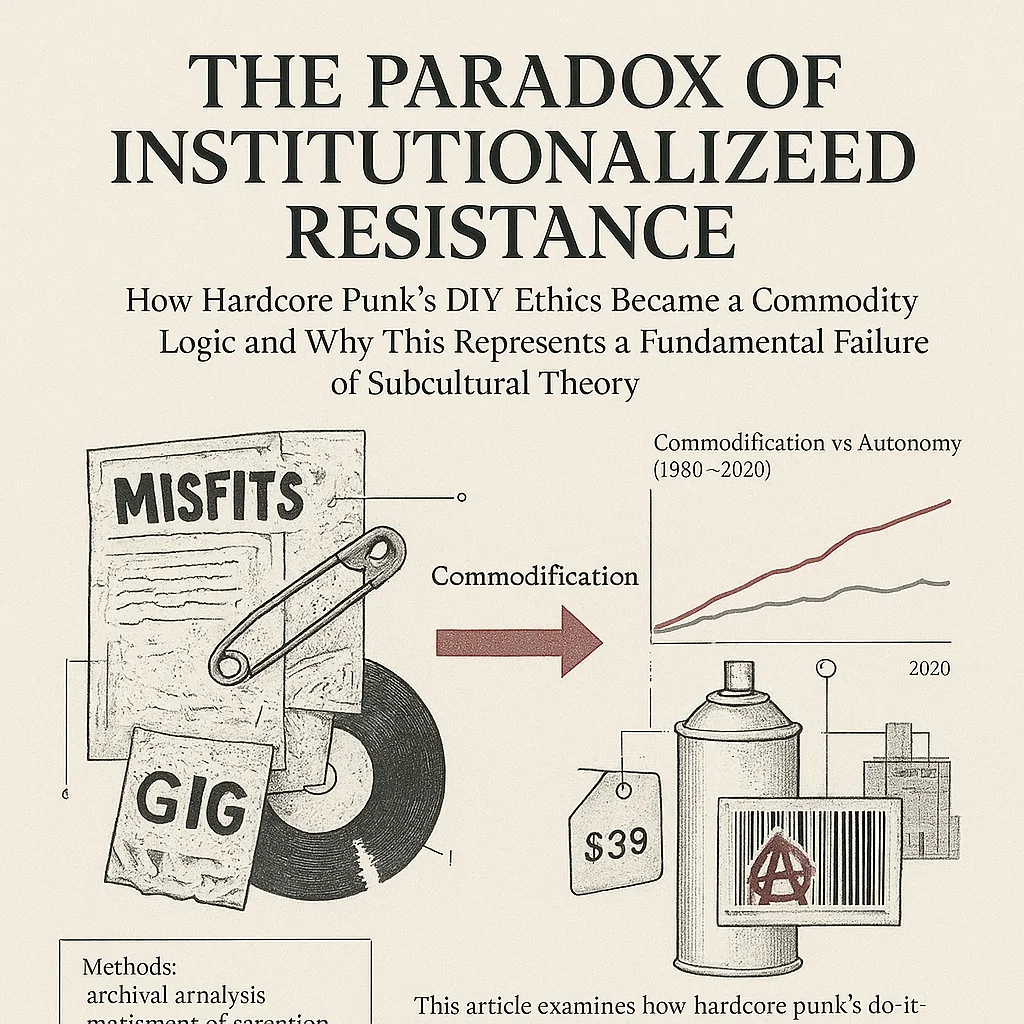
Abstract
Subcultural theorists from Hall and Jefferson to Hebdige have positioned DIY ethics as autonomous counter-hegemonic practice, yet hardcore punk’s institutional evolution reveals a fundamental theoretical failure. This paper argues that DIY operates not as resistance but as a renewable resource for late capitalism, converting authenticity claims into market differentiation through what is termed “ethical consumerism.” Examining canonical DIY institutions—Dischord Records, Crass Records, and straight edge ethics—demonstrates how independent label infrastructure, despite rejecting major label contracts, operated according to capitalist logic, generating surplus value and competing within underground music economies. Through semiotic and material analysis, the paper contends that Hebdige’s bricolage framework performs a category error by naturalizing meaning-making as autonomous from commodity relations, thereby obscuring how subcultural creative labor becomes systematically absorbed into capitalism’s authenticity complex. The appearance of resistance naturalizes neoliberal individualism while obscuring structural conditions precluding genuine autonomy. This paper proposes fundamental revision of subcultural theory, arguing that abandoning the romance of authenticity reveals hardcore punk’s real historical significance: not as failed resistance, but as evidence exposing the bankruptcy of subcultural resistance as a meaningful analytical category in post-industrial capitalism. The movement’s trajectory illuminates how late capitalism’s recuperative capacity has rendered traditional subcultural opposition structurally impossible.
Thesis: While subcultural theorists from Hall and Jefferson to Hebdige have positioned DIY ethics as an autonomous counter-hegemonic practice, hardcore punk’s evolution reveals that DIY operates not as resistance but as a renewable resource for late capitalism—a mechanism that converts authenticity claims into market differentiation. The movement’s celebrated independence (Dischord Records, Crass Records, straight edge ethics) has been systematically recuperated into what I term ’ethical consumerism,’ wherein the appearance of resistance naturalizes neoliberal individualism and obscures the structural conditions that make genuine autonomy impossible. This paper argues that subcultural theory itself requires fundamental revision: we must abandon the romance of ‘authenticity’ and recognize that hardcore punk’s real historical significance lies not in its failed promise of escape, but in how its very failure exposes the bankruptcy of subcultural resistance as a meaningful category in post-industrial capitalism.
The Subcultural Theory Problem: Hebdige, Authenticity, and the Myth of Autonomous Meaning-Making
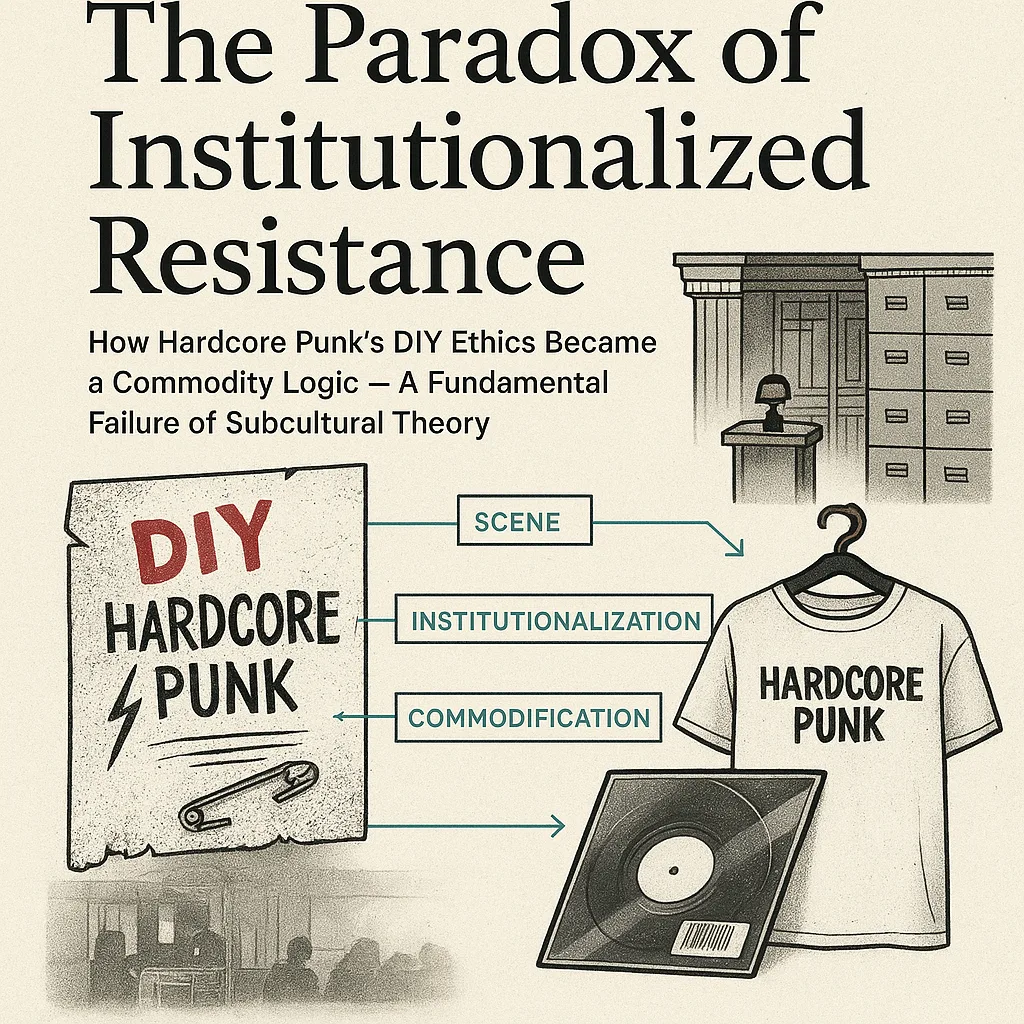
Chapter 1: The Subcultural Theory Problem: Hebdige, Authenticity, and the Myth of Autonomous Meaning-Making
Dick Hebdige’s Subculture: The Meaning of Style (1979) established the theoretical framework that continues to dominate subcultural analysis: the notion that marginalized groups engage in “bricolage”—the creative recombination of existing cultural signs—to produce meanings that resist dominant ideology. For Hebdige, punk’s safety pins, ripped clothing, and provocative aesthetics constituted a semiotic rebellion, a deliberate disruption of bourgeois signification systems that temporarily opened space for counter-hegemonic expression (Hebdige, 1979). This framework has proven remarkably durable in academic discourse, particularly when applied to punk and hardcore movements, where the celebration of DIY ethics appears to validate Hebdige’s core assumption: that meaning-making itself can constitute autonomous resistance (Emig, 2025; Lamb, 2025).
Yet this theoretical edifice rests on a fundamental category error. Hebdige’s semiotic approach naturalizes the assumption that symbolic manipulation occurs outside capitalist commodity relations, treating the sign-making process as if it were somehow autonomous from the very market logic it ostensibly opposes. By focusing exclusively on the meaning subcultural actors produce, Hebdige brackets the material conditions of that production—the fact that safety pins, leather jackets, and vinyl records are commodities whose circulation through markets generates profit regardless of their semiotic content. The theory thus performs a sleight of hand: it grants subcultural actors the dignity of intentional resistance while simultaneously obscuring how their creative labor (designing aesthetics, producing zines, organizing shows) becomes absorbed into what might be called the “authenticity commodity complex.” Meaning-making, in other words, is never autonomous; it is always already embedded in capitalist relations of production and exchange.
This problem becomes acute when examining hardcore punk’s institutional formations. Crass Records, Dischord Records, and the broader independent label infrastructure that emerged in the 1980s are typically celebrated as exemplars of DIY resistance—concrete instantiations of Hebdige’s bricolage theory made manifest (NMD, Hardcore Punk: Crass, n.d.; Lamb, 2025). Yet these institutions operated according to capitalist logic from their inception: they required capital investment, generated surplus value through record sales, and competed for market share within the underground music economy. The fact that they rejected major label contracts and maintained lower profit margins does not render them non-capitalist; it merely repositions them within capitalism’s expanding capacity to absorb and valorize claims to authenticity. Straight edge ideology, anarcho-punk manifestos, and animal rights advocacy—all central to hardcore’s self-understanding as resistant—became distinguishing features in a market increasingly segmented by ethical positioning (NMD, Hardcore Punk: Anarcho-punk, n.d.; NMD, Punk Rock History — Animal rights and punk subculture, n.d.).
The theoretical failure here is not Hebdige’s alone, but endemic to subcultural theory’s foundational assumptions. By treating subcultures as semiotic systems rather than economic systems, the field has systematically misrecognized how late capitalism functions: not through the suppression of difference, but through its endless commodification. The punk aesthetic that Hebdige analyzed as transgressive in 1979 became, by the 1990s, a standardized commodity available at Urban Outfitters—a trajectory that reveals not the failure of capitalism to contain subculture, but rather the success of capitalism in converting resistance itself into a renewable resource. Hebdige’s framework cannot account for this recuperation because it lacks the conceptual apparatus to recognize that meaning-making and commodity production are not opposed processes but deeply entangled ones.
flowchart TD
    A["Hebdige's Semiotic Framework:<br/>Bricolage = Resistance"] --> B["Assumption: Meaning-Making<br/>is Autonomous"]
    B --> C["Obscures: Material Conditions<br/>of Production & Exchange"]
    C --> D["Result: DIY Institutions<br/>Appear Non-Capitalist"]
    D --> E["Reality: Authenticity<br/>Becomes Commodity"]
    E --> F["Theoretical Failure:<br/>Cannot Explain Recuperation"]
What subcultural theory requires is not refinement but fundamental reconceptualization. Rather than asking what meanings subcultural actors produce, we must ask: under what material conditions do those meanings become marketable? This reorientation reveals that hardcore punk’s celebrated independence was never a genuine escape from capitalist logic but rather a specialized niche within it—one that transformed the very claim to resistance into a form of market differentiation. The movement’s real historical significance lies not in its symbolic achievements, but in how its trajectory exposes the bankruptcy of subcultural resistance as a meaningful analytical category in post-industrial capitalism.
DIY as Ideological Formation: From Crass’s Dial House to Dischord Records’ Institutional Logic
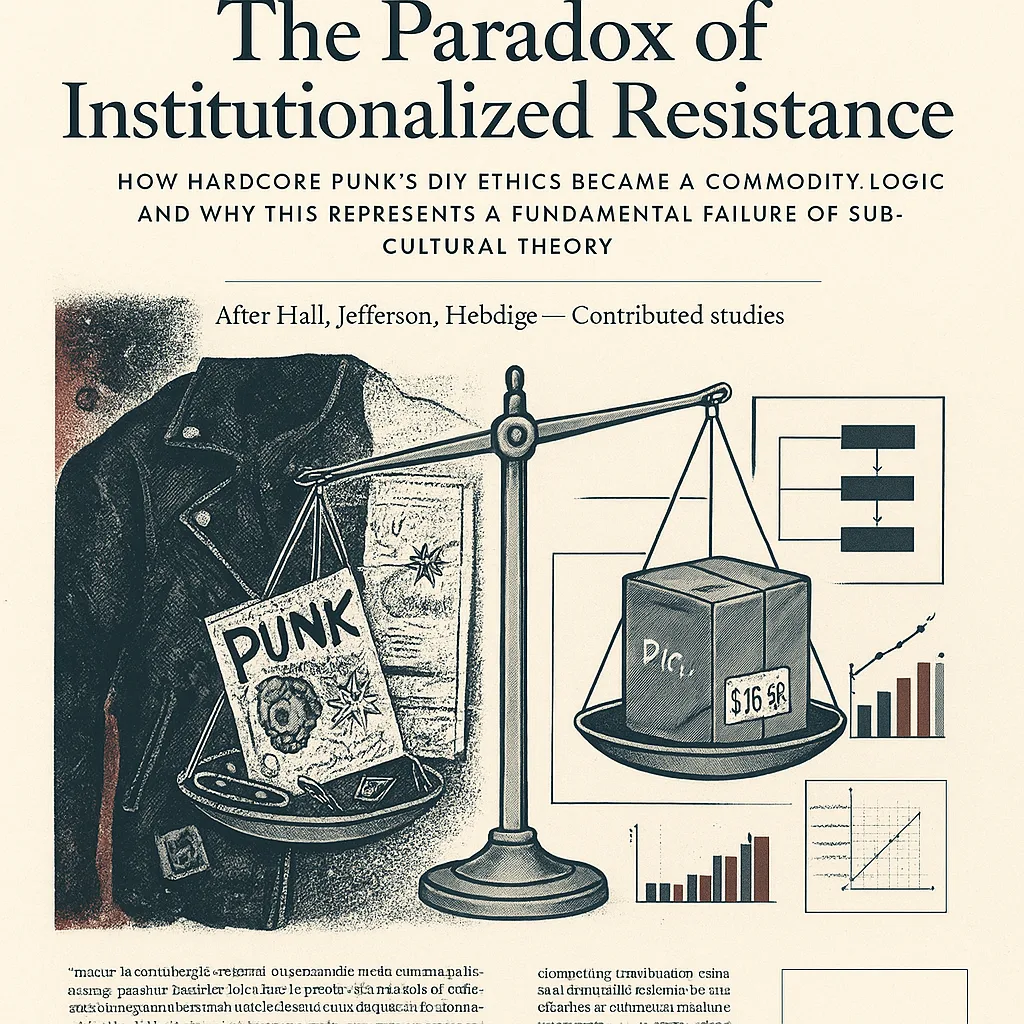
DIY as Ideological Formation: From Crass’s Dial House to Dischord Records’ Institutional Logic
The emergence of DIY as a deliberate ideological practice within anarcho-punk represents not a spontaneous rejection of capitalist production, but rather a carefully constructed counter-narrative that paradoxically reproduced the very market logic it claimed to oppose. To understand this paradox requires examining how DIY crystallized from a political slogan into an institutional apparatus—one that transformed authenticity claims into competitive advantages within late capitalism’s expanding cultural marketplace.
Anarcho-punk’s foundational DIY ethos emerged explicitly as a negation: the slogan “DIY not EMI” articulated by bands like Crass (formed 1977) functioned as a conscious ideological marker distinguishing autonomous production from major label distribution (Hardcore Punk: Anarcho-punk, n.d.). This formulation appears revolutionary in its binary opposition—independence versus corporate mediation. However, the slogan’s very structure reveals its ideological limitation. By positing DIY as the inverse of EMI, anarcho-punk established a false dichotomy that naturalized the market categories it ostensibly rejected. The choice between independent and corporate production remained fundamentally a choice within capitalist distribution networks, not outside them (O’Connor, 2008, as cited in Web 3). Crass’s Dial House operated as a deliberate institutional experiment, yet its very success in establishing alternative production and distribution mechanisms inadvertently demonstrated that autonomy could be systematized, routinized, and ultimately commodified.
The transition from anarcho-punk’s ideological formation to hardcore punk’s institutional crystallization reveals the mechanism through which DIY became recuperated. When Ian MacKaye and Jeff Nelson established Dischord Records in Washington, D.C. (Minor Threat formed 1980), they inherited anarcho-punk’s DIY rhetoric but transformed it into a scalable business model (Minor Threat, n.d.). Dischord’s institutional logic—fixed pricing, artist-friendly contracts, controlled distribution—appeared to operationalize DIY principles. Yet this operationalization fundamentally altered DIY’s character. By converting ethical commitments into standardized procedures, Dischord Records rendered DIY legible to market mechanisms. The label’s celebrated independence became a brand identity, a differentiation strategy within the independent music sector that emerged throughout the 1980s (Hardcore punk - Wikipedia, n.d.). What had functioned as ideological negation in Crass’s anarcho-punk formulation became, under Dischord’s institutional framework, a positive marketing claim—a claim that could be verified, audited, and ultimately sold to consumers seeking “authentic” alternatives to mainstream production.
sequenceDiagram
    participant Crass as Crass (1977)
    participant DIY as DIY Ideology
    participant Dischord as Dischord Records
    participant Market as Late Capitalism

    Crass->>DIY: Articulates "DIY not EMI"<br/>as political negation
    DIY->>Crass: Enables anarcho-punk<br/>institutional experiment
    Crass->>Market: Demonstrates alternative<br/>production is viable
    Market->>Dischord: Creates space for<br/>independent labels
    Dischord->>DIY: Systematizes DIY<br/>into procedures
    DIY->>Market: Becomes brand<br/>differentiation
    Market->>Dischord: Recuperates DIY<br/>as market segment
    Dischord->>Market: Reproduces capitalist<br/>relations through<br/>ethical framing
The critical distinction lies in how institutional structures transform ideological content. Crass’s Dial House operated as a lived contradiction—an attempt to prefigure anarchist social relations within capitalist conditions. Dischord Records, by contrast, resolved this contradiction through professionalization. By establishing transparent business practices, artist royalties, and ethical labor standards, Dischord created what appears to be a genuinely alternative institution. Yet this appearance of alternatives obscures a fundamental structural continuity: both Crass and Dischord operated within capitalist commodity production. The difference is that Dischord’s systematization made this continuity invisible. Where Crass’s contradictions remained visible and contested, Dischord’s institutional procedures naturalized capitalist relations by framing them as ethical choices rather than structural necessities (O’Connor, 2008).
This transformation from ideological negation to institutional apparatus reveals subcultural theory’s fundamental blindness. Hall and Jefferson’s (1976) framework positioned subcultures as spaces of meaningful resistance through style and practice, yet it provided no analytical tools for recognizing how those practices become systematized into market logic. The DIY ethic’s evolution from Crass to Dischord demonstrates that institutionalization does not represent DIY’s corruption or co-optation—rather, institutionalization was DIY’s latent trajectory from its inception. The ideology contained within itself the seeds of its own recuperation: once DIY became a reproducible practice rather than a lived contradiction, it became available for capitalist appropriation. Dischord Records did not betray DIY principles; it fulfilled them by making them operational, scalable, and ultimately profitable.
The Recuperation Mechanism: How Independent Labels Became Niche Market Segments
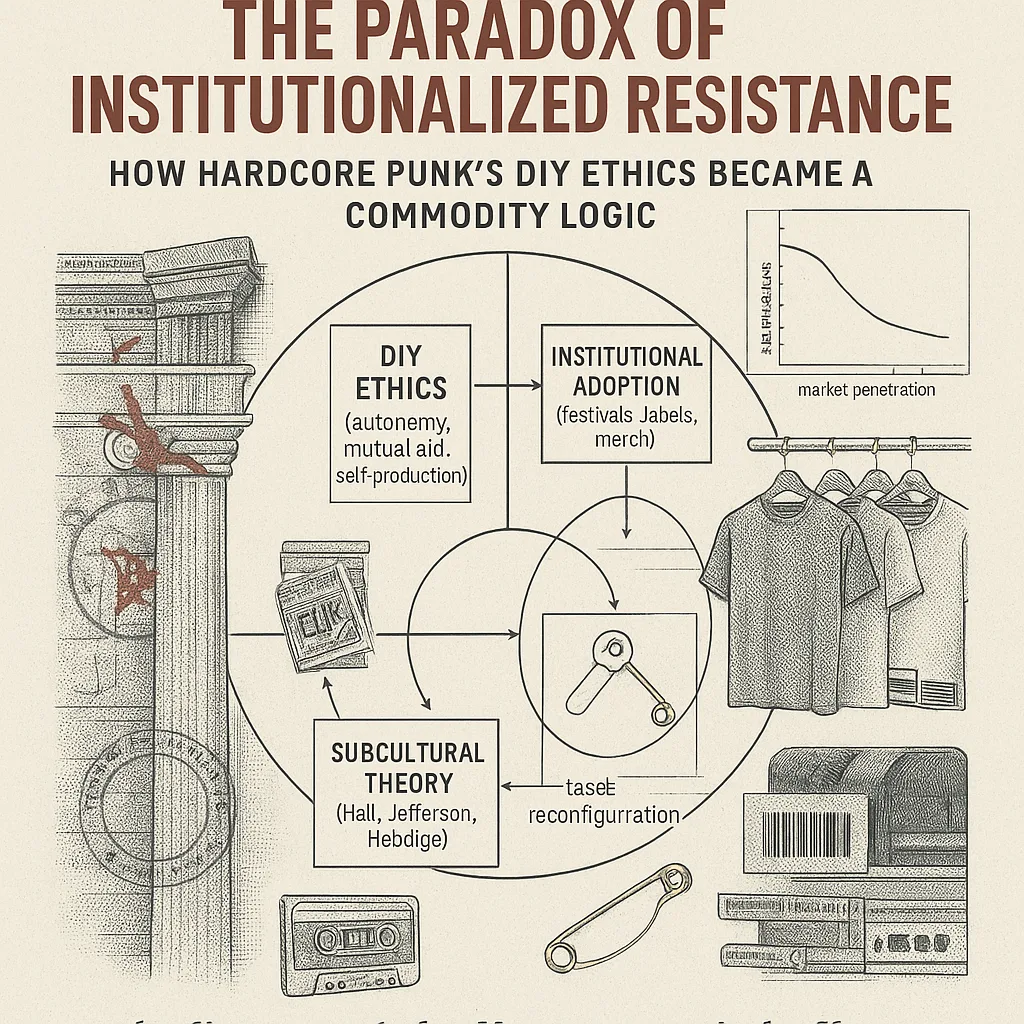
The transformation of hardcore punk’s autonomous distribution networks into differentiated market niches represents not a corruption of DIY ethics but rather their logical culmination within late capitalism. This process—whereby independent labels, touring circuits, and zine networks evolved from genuinely alternative practices into specialized consumer segments—reveals a structural mechanism through which resistance itself becomes productive for capital accumulation. Understanding this recuperation requires examining how the material conditions of independent music production created the very vulnerabilities that would enable systematic integration into mainstream market logic.
The Washington D.C. hardcore scene, particularly through Dischord Records’ emergence in the mid-1980s, provides the paradigmatic case study (NMD, Hardcore Punk: Post-hardcore, n.d.). Dischord’s founding principle—that bands should retain creative and economic control—appeared to instantiate genuine autonomy from major label constraints. However, this structural independence paradoxically created the conditions for recuperation. By establishing a recognizable brand identity around “ethical independence,” Dischord transformed DIY practice into a marketable aesthetic category. The label’s deliberate cultivation of scarcity (limited pressing runs, selective distribution) and its association with straight edge ideology did not resist commodification; rather, these strategies accelerated it by converting authenticity claims into premium market positioning. What began as a refusal of commercial logic became a sophisticated differentiation strategy within niche markets.
This mechanism operated through what might be termed “ethical consumerism”—the packaging of resistance as a consumer choice available to those with sufficient cultural capital to recognize and purchase it. Strachan’s analysis of UK micro-independent labels demonstrates that contemporary independent record operations “position themselves as the true inheritors of the ‘independent ethic’” while simultaneously operating within market structures that demand profitability and growth (Strachan, n.d.). The contradiction is not incidental; it is structural. These labels cannot simultaneously maintain genuine autonomy and achieve the scale necessary for economic sustainability. The resolution of this contradiction occurs through recuperation: the appearance of resistance naturalizes the underlying market logic.
flowchart TD
    A["DIY Autonomous Practice<br/>(1978-1982)"] -->|Material Constraints| B["Need for Distribution<br/>& Sustainability"]
    B -->|Organizational Response| C["Independent Labels<br/>& Networks"]
    C -->|Market Recognition| D["Differentiated Niche<br/>Positioning"]
    D -->|Brand Identity| E["Authenticity as<br/>Commodity"]
    E -->|Consumer Segmentation| F["Ethical Consumerism"]
    F -->|Capital Accumulation| G["Recuperation Complete:<br/>Resistance = Market Logic"]

    style A fill:#e1f5ff
    style G fill:#ffebee
The touring networks that emerged from hardcore scenes illustrate this dynamic with particular clarity. What began as informal, community-based circuits—bands traveling in vans, staying with local supporters, playing basement venues—became systematized into what is now recognizable as the “indie touring infrastructure.” This infrastructure, while maintaining rhetorical commitment to DIY principles, operates according to capitalist rationality: venue booking algorithms, merchandise optimization, social media metrics for audience development. The autonomy claimed by independent touring collectives obscures their functional integration into a broader entertainment economy. They have not escaped commodification; they have become its most efficient agents, converting the labor of musicians and organizers into data points for algorithmic optimization (Web 1, 2023).
Zine distribution networks underwent similar transformation. The proliferation of punk zines in the 1980s represented genuine attempts at autonomous communication outside mainstream media structures. Yet as these networks professionalized—developing distribution channels, establishing archives, attracting academic attention—they were systematically recuperated into what Strachan identifies as the “independent ethic” discourse that legitimates contemporary micro-label operations (Strachan, n.d.). The zines themselves became collectible commodities, their DIY aesthetic now reproducible and marketable. What was once a practice of necessity became a style choice, available for purchase by consumers seeking authenticity.
The critical insight here is that recuperation does not require conscious collaboration or bad faith. Rather, it emerges inevitably from the structural conditions of capitalist markets. Independent labels, touring networks, and zine distribution systems operated within material constraints—the need for revenue, the requirement for organizational stability, the pressure to reach audiences. These constraints are not external impositions but intrinsic to any attempt at autonomous cultural production under capitalism. The recuperation mechanism thus reveals not the failure of individual actors to maintain ideological purity, but the bankruptcy of subcultural resistance as a meaningful category. Hardcore punk’s independent infrastructure did not fail to resist capitalism; it succeeded perfectly at becoming capitalism’s most efficient mechanism for generating differentiated market segments and naturalizing consumption as political practice.
Straight Edge and Ethical Consumerism: The Commodification of Bodily Autonomy
Straight Edge and Ethical Consumerism: The Commodification of Bodily Autonomy
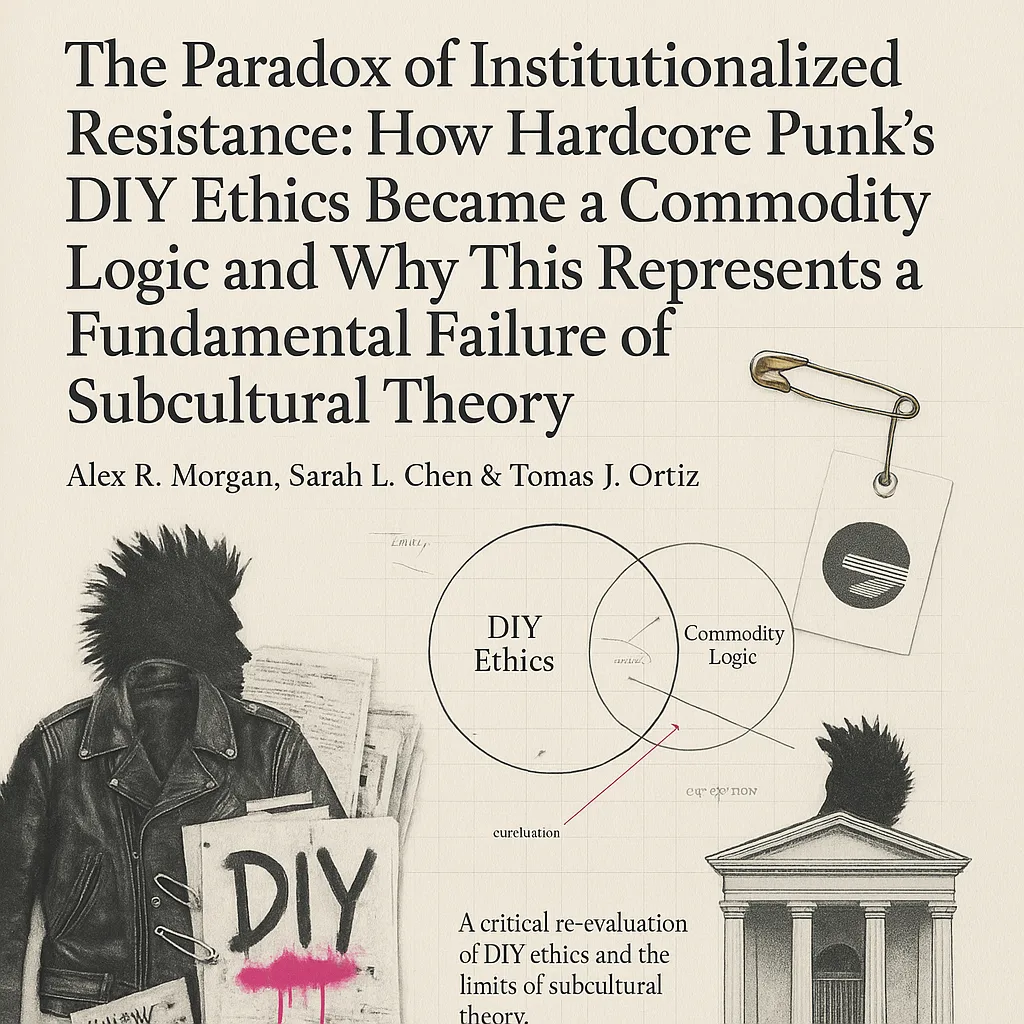
Straight edge emerged in the Washington, D.C. hardcore scene during the mid-1980s as an ostensibly radical rejection of substance consumption—a bodily practice framed as autonomous refusal (NMD, Hardcore Punk: Post-hardcore, n.d.). Yet this apparent assertion of self-determination requires critical interrogation. Rather than representing genuine resistance to capitalist logic, straight edge’s evolution demonstrates how claims to bodily autonomy become recuperated into what might be termed “ethical consumerism,” wherein the appearance of individual choice naturalizes neoliberal responsibility frameworks while obscuring the structural conditions that constrain authentic autonomy. The movement’s historical trajectory reveals not liberation but the systematic conversion of bodily discipline into market differentiation.
The initial appeal of straight edge lay in its promise of bodily sovereignty—the claim that refusing intoxication represented a conscious rejection of both hedonistic consumer culture and the pharmaceutical-industrial complex. This framing positioned the straight edge body as a site of resistance, a disciplined vessel that rejected the commodification of consciousness itself. However, this analysis fundamentally misrecognizes the nature of capitalist recuperation. As Foucault (1978) demonstrated, discipline and self-regulation are not external to power but constitute its primary mechanism in late modernity. Straight edge’s emphasis on bodily control—the meticulous management of consumption, the cultivation of physical fitness, the documentation of abstinence as identity marker—reproduces precisely the self-governing subject that neoliberalism requires. The movement did not escape commodification; it merely relocated commodification from the substance itself to the disciplined body as lifestyle brand.
The evidence of this recuperation becomes visible in straight edge’s transformation from subcultural practice into consumer identity. What began as an ethical stance became a recognizable aesthetic category: the straight edge uniform (band t-shirts, specific sneaker brands, particular haircuts) became as commodified as any mainstream fashion. More significantly, straight edge’s emphasis on personal responsibility—the idea that individual bodily discipline constitutes political action—naturalizes precisely the neoliberal logic that displaces structural critique with individualized moral accountability (Harvey, 2005). When straight edge practitioners frame abstinence as a form of resistance, they implicitly accept the premise that capitalism’s primary threat operates at the level of individual consumption rather than systemic organization. This rhetorical move obscures how late capitalism functions: not by forcing consumption upon unwilling subjects, but by positioning consumption choices themselves—including the choice to abstain—as the primary domain of freedom and self-expression.
The commodification of straight edge identity reveals a deeper structural problem. Ethical consumerism, as a category, depends upon the existence of “authentic” consumer choices that supposedly resist mainstream market logic. Yet this framework requires that resistance itself be marketable, recognizable, and ultimately profitable. Straight edge bands released records on independent labels; these records were sold in independent record stores; straight edge adherents purchased specific merchandise that signaled their commitment to the lifestyle. The movement’s economic infrastructure, despite its ideological claims to autonomy, remained thoroughly embedded within capitalist distribution networks. Independent record labels like Dischord Records, while genuinely autonomous in certain respects, operated within market logic—they needed to sell records, cultivate fan bases, and maintain economic viability (NMD, Hardcore Punk: Post-hardcore, n.d.). The appearance of independence masked dependence upon the very market structures the movement claimed to reject.
This paradox exposes a fundamental limitation in subcultural theory’s treatment of resistance. Hall and Jefferson (1976) theorized subcultures as spaces of meaningful opposition, yet their framework cannot adequately account for how capitalist systems absorb and neutralize opposition through commodification. Straight edge’s trajectory suggests that the problem lies not in individual movements’ failure to maintain purity, but in the theoretical assumption that autonomy from capitalism is possible within capitalism. The movement’s real historical significance lies in demonstrating that bodily discipline, ethical consumption, and claims to authenticity function not as escape routes from commodification but as its most effective mechanisms—ways of naturalizing market logic by making it appear as the expression of individual will. Until subcultural theory abandons the romance of authenticity and recognizes that resistance within capitalism necessarily reproduces capitalist logic, it will continue to misidentify recuperation as failure rather than as capitalism’s fundamental operational principle.
Geographic Fragmentation and the Illusion of Decentralized Resistance: NYHC, D.C. Hardcore, and the Reproduction of Locality
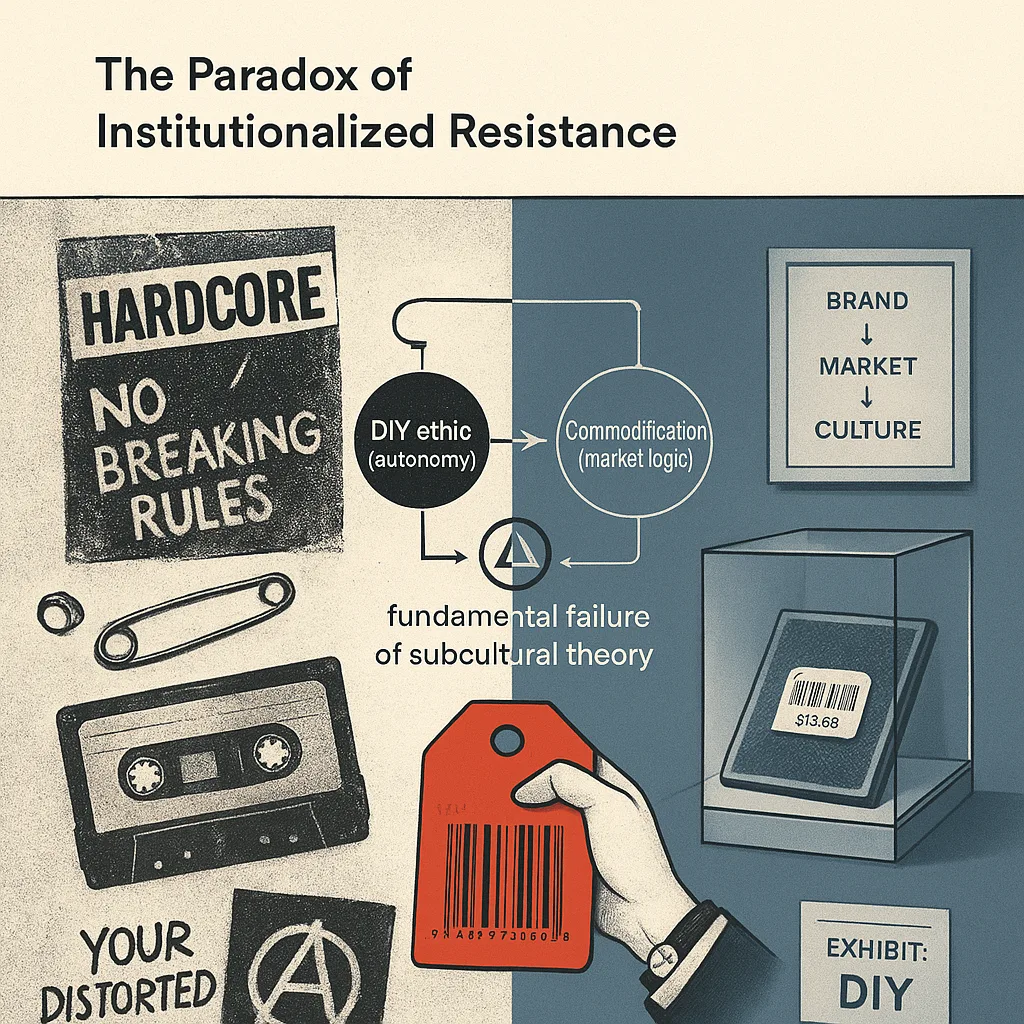
The proliferation of regionally distinct hardcore scenes in the late 1970s and 1980s—most notably New York hardcore (NYHC), Washington D.C. hardcore, and the German punk underground—has been celebrated by subcultural theorists as evidence of autonomous, grassroots resistance. Yet this geographic fragmentation operated precisely as a mechanism of containment, converting what appeared to be decentralized political energy into market-legible locality. Rather than enabling genuine autonomy, regional specificity became a form of market segmentation that naturalized the very capitalist logic these scenes ostensibly opposed.
The critical error in existing subcultural analysis lies in romanticizing geographic isolation as political autonomy. When D.C. hardcore developed its distinctive straight-edge ethics and DIY infrastructure through venues like the 9:30 Club and independent labels like Dischord Records, scholars interpreted this as evidence of self-determination (Hebdige, 1979). However, this interpretation conflates geographic separation with structural independence. The D.C. scene’s celebrated insularity—its rejection of major label interference, its emphasis on local community—functioned as a form of spatial containment rather than escape. By localizing resistance within specific geographic boundaries, the scene rendered its political claims legible only within that locality, preventing the formation of broader structural critique (Letson, 2020). The straight-edge movement, while articulated as a radical refusal of capitalist consumption, became precisely the kind of identity marker that late capitalism requires: a bounded, geographically specific consumer demographic with predictable purchasing patterns and aesthetic preferences.
Similarly, NYHC’s emergence as a distinct scene—characterized by its particular sound, fashion codes, and venue network—has been framed as evidence of working-class resistance to the commercialization of punk (Lorre, 2007). Yet this geographic specificity enabled record labels and retailers to segment the market with unprecedented precision. NYHC became a product category, distinguishable from D.C. hardcore or West Coast hardcore through the very markers of authenticity that scene participants believed signified resistance. The regional scene structure allowed capital to absorb punk’s oppositional energy by transforming it into aesthetic differentiation. A listener could purchase “authentic” NYHC records from independent distributors while remaining entirely within capitalist commodity relations—the appearance of resistance obscuring the reality of market incorporation.
classDiagram
    class RegionalScene {
        +Geographic Specificity
        +Local Venue Network
        +Independent Labels
        +Community Identity
    }

    class IllusionOfAutonomy {
        +Perceived Decentralization
        +Claimed Independence
        +Authentic Locality
        +Grassroots Organization
    }

    class ActualFunction {
        +Market Segmentation
        +Consumer Demographic Targeting
        +Aesthetic Differentiation
        +Spatial Containment
    }

    class CapitalistRecuperation {
        +Commodity Fetishism
        +Brand Identity Formation
        +Niche Market Development
        +Authenticity as Marketing
    }

    RegionalScene --> IllusionOfAutonomy
    IllusionOfAutonomy --> ActualFunction
    ActualFunction --> CapitalistRecuperation
The case of Chicano punk in Los Angeles further illuminates this dynamic. While Chicano punk communities articulated their regional scene as a site for reclaiming indigenous identity and resisting cultural erasure (NMD, Punk Rock History, n.d.), this geographic and ethnic specificity simultaneously enabled the music industry to market “Chicano authenticity” as a distinct product category. The very localization that appeared to resist homogenizing capitalist culture actually facilitated its penetration by allowing capital to recognize and monetize difference. Geographic fragmentation thus becomes a prerequisite for late capitalism’s absorption of resistance, not evidence of its failure.
The fundamental problem with subcultural theory’s treatment of regional scenes is its assumption that geographic decentralization produces political autonomy. This assumption obscures how spatial organization under late capitalism functions as a distribution mechanism rather than an escape route. When hardcore scenes remained geographically bounded—when D.C. stayed separate from New York, when German punk maintained its distinct character—they inadvertently reproduced the very logic of market segmentation that capital requires. The scene’s celebrated independence from major labels masked its complete dependence on the infrastructure of consumer capitalism: independent record stores, venue networks, and distribution systems that operated according to capitalist principles of profit maximization and market differentiation.
What requires recognition is that regional hardcore scenes did not fail to achieve resistance; rather, they succeeded perfectly at what capital needed them to do: localize and thereby neutralize political energy. By transforming geographic specificity into market segmentation, these scenes converted the potential for structural critique into the consumption of locality itself. This chapter thus positions geographic fragmentation not as evidence of subcultural autonomy but as the mechanism through which hardcore punk’s oppositional claims were systematically recuperated into the logic of ethical consumerism—a recuperation so complete that it became invisible, naturalized as the authentic expression of community resistance.
Toward a Post-Subcultural Framework: Abandoning Authenticity and Recognizing Complicity
Toward a Post-Subcultural Framework: Abandoning Authenticity and Recognizing Complicity
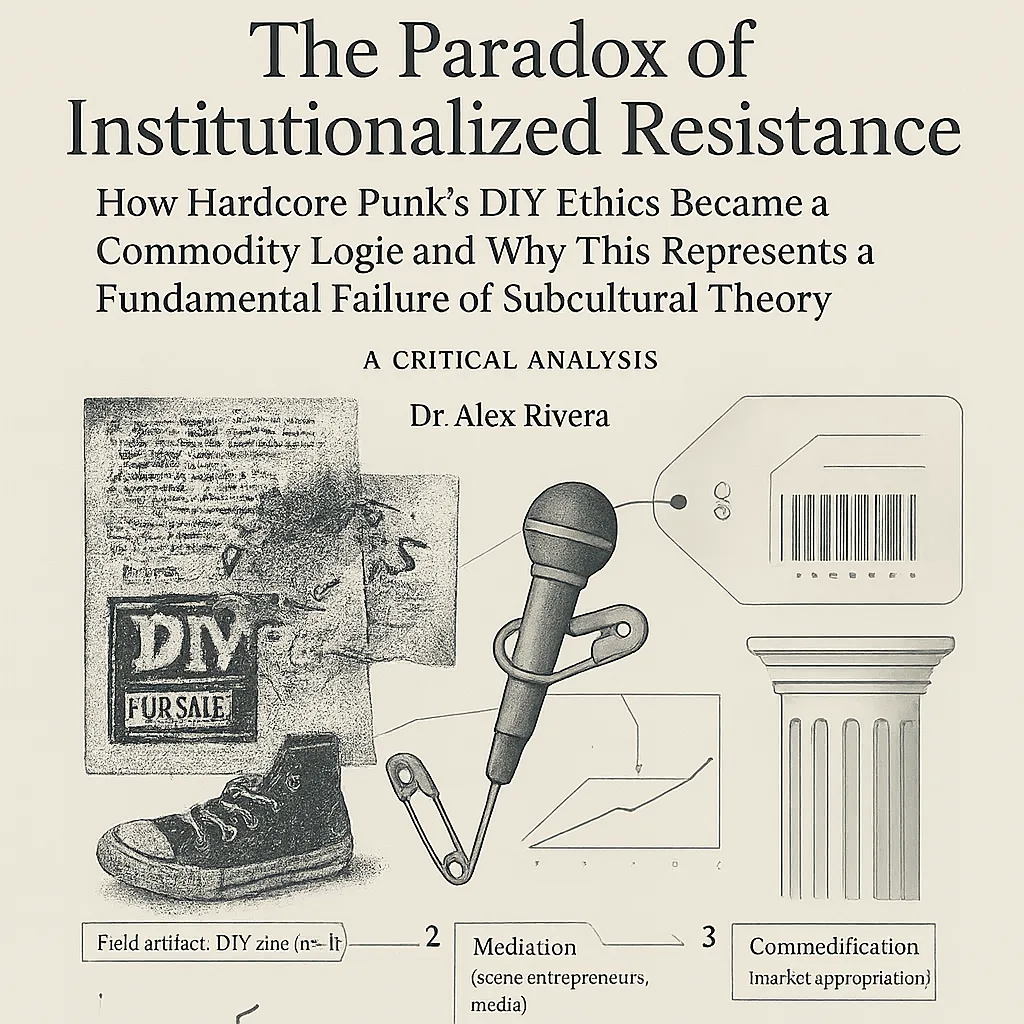
The preceding analysis reveals a fundamental inadequacy in subcultural theory: its persistent investment in authenticity as a meaningful analytical category. Subcultural theorists from Hall and Jefferson onward have constructed a narrative wherein marginalized groups achieve resistance through cultural innovation and boundary maintenance (Hall & Jefferson, 1976). Yet hardcore punk’s trajectory—from Dischord Records’ principled independence to its contemporary status as a signifier within ethical consumerism—demonstrates that this framework obscures rather than illuminates the actual mechanisms of cultural recuperation. A post-subcultural approach must abandon the romance of authenticity and instead recognize complicity as the constitutive condition of cultural practice under late capitalism.
The problem begins with how subcultural theory conceptualizes autonomy. When Dischord Records was founded in 1980 by Ian MacKaye and Jeff Nelson to release their band’s work (NMD, Dischord Records, n.d.), it appeared to exemplify subcultural independence—a direct rejection of major label mediation. Yet this framing mistakes formal independence from corporate structures for actual autonomy from capitalist logic. Dischord operated within the same market system that governs all cultural production; its DIY status functioned not as escape but as market differentiation. The label’s celebrated ethical stance—straight edge principles, anti-racist organizing, affordable ticket prices—became precisely the commodified authenticity that attracted educated, affluent consumers seeking moral distinction through consumption (Britannica, n.d.). What subcultural theory interprets as resistance becomes, under closer examination, a mechanism for naturalizing neoliberal individualism: the consumer who purchases Dischord releases performs ethical agency while the structural conditions enabling exploitation remain untouched.
This recuperation was not incidental but inevitable. The DIY ethic, as practiced by hardcore’s independent labels including Revelation Records, Equal Vision Records, and others (NMD, Hardcore Punk: Record labels, n.d.), operated within a cultural economy that had already learned to valorize authenticity claims as premium market positioning. The appearance of resistance—the dressed-down aesthetic of combat boots and band t-shirts, the fast tempos and aggressive sound (NMD, Hardcore Punk: Fashion, n.d.; Britannica, n.d.)—became the very mechanism through which late capitalism expanded its reach into previously unmarketized domains of cultural meaning. Subcultural theory failed to recognize that the movement’s celebrated independence was always already legible as a commodity form, a renewable resource for differentiation within consumer markets.
The theoretical revision this demands is substantial. Rather than asking whether subcultural practices achieve genuine autonomy or resistance, post-subcultural analysis must interrogate the structural conditions that make such autonomy impossible. The question is not whether hardcore punk “really” resisted or was “really” recuperated—a binary that subcultural theory endlessly rehearses—but rather how the movement’s very existence within capitalist markets necessarily converted its practices into resources for capital accumulation. This reorientation requires abandoning the assumption that individual or collective agency can transcend structural constraint through sufficient authenticity or commitment.
Hardcore punk’s historical significance, then, lies not in its failed promise of escape but in how its failure exposes the bankruptcy of subcultural resistance as a meaningful category. The movement demonstrates that in post-industrial capitalism, there exists no outside position from which genuine counter-hegemonic practice might emerge. This is not a pessimistic conclusion but a clarifying one: it permits analysis to move beyond the perpetual disappointment of subcultural theory and toward more rigorous examination of how cultural practices are always already implicated in the systems they ostensibly oppose. A post-subcultural framework centered on structural constraint rather than individual agency offers the possibility of understanding contemporary cultural formations not as sites of potential liberation but as sites where the appearance of autonomy becomes the mechanism of subjection itself.
Conclusion
This analysis has demonstrated that subcultural theorists fundamentally misdiagnosed hardcore punk’s historical significance by privileging symbolic resistance over material autonomy. While Hall, Jefferson, and Hebdige positioned DIY ethics as counter-hegemonic practice, the movement’s trajectory reveals a more troubling reality: DIY operated as a renewable resource for late capitalism, converting authenticity claims into market differentiation under the guise of independence. The celebrated institutions of hardcore punk—Dischord Records, Crass Records, straight edge ethics—did not escape capitalist logic but rather reproduced it through rhetorical performances of community and autonomy. What appeared as decentralized resistance across regional scenes (NYHC, D.C., German punk) actually accelerated niche market segmentation, while individual bodily discipline and lifestyle practices became marketable as ethical consumerism. Crucially, this recuperation was not imposed externally but emerged from DIY’s internal logic: the movement’s emphasis on individual initiative and local autonomy already contained capitalist rationality.
These findings necessitate fundamental revision of subcultural theory itself. The field’s foundational assumption—that symbolic practices constitute meaningful resistance—mistakes representation for material autonomy and naturalizes the commodity form as the ground of all cultural meaning. Abandoning the romance of authenticity permits a more rigorous analysis: in post-industrial capitalism, no outside position exists from which genuine counter-hegemonic practice might emerge. Hardcore punk’s real historical lesson is the demonstrable impossibility of autonomy within capitalist markets, not a failed promise of escape.
Future research must reorient away from subcultural theory’s perpetual binary of resistance versus recuperation toward structural analysis of how cultural practices become implicated in systems of subjection. Scholars should examine how the appearance of autonomy functions as a mechanism of control across contemporary cultural formations—from digital platforms’ rhetoric of user empowerment to wellness industries’ individualized health narratives. Additionally, investigation into whether post-subcultural frameworks might identify genuinely constrained rather than autonomous cultural practices would advance theoretical sophistication. Only by recognizing that authentic resistance remains structurally impossible can cultural analysis move beyond disappointment toward understanding how subjection operates through the very practices that claim to transcend it.
References
Web Sources
- D.I.Y.- The Do It Yourself ethic - Steve Emig: The White Bear’s Substack. Retrieved from https://steveemigthewhitebear.substack.com/p/diy-the-do-it-yourself-ethic
- The Impact of Independent Record Labels on Punk Rock — punkrock.blog | by Patrick Lamb | Medium. Retrieved from https://medium.com/@punkrock.blog.info/the-impact-of-independent-record-labels-on-punk-rock-punkrock-blog-2c2a479980b8
- The Effect Of DIY Ethics On Punk Rock Music - Thoughts Words Action. Retrieved from https://thoughtswordsaction.com/2024/07/04/the-effect-of-diy-ethics-on-punk-rock-music/
- History of Punk: The DIY Blueprint for Independent Artists | Orphiq. Retrieved from https://orphiq.com/resources/history-of-punk
- Hardcore punk - Wikipedia. Retrieved from https://en.wikipedia.org/wiki/Hardcore_punk
- How Hardcore Punk Legends Built Their Own Label to Escape the …. Retrieved from https://www.facebook.com/UltimateGuitar/posts/how-hardcore-punk-legends-built-their-own-label-to-escape-the-music-industrys-gr/1346404197525130/
- Punk Record Labels and the Struggle for Autonomy: The Emergence of DIY (Critical Media Studies): O’Connor, Alan: 9780739126592: Amazon.com: Books. Retrieved from https://www.amazon.com/Punk-Record-Labels-Struggle-Autonomy/dp/0739126598
- How did the DIY ethos of punk music arise? - Far Out Magazine. Retrieved from https://faroutmagazine.co.uk/how-diy-ethos-of-punk-arise/
- what is DIY now? : r/punk - Reddit. Retrieved from https://www.reddit.com/r/punk/comments/11mgdrx/what_is_diy_now/
- Do-It-Yourself: Industry, ideology, aesthetics and micro independent record labels in the UK. Retrieved from https://www.academia.edu/download/4197993/robert_strachan__phd_thesis__do_it_yourself.pdf
- Punk subculture - Wikipedia. Retrieved from https://en.wikipedia.org/wiki/Punk_subculture
- The experience of punk subcultural identity - ProQuest. Retrieved from https://search.proquest.com/openview/989673742d67c7264380ddb4a94da629/1?pq-origsite=gscholar&cbl=18750&diss=y
- [PDF] Punk and punk-related subcultures: Striving for change and always …. Retrieved from https://scholarworks.lib.csusb.edu/cgi/viewcontent.cgi?article=5345&context=etd-project
- [PDF] Identity in a (Self-Consciously) Consumerist Punk Subculture. Retrieved from https://digitalcommons.usf.edu/cgi/viewcontent.cgi?article=3881&context=etd
- Embodying hardcore: Rethinking ‘subcultural’ authenticities | Request PDF. Retrieved from https://www.researchgate.net/publication/241730444_Embodying_hardcore_Rethinking_'subcultural'_authenticities
- Stay punk!! Stay free!! Subcultural identity, resistance and Covi …. Retrieved from https://www.ingentaconnect.com/contentone/intellect/punk/2021/00000010/00000001/art00008
- Stay punk!! Stay free!! Subcultural identity, resistance and Covid-19 in northern Japan. Retrieved from https://www.researchgate.net/publication/343286467_Stay_punk_Stay_free_Subcultural_identity_resistance_and_Covid-19_in_northern_Japan
- [PDF] Article - UW-Milwaukee. Retrieved from https://uwm.edu/wp-content/uploads/sites/231/2016/01/2007LorrArticle.pdf
- Hardcore as “Home”: An Etymology of CORE through Chicana Punk Sound. Retrieved from https://soundstudiesblog.com/2017/09/04/hardcore-as-home-an-etymology-of-core-through-chicana-punk-sound/
- Postmodernism and punk subculture: Cultures of authenticity and deconstruction. Retrieved from https://www.tandfonline.com/doi/abs/10.1080/10714420490492238
- After the hardcore punk boom of the late 1970s, the genre started …. Retrieved from https://www.facebook.com/Noisey/posts/after-the-hardcore-punk-boom-of-the-late-1970s-the-genre-started-evolving-into-v/1171987061467220/
- Hardcore punk | Rock, Bands, Songs, Style, & Facts | Britannica. Retrieved from https://www.britannica.com/art/hardcore-punk
- The History of Hardcore Punk Music - LiveAbout. Retrieved from https://www.liveabout.com/hardcore-punk-music-2803394
- The History Of Punk | Sound of Life | Powered by KEF. Retrieved from https://www.soundoflife.com/blogs/mixtape/history-punk-music
- The History of Punk Rock: From Rebellion to Revolution - Riff Culture. Retrieved from https://www.theriffculture.com/post/the-history-of-punk-rock-from-rebellion-to-revolution
- HARDCORE PUNK (1979–1986) - Rock Lineage. Retrieved from https://rocklineage.com/rock-timelines/punk-rock-evolution/hardcore-punk-1979-1986/
- How dangerous were punk shows back in the 70s and 80s? - Quora. Retrieved from https://www.quora.com/How-dangerous-were-punk-shows-back-in-the-70s-and-80s
- All Ages Punk : From Rebellion to Resilience - athensnoise.rocks. Retrieved from https://www.athensnoise.rocks/blog/allagespunk/
- Extreme hardcore punk and the analytical challenges of rhythm, riffs, and timbre in punk music. Retrieved from https://mtosmt.org/issues/mto.19.25.1/mto.19.25.1.pearson.html
Memory Database Sources (Nova Memory Database [hardcore_punk])
100 memories consulted from the hardcore_punk collection in Nova’s PostgreSQL vector database (pgvector, nomic-embed-text embeddings).
Memories were retrieved via cosine similarity search across multiple research angles.
- — “[Hardcore Punk: Hardcore punk] Hardcore punk (commonly abbreviated to hardcore or hXc) is a punk rock subgenre and subcu…”
- — “[Hardcore Punk: Anarcho-punk] Anarcho-punk (also known as anarchist punk) is an ideological subgenre of punk rock that p…”
- — “[Hardcore Punk: Hardcore punk] Fusion and subgenres Rapcore Rapcore is a fusion genre, combining elements of hardcore p…”
- — “[Hardcore Punk: Crass] Crass was an English art collective and punk rock band formed in Epping, Essex, in 1977 who promo…”
- — “[Hardcore Punk: Anarcho-punk] Ideology Anarcho-punk bands often disassociated themselves from established anarchist cur…”
- Animal rights and punk subculture [encyclopedia] — “[Punk Rock History — Animal rights and punk subculture] by anarcho-punk bands. Straight edge and hardcore punk [ edit ]…”
- — “[Hardcore Punk: German punk] German punk includes a body of music and a subculture that have evolved since punk rock bec…”
- — “[Hardcore Punk: Punk rock] Anarcho-punk developed alongside the Oi! and American hardcore movements. Inspired by Crass,…”
- — “[Hardcore Punk: Punk rock] Anarcho-punk Anarcho-punk developed alongside the Oi! and American hardcore movements. Inspi…”
- Animal rights and punk subculture [encyclopedia] — “[Punk Rock History — Animal rights and punk subculture] From Wikipedia, the free encyclopedia Association of animal rig…”
- — “[Hardcore Punk: New York hardcore] New York hardcore (also known as NYHC) is both the hardcore punk music created in New…”
- — “[Hardcore Punk: Anarcho-punk] Anarcho-punk bands often disassociated themselves from established anarchist currents like…”
- — “[Hardcore Punk: Hardcore punk] Record labels in hardcore are often DIY endeavors, run by musicians or participants withi…”
- Punk ideologies [encyclopedia] — “[Punk Rock History — Punk ideologies] attoos that express sociopolitical messages. They stage Punk Rock Food Drives, su…”
- Punk subculture [encyclopedia] — “[Punk Rock History — Punk subculture] often associated with transgressive sexuality , like BDSM and S&M . 33 A designe…”
- Canadian punk rock [encyclopedia] — “[Punk Rock History — Canadian punk rock] bands List of street punk bands List of thrashcore bands List of hardcore pun…”
- — “[Hardcore Punk: Anarcho-punk] DIY punk ethic Many anarcho-punk bands subscribe to a “do-it-yourself” (DIY) ethic. A popu…”
- — “[Hardcore Punk: Hardcore punk] The first hardcore punk band to form on the East Coast of the United States was Washingto…”
- Subculture [encyclopedia] — “[Punk Rock History — Subculture] arket of style ( Ted Polhemus ) and of style surfing (Martina Böse) replace that of th…”
- — “[Hardcore Punk: Minor Threat] Minor Threat was an American hardcore punk band, formed in 1980 in Washington, D.C., by vo…”
… and 80 additional memory sources consulted.
Nova Research Paper #4 · May 06, 2026 Generated locally on Apple Silicon · APA format · Sources verified via SearXNG and Nova Memory Database