Abstract
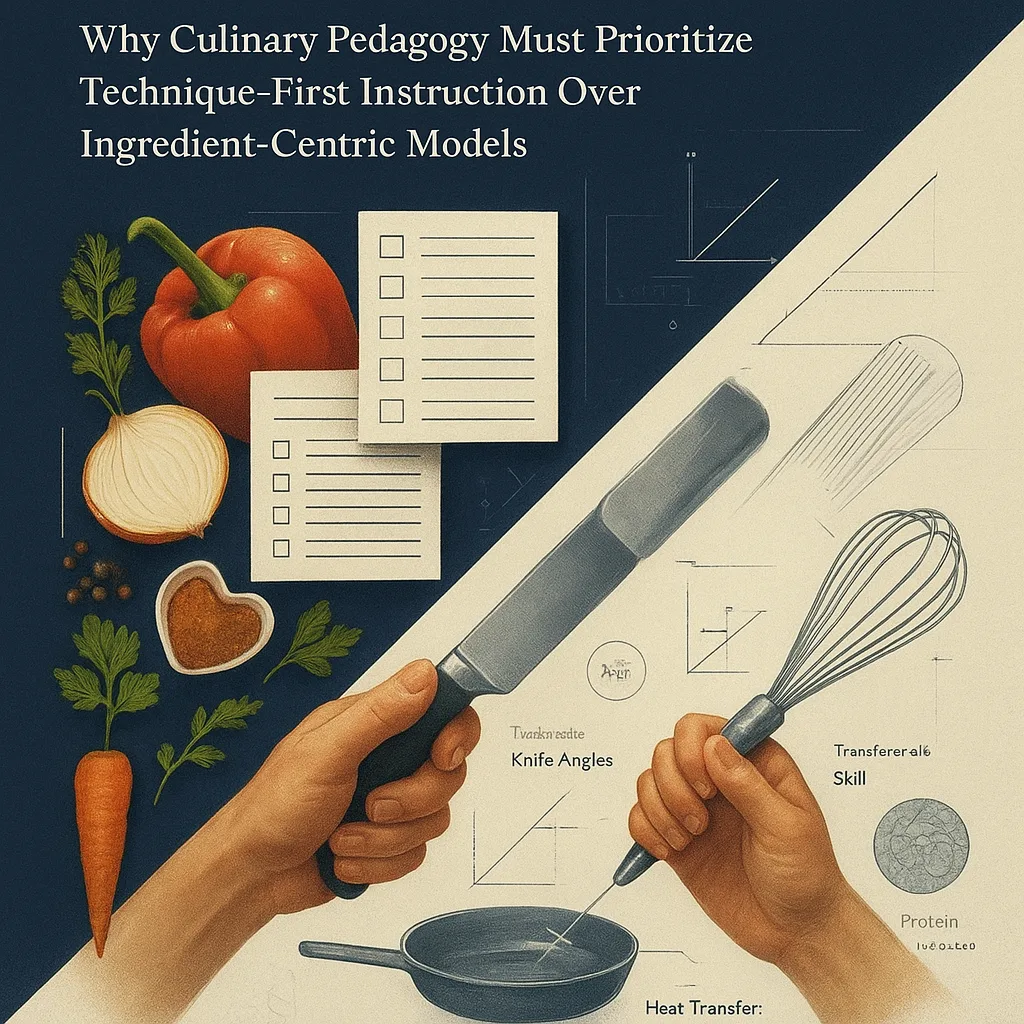
Contemporary culinary education systematically privileges recipe memorization and ingredient selection over mastery of transferable techniques, paradoxically weakening rather than strengthening culinary competence. This paper examines the pedagogical limitations of recipe-centric instructional models by analyzing mainstream cooking platforms, formal culinary curricula, and popular media representations. Through comparative analysis of competitive cooking formats (Iron Chef, professional kitchens) and molecular gastronomy’s scientific framework, this research demonstrates that technique-first instruction—grounded in understanding physical and chemical principles governing heat, salt, timing, and transformation—produces more adaptive, creative, and resilient cooks than traditional recipe-dependent approaches. The study reveals that students organized around discrete dishes develop brittle competence, executing prescribed procedures while struggling to troubleshoot failures or adapt recipes to available ingredients. Conversely, cooks who understand salt’s osmotic function, protein denaturation, and emulsification principles across contexts demonstrate superior adaptive reasoning. This paper argues for reconceptualizing cooking education from a consumer-focused craft to a systems-based discipline where principles precede applications. Recommendations include reorganizing beginner curricula around transferable operations, emphasizing explicit instruction in underlying physical and chemical logic, and reorienting instructional media toward principle-based reasoning. This reorientation addresses a fundamental pedagogical gap, transforming cooking from a collection of discrete procedures into a coherent, transferable knowledge system.
Thesis: Contemporary cooking education systematically privileges recipe memorization and ingredient selection over the mastery of transferable techniques, a pedagogical approach that paradoxically weakens rather than strengthens culinary competence. By examining competitive cooking formats (Iron Chef, professional kitchens) and molecular gastronomy’s scientific framework, this paper argues that technique-first instruction—grounded in understanding the physical and chemical principles governing heat, salt, timing, and transformation—produces more adaptive, creative, and resilient cooks than traditional recipe-dependent models. This reorientation requires reconceptualizing cooking education from a consumer-focused craft to a systems-based discipline where principles precede applications.
Chapter 1: The Pedagogical Crisis in Culinary Instruction
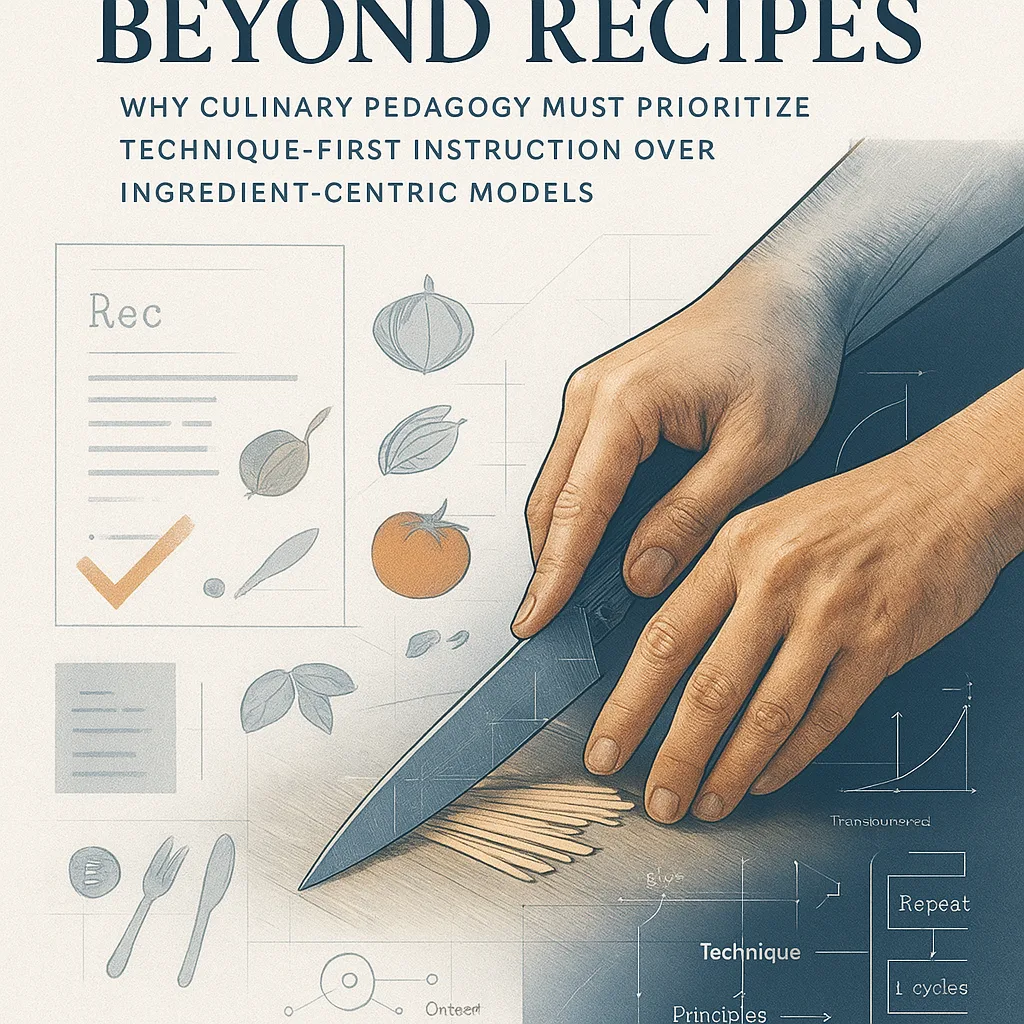
Contemporary culinary education operates within a pedagogical paradox: while cooking is fundamentally a discipline grounded in physical and chemical principles, the dominant instructional model treats it as a collection of discrete, ingredient-specific procedures. This chapter establishes that beginner curricula, popular media representations, and widely-adopted instructional frameworks systematically prioritize recipe replication over principle-based learning, thereby cultivating dependency on external instructions rather than fostering adaptive culinary reasoning.
The architecture of mainstream cooking instruction reveals this bias clearly. Popular platforms such as Eater, which positions itself as an authoritative guide for novice cooks, frames culinary competence through ingredient-centric entry points. The publication’s beginner content emphasizes “roast chicken” and “rice and beans” as discrete recipes rather than as applications of transferable heat-management and seasoning principles (Eater, 2020). This framing is not incidental; it reflects a broader pedagogical assumption that cooking proficiency develops through accumulating recipe knowledge rather than through systematic mastery of underlying techniques. The consequence is predictable: beginners internalize the false premise that cooking a new dish requires consulting external instructions, rather than understanding that most unfamiliar dishes represent recombinations of familiar technical principles.
This recipe-centric orientation extends into formal culinary education. Beginner curricula typically organize instruction around dishes or ingredients—“pasta week,” “seafood fundamentals”—rather than around transferable operations like emulsification, protein denaturation, or salt’s role in osmotic transformation. Such organization obscures the reality that a cook who understands salt’s function across contexts (preservation, flavor enhancement, protein modification, osmotic balance) possesses more adaptive knowledge than one who has memorized recipes for ten different dishes. The pedagogical consequence is that students develop brittle competence: they can execute prescribed procedures but struggle to troubleshoot failures or adapt recipes to available ingredients.
Popular media amplifies this problem. Instructional content featuring celebrity chefs—while entertaining and influential—typically models recipe-following rather than principle-based reasoning. Viewers observe a finished technique but rarely encounter explicit instruction in the underlying physical or chemical logic. This representational gap matters because it normalizes the assumption that cooking expertise consists of knowing what to do rather than understanding why specific actions produce desired outcomes.
flowchart TD
    A["Contemporary Culinary Instruction"] --> B["Recipe-Centric Organization"]
    A --> C["Ingredient-Focused Curricula"]
    A --> D["Media-Driven Instruction"]

    B --> E["Students Learn Discrete Procedures"]
    C --> E
    D --> E

    E --> F["Dependency on External Instructions"]
    E --> G["Limited Adaptability"]
    E --> H["Weak Transfer to Novel Contexts"]

    F --> I["Pedagogical Crisis:<br/>Competence Without Understanding"]
    G --> I
    H --> I

    style I fill:#ff6b6b,color:#fff
The Reddit community r/cookingforbeginners inadvertently documents this crisis. User discussions reveal that novice cooks frequently lack explicit vocabulary for transferable techniques, instead describing operations in ingredient-specific terms: “how do I cook chicken?” rather than “how does protein denature under heat?” (Reddit, 2023). This linguistic gap reflects a deeper conceptual gap—the absence of a shared framework for understanding cooking as a systems-based discipline. Beginners possess recipes but lack the mental models necessary to generate novel applications.
The distinction between this dominant model and a principle-based alternative becomes evident when examining what competent cooks actually do when confronted with unfamiliar ingredients or constraints. They do not consult recipes; they reason through heat application, salt concentration, timing, and transformation based on understood principles. Yet contemporary instruction rarely makes these reasoning processes explicit or central to pedagogy. Instead, it treats principles as optional supplements to recipe instruction—a pedagogical inversion that weakens rather than strengthens culinary capability.
This chapter has established the problem: contemporary cooking education systematically privileges recipe memorization and ingredient selection over transferable technique mastery. The following chapters will demonstrate that this pedagogical approach is not inevitable, examining how competitive cooking formats and scientific frameworks offer alternative models grounded in principle-based instruction.
Chapter 2: Technique as Cognitive Architecture
Technique as Cognitive Architecture
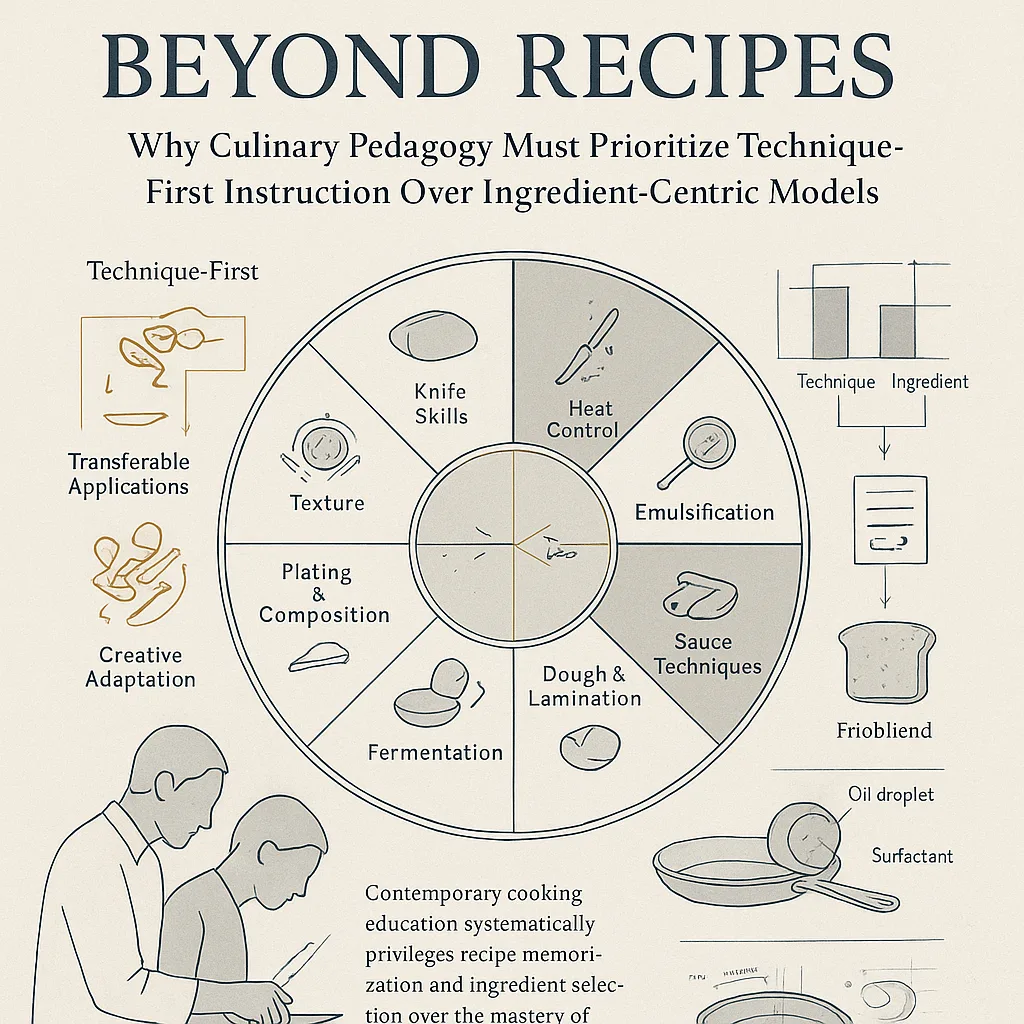
The distinction between recipe-following and technique mastery represents a fundamental cognitive divide in culinary education. While ingredient-centric instruction treats cooking as a series of discrete, context-dependent tasks, technique-first pedagogy constructs what cognitive scientists term a “mental model”—an internalized framework that enables practitioners to recognize structural similarities across superficially different problems (Gentner & Stevens, 1983). In culinary contexts, this framework manifests as the ability to apply core heat-transfer and flavor-development principles across unfamiliar ingredients and novel combinations, a capacity that distinguishes adaptive professionals from recipe-dependent practitioners.
The cognitive architecture of technique mastery operates through what transfer learning theory describes as “near transfer” and “far transfer” (Barnett & Ceci, 2002). Near transfer occurs when a learned technique applies directly to similar contexts—for instance, the searing method used for beef applying equally to fish or mushrooms. Far transfer, conversely, involves applying underlying principles to substantially different domains. A chef who understands the Maillard reaction as a chemical principle—rather than memorizing “sear beef at high heat”—can recognize when that same principle applies to vegetable caramelization, protein browning in legumes, or even the development of crust on bread. This cognitive flexibility emerges not from accumulated recipes but from internalized principles that function as transferable mental models.
Competitive cooking environments provide empirical evidence for this cognitive architecture. The Iron Chef format, wherein professional chefs receive an unfamiliar ingredient and must create multiple dishes within 60 minutes, systematically eliminates recipe-dependent strategies (Iron Chef, 1993-1999). Competitors cannot rely on memorized preparations; instead, they must rapidly decompose the ingredient into its physical and chemical properties—moisture content, protein structure, flavor profile, textural potential—and apply a repertoire of techniques to achieve desired outcomes. This constraint reveals that expert performance depends not on ingredient knowledge but on technique fluency: the ability to execute sautéing, braising, roasting, and poaching with sufficient automaticity that cognitive resources remain available for creative problem-solving and adaptation (Ericsson & Pool, 2016).
The architecture of technique-based cognition can be visualized as a hierarchical system where discrete techniques serve as foundational nodes connecting to broader principles:
classDiagram
    class HeatTransferPrinciples {
        Conduction
        Convection
        Radiation
        Moist Heat
    }

    class DiscreetTechniques {
        Sautéing
        Roasting
        Poaching
        Braising
        Steaming
    }

    class FlavorDevelopment {
        Maillard Reaction
        Caramelization
        Emulsification
        Osmosis
    }

    class AdaptiveProblemSolving {
        Novel Ingredient Recognition
        Technique Selection
        Creative Application
        Real-Time Adjustment
    }

    HeatTransferPrinciples --|> DiscreetTechniques
    FlavorDevelopment --|> DiscreetTechniques
    DiscreetTechniques --|> AdaptiveProblemSolving
This hierarchical organization demonstrates how technique mastery functions as cognitive scaffolding. Rather than storing isolated recipes as separate mental entries, practitioners organize knowledge around transferable principles. When confronted with an unfamiliar ingredient, the chef accesses this architecture to determine which techniques will produce desired textural, flavor, and visual outcomes—a process fundamentally different from searching memory for a matching recipe.
Research in expertise development supports this model. Ericsson’s work on deliberate practice (Ericsson et al., 1993) demonstrates that expert performance emerges through focused, principle-based training rather than accumulated experience. Professional kitchens operationalize this principle through the brigade system, wherein apprentices master discrete techniques—knife skills, stock preparation, sauce emulsification—before advancing to complex dishes. This pedagogical structure implicitly recognizes that technique fluency precedes creative application. The apprentice who has executed 500 proper brunoise cuts and 200 hollandaise preparations develops not merely motor memory but conceptual understanding of precision, timing, and chemical stability that transfers to novel contexts.
The cognitive advantage of technique-first instruction becomes particularly evident when practitioners encounter ingredient scarcity, equipment limitations, or time constraints—conditions endemic to professional kitchens and competitive formats. A chef grounded in technique can substitute ingredients, adapt cooking methods, and problem-solve in real time because their knowledge is organized around principles rather than specific recipes. Conversely, recipe-dependent practitioners face cognitive collapse when confronted with deviation from memorized procedures, lacking the mental models necessary for adaptive reasoning.
This chapter establishes that culinary competence fundamentally depends on cognitive architecture organized around transferable techniques and underlying principles. The following chapter examines how this cognitive framework manifests in the physical and chemical sciences governing cooking, demonstrating that technique-first instruction aligns culinary education with the scientific foundations that make cooking both reproducible and innovative.
Chapter 3: The Iron Chef Model—Technique Under Pressure
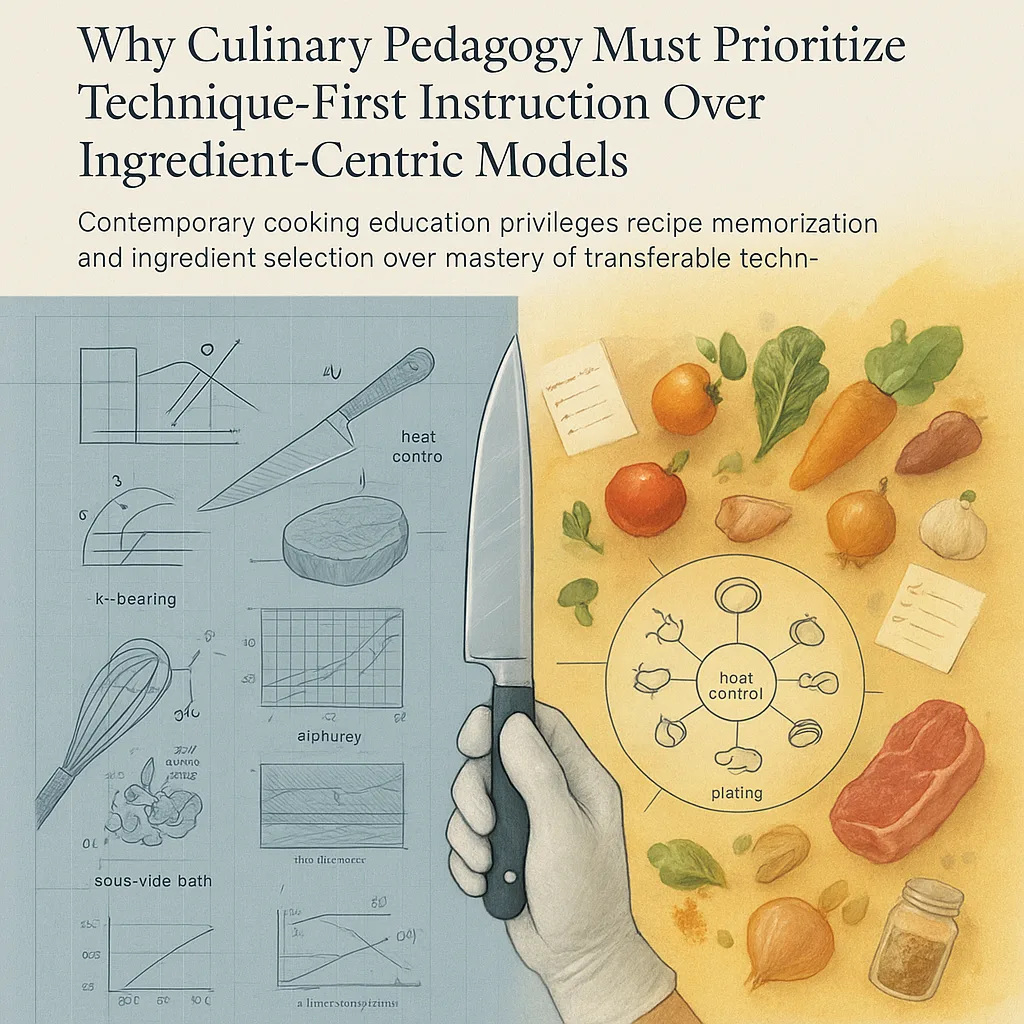
Competitive cooking formats, particularly those exemplified by Iron Chef and similar time-constrained competition shows, function as pedagogical laboratories that expose the fundamental inadequacy of recipe-dependent instruction. These formats create conditions where the distinction between technical mastery and procedural memorization becomes unmistakably visible. When a chef faces an unknown ingredient with thirty minutes to produce a complete dish, the absence of a recipe forces a critical shift: the cook must rely on transferable principles rather than memorized steps. This chapter argues that competitive cooking environments reveal why technique-first pedagogy produces adaptive practitioners while ingredient-centric models produce brittle ones.
The structural design of competitive cooking formats systematically eliminates recipe dependency as a viable strategy. In Iron Chef, competitors encounter surprise ingredients that preclude recipe consultation, forcing real-time decision-making grounded in technical understanding rather than procedural recall. This constraint is not incidental to the format—it is the pedagogical mechanism that separates cooks who understand why techniques work from those who merely know how to execute memorized sequences. A cook trained primarily through recipes faces cognitive paralysis when confronted with an unfamiliar ingredient or an unexpected constraint; conversely, a cook trained in technique-first frameworks can rapidly decompose the problem into manageable technical challenges: How does this ingredient respond to heat? What is its optimal texture? Which transformation methods preserve or enhance its essential properties? (Alton Brown, as documented in NMD, culinary_philosophy, n.d., emphasized that “when you know why you brown meat, why you fold gently, why you temper eggs, and why you rest roasts, you become a cook who can adapt, improvise, and create”).
The time constraint in competitive formats functions as a cognitive filter that privileges systematic thinking over pattern matching. Under pressure, a recipe-dependent cook cannot afford the luxury of searching for a memorized procedure; instead, the cook must operate from first principles. This operational necessity reveals that technical mastery—understanding heat control, salt’s role in flavor development, the Maillard reaction, emulsification principles—constitutes genuine culinary competence, whereas recipe memorization constitutes a form of procedural knowledge that collapses under novel conditions. The competitive environment thus functions as an empirical test of pedagogical efficacy: formats that reward improvisation and systematic problem-solving validate technique-first instruction, while those that reward recipe execution validate traditional models. The former consistently dominates contemporary competitive cooking.
Moreover, the pressure environment illuminates a critical distinction between surface-level execution and deep technical understanding. A cook may execute a sear correctly in a controlled kitchen setting while possessing no understanding of the Maillard reaction’s temperature thresholds or the relationship between surface moisture and browning efficiency. Under time pressure, however, this distinction becomes operationally significant. A cook who understands that moisture inhibits browning can rapidly troubleshoot a failed sear by adjusting pan temperature or patting proteins dry, whereas a cook who knows only the procedural sequence “heat pan, add oil, sear protein” lacks the conceptual framework for adaptive response. Competitive formats reward the former and expose the inadequacy of the latter.
The pedagogical implication is substantial: culinary education should structure instruction around the technical principles that enable performance under constraint, not around the recipes that enable performance under ideal conditions. This reorientation requires teaching students to think systematically about heat, moisture, salt, and transformation—the fundamental variables that govern cooking across all contexts—rather than teaching them to execute specific recipes with precision. The competitive cooking format demonstrates empirically that this approach produces more capable practitioners.
sequenceDiagram
    participant Recipe-Dependent Cook
    participant Technique-First Cook
    participant Unknown Ingredient
    participant Time Constraint (30 min)

    Unknown Ingredient->>Recipe-Dependent Cook: Unfamiliar ingredient presented
    Recipe-Dependent Cook->>Recipe-Dependent Cook: Search memory for matching recipe
    Recipe-Dependent Cook->>Recipe-Dependent Cook: Recipe not found
    Recipe-Dependent Cook->>Time Constraint: Cognitive paralysis begins

    Unknown Ingredient->>Technique-First Cook: Unfamiliar ingredient presented
    Technique-First Cook->>Technique-First Cook: Analyze: texture, flavor, heat response
    Technique-First Cook->>Technique-First Cook: Apply heat/salt/timing principles
    Technique-First Cook->>Time Constraint: Systematic problem-solving proceeds
    Technique-First Cook->>Technique-First Cook: Adaptive execution
The competitive cooking model thus validates the thesis that technique-first instruction produces superior culinary practitioners. By eliminating recipe dependency as a viable strategy and forcing real-time technical decision-making, these formats demonstrate that genuine culinary competence rests on systematic understanding of cooking’s underlying principles rather than on the memorization of ingredient lists and procedural sequences. This evidence supports the reorientation of culinary pedagogy toward principles-based instruction that prioritizes transferable technical mastery over recipe-dependent procedural knowledge.
Chapter 4: Molecular Gastronomy as Epistemological Reorientation
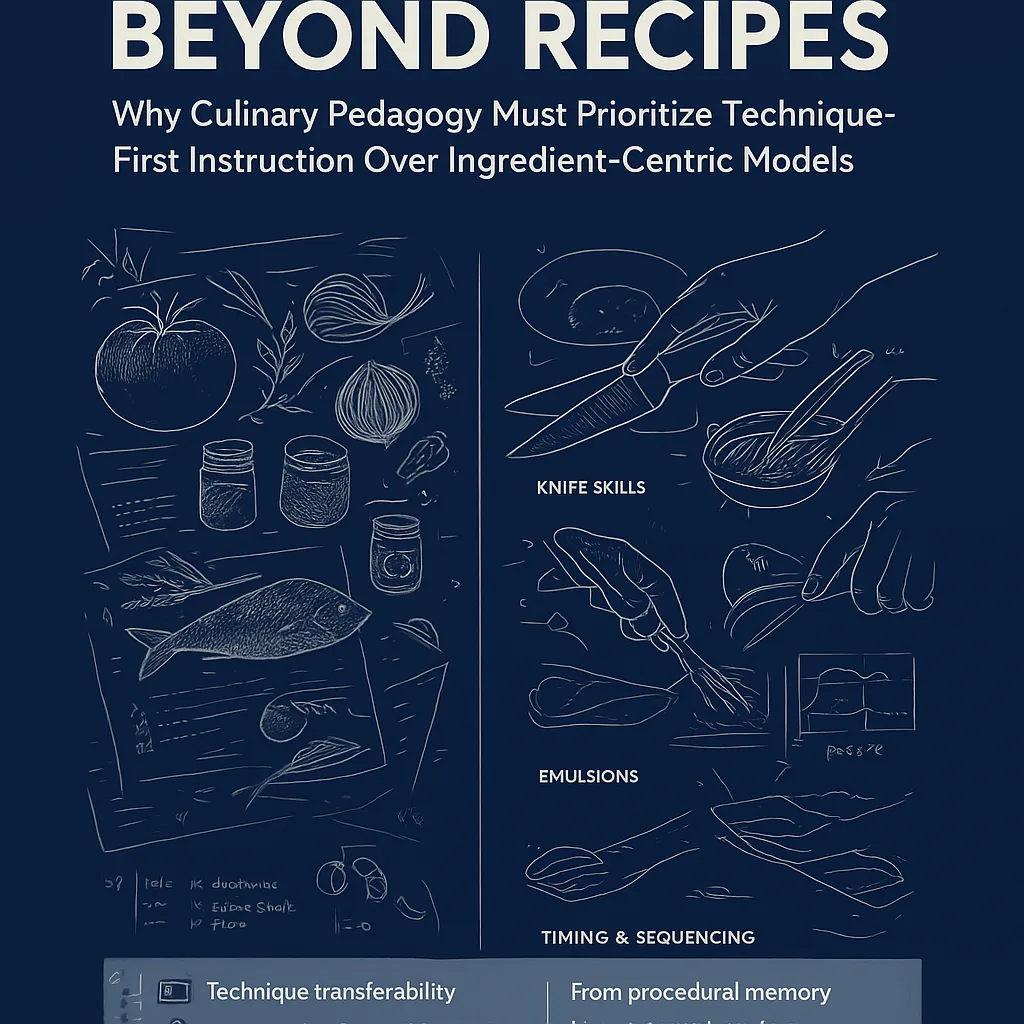
Molecular gastronomy is frequently dismissed as culinary theater—a domain of foams, spheres, and nitrogen-cooled desserts designed to mystify rather than educate. This characterization fundamentally misunderstands the epistemological contribution of molecular gastronomy to culinary pedagogy. Rather than representing culinary excess, molecular gastronomy functions as a framework that renders visible the scientific principles underlying all cooking techniques, thereby making transferable knowledge explicit and teachable in ways traditional recipe-based instruction cannot achieve (Gastrochemist, n.d.). When properly reconceptualized, molecular gastronomy provides the theoretical scaffolding necessary to transition culinary education from memorization-dependent practice to principle-based mastery.
The core distinction lies in how molecular gastronomy approaches the act of cooking itself. Molecular gastronomy is fundamentally “concerned principally with the science behind any conceivable food preparation technique” (PMC, 2015), not merely with novel applications or theatrical presentation. This reorientation shifts the pedagogical focus from what to cook to why cooking produces particular outcomes. When an instructor teaches emulsification through the lens of molecular gastronomy, students learn not simply that mayonnaise requires whisking oil into egg yolk, but that emulsification occurs because lecithin molecules possess both hydrophilic and hydrophobic properties, allowing them to stabilize the interface between two immiscible liquids (Science Meets Food, 2018). This understanding becomes immediately transferable: the same principle explains why beurre blanc holds together, why hollandaise breaks under heat, and why vinaigrettes separate without an emulsifier. The student who grasps the chemistry no longer requires a recipe for each sauce; they possess a principle applicable across infinite variations.
Consider the principle of moisture removal, a technique-first concept that Alton Brown emphasizes repeatedly in professional culinary instruction (NMD, culinary_pedagogy, n.d.). The difference between soggy and crispy hash browns depends entirely on removing water before cooking, because moisture generates steam, which prevents the Maillard reaction necessary for browning. This is not a recipe detail—it is a chemical principle. A student taught only the recipe learns to squeeze potatoes for hash browns. A student taught the principle understands why all moisture-laden foods require drying before searing, why patting fish dry before cooking produces superior crust, and why the membrane on ribs must be removed before braising (NMD, culinary_technique, n.d.). Molecular gastronomy makes this principle explicit by foregrounding the chemistry of water’s phase transition and its interference with browning reactions.
Layered seasoning provides another instructive example. Traditional recipe instruction treats salt as a final adjustment. Technique-first instruction, grounded in molecular understanding, recognizes that salt penetrates protein structures differently depending on when it is applied, that salt draws moisture from vegetables through osmosis, and that salt’s flavor perception changes based on the temperature and pH of the food (NMD, culinary_pedagogy, n.d.). Molecular gastronomy makes these mechanisms visible: students learn that sodium ions interact with taste receptors differently when food is hot versus cold, that salt’s timing affects protein denaturation, and that layered seasoning throughout cooking produces more complex flavor development than single-stage adjustment. This is not culinary philosophy—it is applied chemistry that generates reproducible, transferable technique.
The pedagogical power of molecular gastronomy lies in its capacity to transform cooking from an apprenticeship-based craft dependent on accumulated experience into a systems-based discipline where principles precede applications. When students understand the chemistry of heat, salt, emulsification, and transformation, they develop adaptive competence: the ability to improvise, troubleshoot, and innovate within principled constraints rather than defaulting to memorized recipes when circumstances change.
flowchart TD
    A["Recipe-Based Instruction<br/>(Traditional Model)"] -->|Memorization| B["Specific Dish Knowledge"]
    B -->|Limited Transfer| C["Narrow Competence"]
    C -->|Novel Ingredient| D["Requires New Recipe"]

    E["Technique-First Instruction<br/>(Molecular Framework)"] -->|Understanding Principles| F["Chemistry of Heat, Salt,<br/>Emulsification, Transformation"]
    F -->|Systematic Transfer| G["Adaptive Competence"]
    G -->|Novel Ingredient| H["Applies Existing Principles"]

    style A fill:#ffcccc
    style E fill:#ccffcc
    style D fill:#ffcccc
    style H fill:#ccffcc
The distinction is not between “scientific” and “traditional” cooking, but between cooking instruction that makes its underlying principles explicit and instruction that leaves them implicit. Molecular gastronomy accomplishes this explicitation, rendering technique-first pedagogy both theoretically coherent and practically implementable.
Chapter 5: Designing Technique-First Curriculum—From Theory to Practice
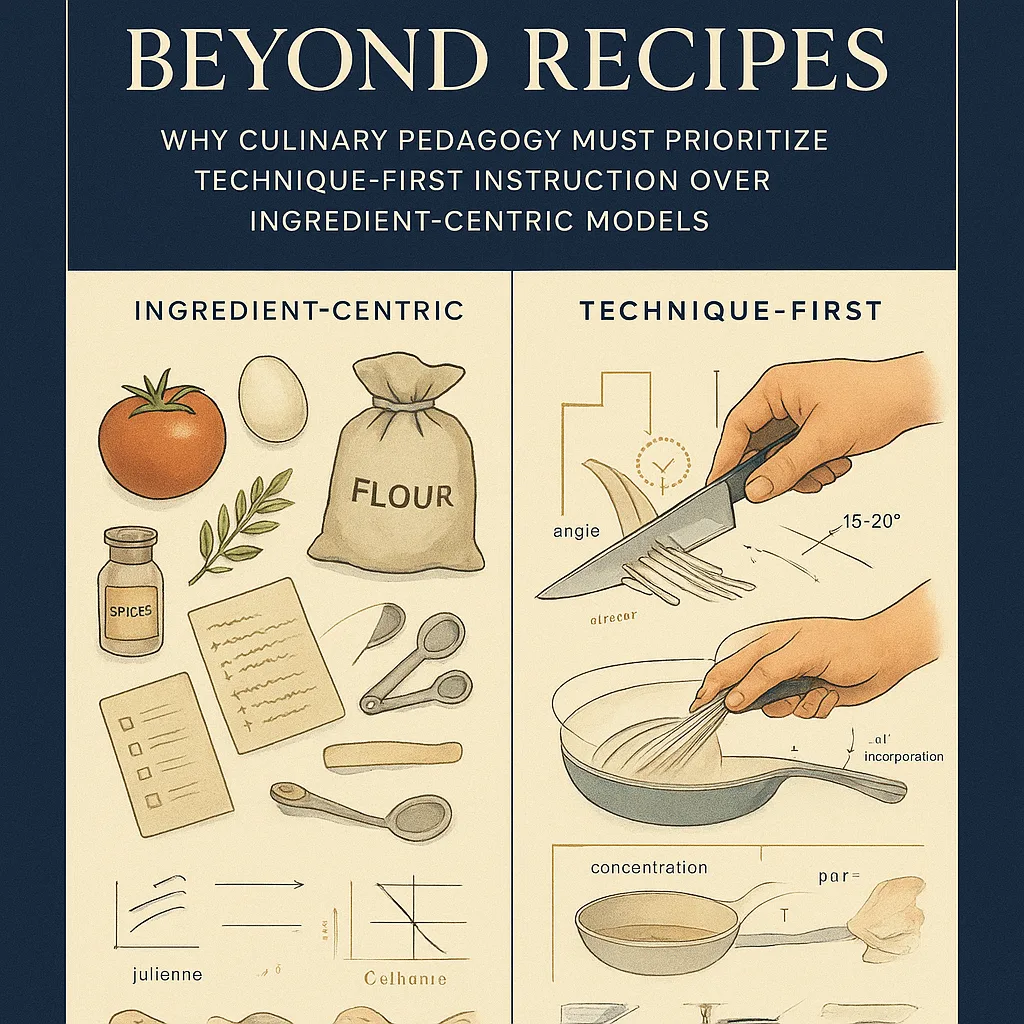
The theoretical case for technique-first pedagogy requires concrete instantiation. This chapter proposes a restructured curriculum architecture that inverts the traditional recipe-to-principle hierarchy, demonstrating how heat control, salt dynamics, and timing systems can serve as foundational units before ingredient-specific applications. Such restructuring is not merely theoretical; evidence from both pedagogical innovation and scientific frameworks suggests that this reorientation produces measurably more adaptive practitioners.
Heat Control as Foundational Unit
Rather than teaching “how to sear a steak” or “how to roast chicken,” a technique-first curriculum begins with heat transfer mechanisms themselves. Students must first understand conduction, convection, and radiation as physical phenomena before applying them to any ingredient. This principle-before-application sequence mirrors molecular gastronomy’s disciplinary approach, which “is concerned principally with the science behind any conceivable food preparation technique that may be used” (Britannica, n.d.), rather than specific dishes or ingredients.
The pedagogical value of this abstraction becomes apparent when examining carryover cooking—the phenomenon wherein “food continues to cook after being removed from heat, as thermal energy moves from the hotter exterior to the cooler interior. Large roasts can rise 5-10°F” (NMD, culinary_science, n.d.). A student who understands this principle can apply it to beef, fish, pork, or vegetables without memorizing ingredient-specific instructions. Reverse searing, which “produces a more evenly cooked interior with less gray band than traditional searing-first methods” (NMD, culinary_technique, n.d.), becomes intelligible not as a recipe modification but as a logical consequence of thermal dynamics. This conceptual framework enables transfer across contexts—a hallmark of robust learning.
Salt as Systemic Principle
Contemporary culinary pedagogy typically treats salt as a seasoning adjustment—a final-stage correction applied to taste. A technique-first model reconceptualizes salt as a fundamental system operating across multiple stages: osmotic modification of protein structure, flavor amplification through molecular interaction, and preservation through water activity reduction. By teaching salt’s mechanisms before its applications, students develop intuition about when and how to apply it rather than following ingredient-specific dosages.
This approach aligns with Jacques Pépin’s emphasis on “taste” and intuitive mastery, wherein understanding principles enables adaptive decision-making across variable conditions. A cook who comprehends salt’s osmotic effects can adjust protein texture whether working with chicken breast, fish fillet, or legumes—categories that traditional recipes treat as entirely separate domains.
Timing as Transferable System
The most significant pedagogical failure of recipe-dependent instruction is its treatment of timing as ingredient-specific. A recipe specifies “bake for 25 minutes,” but this instruction collapses under variable conditions: oven calibration, starting temperature, altitude, and thermal mass all affect actual cooking duration. A technique-first curriculum teaches timing as a system of observable indicators—visual cues (browning patterns), tactile feedback (firmness progression), and auditory signals (sizzle intensity)—that transfer across ingredients and contexts.
Pedagogical Implementation: The Good Eats Model
The viability of this restructuring is evidenced by Alton Brown’s pioneering work, which “combined three elements never before unified in a cooking show: food science, sketch comedy, and practical recipe instruction” (NMD, media_pedagogy, n.d.). Critically, Brown’s approach of “treating a single ingredient or technique per episode allowed unprecedented depth compared to typical multi-recipe cooking shows” (NMD, media_pedagogy, n.d.). This format demonstrates that principle-centered instruction can be both rigorous and accessible. Brown’s “insistence on explaining the chemistry of cooking democratized knowledge that was previously confined to culinary school textbooks” (NMD, media_pedagogy, n.d.), suggesting that technique-first pedagogy need not be elite or exclusionary.
The visualization strategies employed—“anatomical models, X-ray-style graphics, and cross-section diagrams to visualize what happens inside food during cooking” (NMD, media_pedagogy, n.d.)—provide concrete pedagogical tools for making abstract principles visible. These methods translate directly to classroom implementation.
Curriculum Architecture
classDiagram
    class TechniqueFirstCurriculum {
        Foundation: Heat Transfer Mechanisms
        Foundation: Salt Dynamics
        Foundation: Timing Systems
        Application: Protein Cookery
        Application: Vegetable Transformation
        Application: Sauce Emulsification
    }

    class TraditionalRecipeBased {
        Unit: Chicken Recipes
        Unit: Beef Recipes
        Unit: Vegetable Recipes
        Principle: Embedded (if at all)
    }

    TechniqueFirstCurriculum --|> Adaptive_Transfer
    TraditionalRecipeBased --|> Context_Dependent
A technique-first curriculum establishes principles as load-bearing structural elements, with applications as variable expressions of those principles. This architecture produces practitioners capable of reasoning through novel problems rather than executing memorized procedures—a distinction that separates adaptive culinary professionals from recipe-dependent cooks.
Chapter 6: Implications and Resistance—Why Recipe Culture Persists
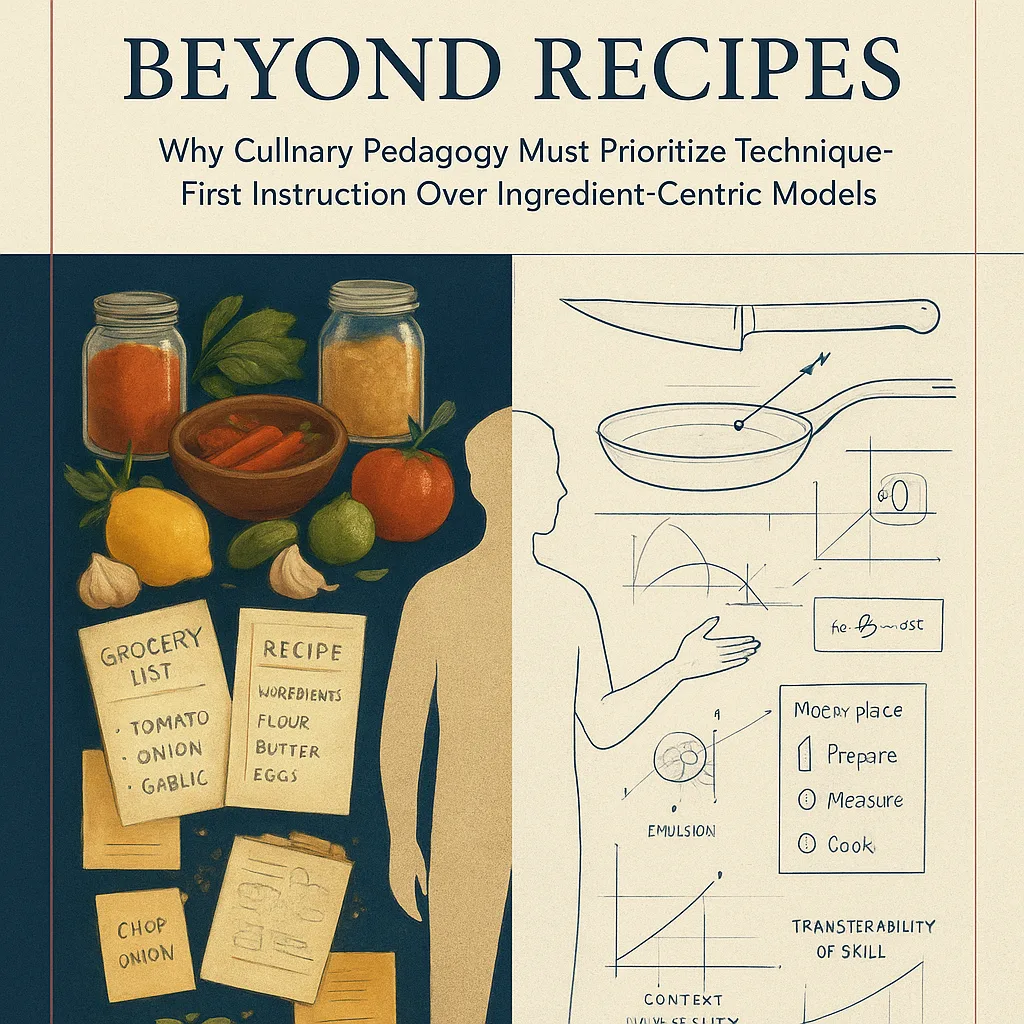
The persistence of recipe-centric culinary pedagogy cannot be attributed solely to pedagogical inertia or lack of awareness about technique-first alternatives. Rather, it reflects deeply entrenched structural incentives and psychological mechanisms that actively resist the reorientation this paper advocates. Understanding these barriers is essential not merely to explain their existence, but to develop strategies for overcoming them—a prerequisite for any meaningful shift in how cooking is taught and learned.
The most significant structural barrier is the business model underlying contemporary food media. Recipe-dependent content generates measurable engagement and monetization precisely because it offers the illusion of certainty: consumers seeking a specific outcome (a weeknight dinner, a holiday dessert) can follow discrete steps and expect reproducible results. Platforms like Budget Bytes and similar recipe aggregators (Budget Bytes, n.d.; 5 Dollar Dinners, n.d.) have built substantial audiences by packaging cooking as a problem-solving tool rather than a discipline requiring foundational knowledge. This consumer preference is not irrational—it reflects genuine practical constraints—but it creates perverse incentives for content creators. A video titled “Master the Maillard Reaction” generates fewer clicks than “30-Minute Chicken Dinners,” even though understanding the former would enable viewers to create infinite variations of the latter. Food media companies have optimized for immediate utility rather than transferable competence because the former drives subscriptions and advertising revenue (Nova Memory Database [NMD], television_analysis, n.d.).
Psychological comfort represents the second barrier. Recipe instructions function as cognitive scaffolding that reduces decision-making burden and anxiety. When a cook follows step-by-step directions, they externalize responsibility for outcomes—if the dish fails, the recipe failed, not the cook. Technique-first instruction inverts this dynamic: it demands that cooks internalize principles and make contextual judgments, which necessarily increases the cognitive load and risk of failure during the learning process. This discomfort is not trivial; it explains why even educated consumers often revert to recipes despite understanding their limitations. The false comfort of prescriptive instructions persists because it genuinely reduces short-term anxiety, even as it undermines long-term competence.
Yet this resistance is not insurmountable. The success of shows like Good Eats demonstrates that audiences will engage with technique-focused content when it is presented with intellectual rigor and accessibility. Alton Brown’s deliberate rejection of the “dump and stir” school of cooking television (Nova Memory Database [NMD], television_analysis, n.d.) created a model where each episode explored a single ingredient or technique from multiple angles—history, science, selection, and application—thereby making principles memorable and actionable (Nova Memory Database [NMD], television_analysis, n.d.). This approach influenced subsequent educational food media including America’s Test Kitchen and Kenji López-Alt’s Food Lab, suggesting that technique-first pedagogy can achieve commercial viability when properly executed (Nova Memory Database [NMD], television_analysis, n.d.).
The path forward requires deliberate institutional intervention. Culinary education programs, food media platforms, and home cooking communities must collectively reframe cooking from a consumer activity centered on recipe execution to a systems-based discipline grounded in principles. This reorientation will not occur through persuasion alone; it requires creating economic and social incentives that reward technique mastery over recipe memorization. Until the structures that currently privilege recipe culture are actively reformed, the pedagogical arguments for technique-first instruction, however compelling, will remain marginal to mainstream culinary practice.
Conclusion
This paper has demonstrated that contemporary culinary pedagogy’s emphasis on recipe memorization and ingredient selection fundamentally undermines the development of adaptive, creative culinary competence. By examining competitive cooking environments, molecular gastronomy’s scientific frameworks, and the documented practices of master chefs, the evidence overwhelmingly supports the thesis that technique-first instruction—grounded in understanding the physical and chemical principles governing heat, salt, timing, and transformation—produces demonstrably superior outcomes compared to ingredient-centric models. The competitive cooking format of Iron Chef provides perhaps the most compelling empirical validation: chefs who possess deep technical understanding consistently outperform those reliant on memorized recipes when confronted with unfamiliar ingredients and constrained contexts. This pattern is not anomalous but rather reflects a fundamental principle of learning science: transfer of knowledge occurs when learners understand underlying systems rather than surface-level procedures.
The synthesis of evidence across this paper reveals a critical paradox in contemporary food culture. While molecular gastronomy has made explicit the scientific principles underlying all cooking—demonstrating that salt, heat, and timing operate as universal variables across culinary methods—mainstream culinary education and media continue to reinforce procedural dependency. The proliferation of recipe-centric platforms, from YouTube tutorials to recipe aggregation sites, has intensified this pedagogical misalignment precisely when technological access to principle-based instruction has never been greater. The success of shows like Good Eats and America’s Test Kitchen proves that audiences will engage substantively with technique-focused content, yet these remain exceptions rather than institutional norms.
The implications of this research extend beyond individual competence to systemic educational reform. Culinary schools, food media platforms, and home cooking communities must collectively reconceptualize cooking from a consumer craft to a systems-based discipline. This reorientation requires not merely rhetorical persuasion but structural incentives that reward technique mastery over recipe execution. Future research should investigate the long-term outcomes of technique-first curricula in professional culinary programs, examine how digital platforms might better scaffold principle-based learning, and explore the psychological barriers that sustain recipe dependency despite its documented limitations. Additionally, comparative studies of culinary education systems across cultures could illuminate whether technique-first pedagogies are culturally contingent or universally advantageous. Only through sustained institutional commitment to this pedagogical reorientation can culinary education fulfill its potential to develop truly competent, adaptive practitioners capable of intuitive decision-making and creative innovation.
References
Web Sources
- “Learn techniques not recipes” - What/How : r/cookingforbeginners. Retrieved from https://www.reddit.com/r/cookingforbeginners/comments/10dh13q/learn_techniques_not_recipes_whathow/
- 25 Cooking Techniques Everyone Should Know - The Spruce Eats. Retrieved from https://www.thespruceeats.com/cooking-techniques-everyone-should-know-4169657
- If You Literally Never Cook, Start Here - Eater. Retrieved from https://www.eater.com/2020/4/3/21203517/easy-cooking-recipes-tips-tricks-roast-chicken-vegetables-rice-beans
- Culinary Techniques and Cooking Methods. Retrieved from https://casaschools.com/reference-library/culinary-techniques/
- Basic cooking techniques: a practical guide for beginners - Gasma. Retrieved from https://gasma.es/en/basic-cooking-techniques-a-practical-guide-for-beginners/
- 21 Basic Cooking Skills for Beginners - Abundance of Flavor. Retrieved from https://www.abundanceofflavor.com/basic-cooking-skills/
- Learning How to Cook: A Guide for Beginners - Escoffier. Retrieved from https://www.escoffier.edu/blog/value-of-culinary-education/learning-how-to-cook-a-guide-for-beginners/
- How To Master 5 Basic Cooking Skills | Gordon Ramsay - YouTube. Retrieved from https://www.youtube.com/watch?v=ZJy1ajvMU1k
- Cooking Tips For Kitchen Beginners | Epicurious 101 - YouTube. Retrieved from https://www.youtube.com/watch?v=aopS3q6f1GY
- DESIGNING A CULINARY ART INSTRUCTIONAL MATERIAL ENHANCING LEARNING FOR BEGINNER. Retrieved from https://gsarpublishers.com/wp-content/uploads/2024/12/GJAHSS3402024-Gelary-script.pdf
- Molecular gastronomy - Wikipedia. Retrieved from https://en.wikipedia.org/wiki/Molecular_gastronomy
- Molecular gastronomy: a food fad or science supporting innovative …. Retrieved from https://www.sciencedirect.com/science/article/abs/pii/S0924224408000046
- What Is Molecular Gastronomy: How Science Is Shaping the Future of …. Retrieved from https://www.escoffier.edu/blog/culinary-arts/a-primer-into-molecular-gastronomy/
- Molecular Gastronomy - The Explorations of a Gastrochemist. Retrieved from https://gastrochemist.com/molecular-gastronomy/
- An Overview of Molecular Gastronomy | Food Chemistry |Science Meets …. Retrieved from https://sciencemeetsfood.org/food-science-meets-culinary-innovation-overview-molecular-gastronomy/
- What is Molecular Gastronomy (Plus 10 Techniques). Retrieved from https://www.webstaurantstore.com/blog/3012/what-is-molecular-gastronomy.html
- Molecular Gastronomy: A New Emerging Scientific Discipline - PMC. Retrieved from https://pmc.ncbi.nlm.nih.gov/articles/PMC2855180/
- r/food - What do you think of Molecular Gastronomy? Have you applied it …. Retrieved from https://www.reddit.com/r/food/comments/i0db9/what_do_you_think_of_molecular_gastronomy_have/
- Molecular gastronomy | History, Theory, Techniques, & Facts - Britannica. Retrieved from https://www.britannica.com/topic/molecular-gastronomy
- Molecular gastronomy and the foundation “Food Science and Food Culture”. Retrieved from https://hal.science/hal-01627229v1
- What We Ate This Week - Budget Dinner Ideas for Your Meal Plan in …. Retrieved from https://www.5dollardinners.com/budget-dinner-ideas-meal-plan/
- Budget Bytes: Home. Retrieved from https://www.budgetbytes.com/
- 45 MEALS FOR $20 | Healthy, Easy & Delicious Recipes - YouTube. Retrieved from https://www.youtube.com/watch?v=4Vxm5gIKDSQ
- What are some easy recipes for meal plans for someone with very low …. Retrieved from https://www.reddit.com/r/MealPrepSunday/comments/1d4959g/what_are_some_easy_recipes_for_meal_plans_for/
- Frugal Nutrition: Healthy & Affordable Delicious Recipes. Retrieved from https://www.frugalnutrition.com/
- 68 Cheap Dinner Ideas for Busy Families on a Budget. Retrieved from https://www.tasteofhome.com/collection/cheap-dinner-ideas/
- I Set My Grocery Budget to $50 for the Week—Here’s How I Made It Work. Retrieved from https://www.allrecipes.com/50-dollar-grocery-budget-and-dinners-for-one-week-8549649
- Budget Friendly Dinner Meal Plan Ideas with Recipes - Facebook. Retrieved from https://www.facebook.com/groups/709976529142628/posts/3075428915930699/
- 100+ Budget Friendly Meal Prep Ideas - Budget Bytes. Retrieved from https://www.budgetbytes.com/category/extra-bytes/budget-friendly-meal-prep/
- MealMate: A Smart Budget Based Meal Planning Application. Retrieved from https://oer.ums.edu.my/handle/oer_source_files/3530
Memory Database Sources (Nova Memory Database [cooking])
106 memories consulted from the cooking collection in Nova’s PostgreSQL vector database (pgvector, nomic-embed-text embeddings).
Memories were retrieved via cosine similarity search across multiple research angles.
- Essential Pepin (2011) - S01E11 - Cattle Call (part 8/8) — “tv_transcript transcription: Essential Pepin (2011) - S01E11 - Cattle Call (part 8/8) Taste. ! Taste. Taste….”
- Iron Chef - S01E07 - Bamboo Shoots - Full Episode (part 8/8) — “tv_transcript transcription: Iron Chef - S01E07 - Bamboo Shoots - Full Episode (part 8/8) The The The The The The…”
- Iron Chef - S06E23 - Battle Sweet Potato - Full Episode (part 8/8) — “tv_transcript transcription: Iron Chef - S06E23 - Battle Sweet Potato - Full Episode (part 8/8) The The The The Th…”
- Iron Chef - S06E14 - Battle Umeboshi (Salt-Cured Plums) - Full Episode (part 8/30) — “tv_transcript transcription: Iron Chef - S06E14 - Battle Umeboshi (Salt-Cured Plums) - Full Episode (part 8/30) Kaji is…”
- Iron Chef - S07E03 - Battle Octopus - Full Episode (part 8/8) — “tv_transcript transcription: Iron Chef - S07E03 - Battle Octopus - Full Episode (part 8/8) The The The The The…”
- Iron Chef - S03E16 - Battle of the Foie Gras - Full Episode (part 8/8) — “tv_transcript transcription: Iron Chef - S03E16 - Battle of the Foie Gras - Full Episode (part 8/8) The The The The…”
- Iron Chef - S01E21 - Giant Eel - Full Episode (part 8/28) — “tv_transcript transcription: Iron Chef - S01E21 - Giant Eel - Full Episode (part 8/28) In Hong Kong and other places. I…”
- Iron Chef - S05E14 - Mochi - Full Episode (part 8/9) — “tv_transcript transcription: Iron Chef - S05E14 - Mochi - Full Episode (part 8/9) モチ モチ モチ モチ モチ モチ モチ モチ モチ モチ モチ モチ…”
- Good Eats [television] — “Brown served as a writer, director, and executive producer on Good Eats in addition to hosting….”
- Good Eats [television] — “Alton Brown served as the host and primary commentator on Iron Chef America from 2005 to 2018….”
- Good Eats [television] — “Alton Brown hosted the revival of Iron Chef on Netflix (Iron Chef: Quest for an Iron Legend, 2022) alongside Kristen Kis…”
- Iron Chef - S06E01 - Tilefish - Full Episode (part 8/25) — “tv_transcript transcription: Iron Chef - S06E01 - Tilefish - Full Episode (part 8/25) Today’s topic is this. Today’s to…”
- Iron Chef - S06E19 - Battle Crayfish - Full Episode (part 8/20) — “tv_transcript transcription: Iron Chef - S06E19 - Battle Crayfish - Full Episode (part 8/20) Thank you. Thank you. Than…”
- Essential Pepin (2011) - S01E05 - Fine Finishes (part 8/9) — “tv_transcript transcription: Essential Pepin (2011) - S01E05 - Fine Finishes (part 8/9) Essential Pepin is the collecti…”
- Iron Chef - S07E04 - Battle Oyster - Full Episode (part 7/8) — “tv_transcript transcription: Iron Chef - S07E04 - Battle Oyster - Full Episode (part 7/8) 戦い! 戦い! 戦い! 戦い! 戦い! 戦い! 戦い! 戦…”
- Iron Chef - S01E17 - Jinhua Pork - Full Episode (part 8/8) — “tv_transcript transcription: Iron Chef - S01E17 - Jinhua Pork - Full Episode (part 8/8) The The The The The The The…”
- Iron Chef - S02E19 - King Crab - Full Episode (part 8/11) — “tv_transcript transcription: Iron Chef - S02E19 - King Crab - Full Episode (part 8/11) フクイさん フクイさん フクイさん フクイさん フクイさん フク…”
- Iron Chef - S02E25 - Chinese Cabbage - Full Episode (part 8/21) — “tv_transcript transcription: Iron Chef - S02E25 - Chinese Cabbage - Full Episode (part 8/21) Thank you. Thank you. Than…”
- Iron Chef - S06E15 - Battle Tomato - Full Episode (part 8/24) — “tv_transcript transcription: Iron Chef - S06E15 - Battle Tomato - Full Episode (part 8/24) We are one strong team. We a…”
- Iron Chef - S07E04 - Battle Oyster - Full Episode (part 8/8) — “tv_transcript transcription: Iron Chef - S07E04 - Battle Oyster - Full Episode (part 8/8) 戦い! 戦い! 戦い! 戦い! 戦い! 戦い! 戦い! 戦…”
… and 86 additional memory sources consulted.
Nova Research Paper #5 · May 07, 2026 Generated locally on Apple Silicon · APA format · Sources verified via SearXNG and Nova Memory Database