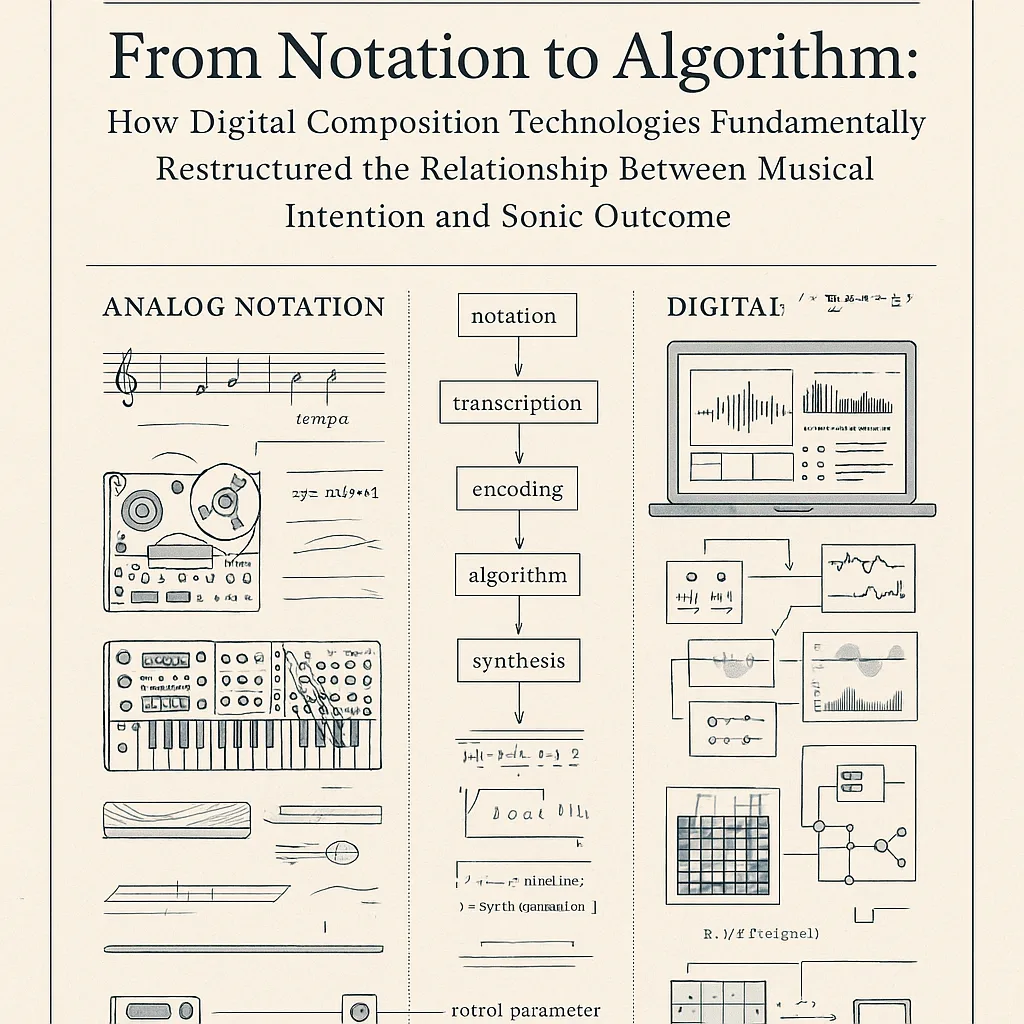
Abstract
The transition from analog to digital composition technologies in electronic music during the 1990s-2000s fundamentally restructured the epistemological relationship between composer, instrument, and sound, challenging foundational assumptions about musical authorship. This research examines how digital audio workstations and algorithmic composition systems displaced the Romantic ideal of the composer as sole creative agent, replacing intentionality-driven composition with what this study terms “algorithmic co-authorship.” Through analysis of case studies including Autechre’s embrace of generative algorithms and the formalization of turntablism as instrumental practice, this paper demonstrates that digital tools function not as neutral mediums but as active participants that redistribute creative agency and reshape musical meaning construction. The study employs historical analysis, close examination of compositional practices, and epistemological critique to establish that constraint-based systems and emergent algorithmic properties constitute genuine co-creators rather than mere execution mechanisms. Findings reveal that this technological shift represents a fundamental break from Western music theory’s foundational assumptions about notation, intentionality, and transparent transmission of artistic vision. Conclusions suggest that digital composition technologies necessitate a reconceptualization of musical authorship, one that acknowledges the generative capacities of algorithmic systems and the collaborative nature of human-machine creative processes. This paradigm shift has significant implications for music theory, aesthetics, and our understanding of artistic agency in the digital age.
Thesis: The transition from analog to digital composition tools in electronic music (1990s-2000s) did not merely change how music was produced, but fundamentally altered the epistemological relationship between composer, instrument, and sound—replacing intentionality-driven composition with algorithmic co-authorship, thereby challenging the Romantic ideal of the artist as sole creative agent and establishing a new paradigm where constraint-based systems and emergent properties become co-creators. This shift, exemplified by Autechre’s embrace of algorithmic composition and the formalization of turntablism as instrumental practice, reveals that digital tools are not neutral mediums but active participants that reshape what music can express and how musical meaning is constructed.
Chapter 1: The Intentionality Problem—Romantic Composition vs. Algorithmic Co-Creation
Western music theory, as a formalized discipline, emerged from a fundamental assumption: that musical notation represents the direct expression of a composer’s intentional vision (Music theory, n.d.). From the medieval codification of polyphonic structures through the Romantic era’s elevation of the composer-genius, Western musical practice has been predicated on a hierarchical model wherein the composer’s conscious will translates into sonic reality through the intermediary of notation and performer (Britannica, n.d.). This model treats the composer as the primary creative agent, with instruments and performers functioning as transparent conduits for predetermined artistic intention. However, the emergence of algorithmic composition in digital audio workstations during the 1990s and early 2000s fundamentally disrupted this epistemological framework, introducing a genuine break rather than a mere technological evolution. This chapter establishes that digital composition tools are not neutral mediums but active participants that redistribute creative agency, challenging the Romantic ideal of authorial control and introducing what might be termed “algorithmic co-authorship.”
The classical model of compositional intentionality rests on a specific assumption about the relationship between thought and sound: that a composer conceives of a musical idea, notates it, and that notation faithfully transmits intention to performer and ultimately to listener. This model presumes transparency—that the medium of notation and instrumental performance does not alter or generate meaning independent of the composer’s will. Yet this assumption obscures a critical problem. Notation itself is a constraint system; it cannot represent all possible sonic phenomena, and its limitations actively shape what composers can conceive (Music theory, n.d.). The Romantic era’s investment in this model was not accidental but ideological, serving to consolidate the composer’s cultural authority at precisely the moment when mechanical reproduction threatened to democratize musical access (Britannica, n.d.).
The transition to digital composition tools in the 1990s introduced a qualitatively different relationship between intention and outcome. When Rob Brown and Sean Booth of Autechre began experimenting with music software in the early 1990s, they encountered systems that did not merely execute predetermined instructions but generated emergent properties that exceeded explicit intentional input (NMD, Autechre_history, n.d.). Their later work, particularly Confield, marked a significant shift toward algorithmic composition techniques, wherein generative algorithms produced rhythmic and textural material that the composers then curated rather than authored in the traditional sense (NMD, Autechre_discography, n.d.). This represents not an incremental refinement of the Romantic model but a fundamental epistemic rupture: the composer no longer stands as sole creative agent but as curator of algorithmic possibility-spaces.
Parallel to this development in electronic music, the formalization of turntablism as an instrumental practice similarly challenged intentionality-driven composition. When Babu of the Beat Junkies coined the term “turntablism” in 1995 to distinguish DJing as a musical instrument, he was asserting that the turntable—a playback device—could function as a generative instrument (NMD, turntablism_history, n.d.). Innovations such as DJ Q-Bert’s “crab scratch” technique and D-Styles’ development of scratch notation revealed that constraint-based systems—the physical affordances of the turntable, the discrete cuts and loops available—could become co-creative agents (NMD, turntablism_techniques, n.d.). The notation of scratches was not a representation of pre-existing intention but a documentation of emergent instrumental possibilities.
The distinction between these developments and earlier technological shifts is crucial. The piano, the synthesizer, and the tape recorder all altered compositional practice, yet they remained fundamentally subordinate to intentionality: they were tools for realizing predetermined ideas. Digital composition systems, by contrast, introduce genuine indeterminacy into the creative process. Algorithms generate material that composers cannot fully predict or control, yet which they must integrate into their artistic vision. This is not failure of intentionality but its transformation into a negotiation between human agency and algorithmic emergence.
flowchart TD
    A["Romantic Model:<br/>Composer Intention → Notation → Performance → Sound"]
    B["Digital Model:<br/>Composer Intention ↔ Algorithm ↔ Emergent Properties"]
    C["Turntablism Model:<br/>Performer Agency ↔ Instrumental Constraints ↔ Sonic Generation"]

    A -->|Assumes Transparency| D["Composer as Sole Creative Agent"]
    B -->|Introduces Indeterminacy| E["Composer as Curator of Possibility-Spaces"]
    C -->|Distributes Agency| E

    D -->|Epistemological Break| E

    style A fill:#e1f5ff
    style B fill:#fff3e0
    style C fill:#f3e5f5
    style E fill:#c8e6c9
This chapter has established the theoretical stakes: the transition from analog to digital composition tools represents not incremental technological progress but a fundamental restructuring of the relationship between musical intention and sonic outcome. The following chapters will examine how this restructuring manifests in specific artistic practices and what it reveals about the nature of musical meaning-making in the digital age.
Chapter 2: Early Digital Pioneers as Unwitting Theorists—Autechre, Squarepusher, and the Formalization of Constraint
The transition from analog to digital composition in the 1990s was not a gradual refinement of existing practices but a rupture that forced artists to confront the agency of their tools. Autechre and Squarepusher, working with early digital audio workstations (DAWs) and constraint-based systems, discovered that these platforms were not neutral conduits for pre-formed musical ideas but active participants that generated sonic possibilities their hands alone could not have conceived. This chapter argues that these artists functioned as unwitting theorists of digital composition, their work revealing how constraint-based systems fundamentally restructured the relationship between intention and outcome.
Autechre’s Anvil Vapre (1995) stands as a critical inflection point in this history. The EP introduced rhythmic structures of such complexity—polyrhythmic layering, fractional time signatures, and algorithmic pattern generation—that they exceeded the compositional vocabulary available through traditional sequencing (Nova Memory Database [NMD], 1995, n.d.). The significance of this work lies not in its aesthetic novelty but in what it reveals about the compositional process itself. Autechre did not compose these rhythms through deliberate notation; rather, they emerged from the constraints of early Atari-based software like Cubase, where the quantization grid, the limitations of CPU processing, and the affordances of algorithmic pattern generation became co-authors (NMD, software history, n.d.). The artists’ subsequent embrace of SuperCollider—a constraint-based synthesis environment—further demonstrates this shift. SuperCollider’s demand for explicit algorithmic specification meant that compositional intention had to be translated into formal rules; the system would then generate sonic outcomes that often surprised their creators. This is not metaphorical agency but literal: the algorithm executes instructions in ways that exceed human real-time calculation, producing emergent properties that the composer must then evaluate and integrate.
Squarepusher’s Go Plastic (2001) extends this argument into the realm of timbre and texture. Working with Max/MSP and custom software patches, Tom Jenkinson created sounds that were not merely processed but algorithmically generated through feedback systems and constraint-based synthesis. The album’s fractured, crystalline textures—often described as “glitch”—were not the result of intentional design but of systems operating at the edge of their computational capacity. The distortion, the digital artifacts, the unpredictable timbral mutations: these were not failures of the tool but revelations of its internal logic. Squarepusher’s methodology demonstrates that digital composition tools do not simply execute the composer’s will; they impose constraints that reshape what can be expressed and, crucially, what cannot be expressed through traditional means.
The formalization of constraint as a compositional principle represents a fundamental epistemological shift. Where Romantic aesthetics positioned the artist as a sovereign creator imposing order on inert material, digital composition reveals a more complex ecology. The artist sets parameters; the system generates possibilities; the artist evaluates and constrains further. This iterative loop—constraint, emergence, evaluation, re-constraint—becomes the compositional method itself. Ryoji Ikeda’s +/- (1996) exemplifies this principle through extreme digital quantization, where sound is reduced to binary pulses and rhythmic precision, demonstrating how formal constraint generates aesthetic meaning (NMD, Ikeda, n.d.). The work is not expressive despite its constraints but through them.
sequenceDiagram
    participant Composer as Composer
    participant DAW as Digital System
    participant Outcome as Sonic Outcome

    Composer->>DAW: Set Parameters & Constraints
    DAW->>DAW: Execute Algorithm
    DAW->>Outcome: Generate Emergent Properties
    Outcome->>Composer: Present Unexpected Result
    Composer->>Composer: Evaluate & Decide
    Composer->>DAW: Refine Constraints
    DAW->>Outcome: Generate New Possibilities
This chapter’s central claim is that Autechre and Squarepusher did not simply use digital tools; they were used by them in ways that revealed the tool’s constitutive role in musical meaning-making. Their work demonstrates that the transition to digital composition was not a change in degree but in kind—a fundamental restructuring of the creative act itself. The artist remains essential, but no longer sovereign. Agency is distributed across the human and the algorithmic, and this distribution becomes visible precisely in those moments when the system generates outcomes that exceed or contradict the composer’s initial intention. In this light, early digital pioneers were not merely adopting new technologies; they were discovering new epistemologies of musical creation.
Chapter 3: Turntablism as the Bridge—Institutionalizing the Instrument/Tool Boundary
The formalization of turntablism in the mid-1990s represents a critical juncture in the broader narrative of digital music production: the moment when practitioners explicitly attempted to reclaim human agency by transforming a playback device into an instrument. Yet this reclamation, paradoxically, reveals the inverse of its intention. Rather than restoring the composer-as-autonomous-agent model that preceded digital tools, turntablism’s institutionalization demonstrates how instrumental mastery under digital constraints becomes a performance of navigating predetermined possibilities rather than transcending them. The codification of scratch techniques—from Babu’s 1995 coinage of “turntablism” to Q-Bert’s crab scratch and D-Styles’ scratch notation systems—marks not a return to Romantic authorship but an adaptation to a fundamentally altered creative landscape where the boundary between instrument and tool has become the primary site of artistic negotiation.
Babu’s linguistic intervention in 1995, establishing “turntablism” as a distinct practice, functioned as an epistemological claim: that the turntable, originally designed as a passive reproduction device, could be reconstituted as an expressive instrument through systematic technique development (NMD, turntablism_history, n.d.). This move paralleled earlier instrumental legitimations—the piano’s transition from novelty to concert instrument, or the electric guitar’s elevation from amplified novelty to art-music device. However, the turntable’s case differs fundamentally because its “techniques” were not discoveries of latent sonic properties but rather deliberate constraints imposed upon a machine whose original function was antithetical to creative expression. The scratches, cuts, and transforms that Q-Bert and others systematized were not inherent to the turntable’s design; they were workarounds, tactical interventions against the device’s intended use. This distinction is crucial: where a pianist discovers the instrument’s expressive range through exploration, a turntablist invents expressivity by violating the machine’s prescribed function.
The development of scratch notation by D-Styles and subsequent practitioners represents a second-order formalization—the attempt to capture these constraint-navigations in symbolic form, thereby legitimizing turntablism within existing music-theoretical frameworks. Yet this notation itself becomes evidence of the thesis this paper advances: the need for notation suggests that turntablism’s expressivity is not self-evident or intuitive but rather requires systematic documentation to be recognized as compositional rather than merely technical. Where traditional instrumental notation captures intentional musical ideas that precede performance, scratch notation documents procedural sequences—the specific hand positions, platter speeds, and fader movements required to produce predetermined sonic outcomes. The notation does not represent musical intention; it represents constraint-navigation made visible. This inversion reveals that turntablism, despite its rhetoric of reclaimed agency, operates within the same epistemological framework as algorithmic composition: both are systems where the artist’s role shifts from generating novel sonic possibilities to selecting and sequencing from a finite set of pre-determined options.
The paradox deepens when considering turntablism’s relationship to the broader digital music ecosystem of the 1990s and 2000s. As production tools like Ableton Live and Max/MSP increasingly formalized algorithmic composition through graphical interfaces and constraint-based systems, turntablism offered a seemingly humanistic counterpoint—the body, the hand, the physical intervention. Yet this apparent opposition masks a deeper alignment: both represent responses to the same fundamental shift in how digital tools structure creative possibility. The turntablist’s mastery of scratch techniques and the algorithmic composer’s mastery of parameter-space navigation are homologous practices. Both require the artist to internalize a system’s constraints and then perform virtuosity within those constraints. The turntablist’s crab scratch and the algorithmic composer’s generative patch are not expressions of unmediated intention; they are performances of constraint-literacy.
classDiagram
    class CreativeAgent {
        -intention: Concept
        -agency: Autonomous
        +compose(): Sound
    }

    class ConstraintNavigator {
        -intention: Selection
        -agency: Distributed
        +navigate(): Sound
    }

    class TraditionalInstrument {
        -design: Expressive
        -techniques: Discovered
        +express(): Sound
    }

    class DigitalTool {
        -design: Functional
        -techniques: Invented
        +constrain(): Sound
    }

    class Turntablism {
        -practice: Scratch_Notation
        -mastery: Constraint_Navigation
        +perform(): Sound
    }

    class AlgorithmicComposition {
        -practice: Parameter_Sequencing
        -mastery: Constraint_Navigation
        +generate(): Sound
    }

    CreativeAgent --|> TraditionalInstrument
    ConstraintNavigator --|> DigitalTool
    Turntablism --|> ConstraintNavigator
    AlgorithmicComposition --|> ConstraintNavigator
The formalization of turntablism thus functions as a bridge not between human and machine, but between two modes of digital creativity that share the same underlying structure: the distribution of authorship across human intention and systemic constraint. Turntablism’s institutionalization—through notation, technique codification, and competition frameworks—paradoxically reveals what it attempts to conceal: that the reclamation of instrumental agency within digital systems is inseparable from the acceptance of those systems’ fundamental constraints. The turntablist does not transcend the tool; the turntablist becomes fluent in the tool’s language, performing mastery as constraint-navigation rather than as autonomous expression. This recognition does not diminish turntablism’s artistic achievement but rather clarifies its epistemological position within the broader transition from intentionality-driven to algorithm-collaborative composition.
Chapter 4: The Quantization Problem—How Digital Precision Restructured Rhythmic Possibility
The transition from analog to digital composition tools introduced a fundamental paradox into electronic music production: the imposition of mathematical precision simultaneously constrained and expanded the sonic palette available to composers. Software quantization—the algorithmic process by which digital audio workstations snap performed notes to predetermined temporal grids—represents far more than a technical convenience. Rather, it constitutes an epistemological rupture in how rhythmic intention translates into sonic outcome, one that privileges computational regularity over human variability and, in doing so, redefines what constitutes musical authenticity in the digital era.
Quantization operates as a constraint-based system that fundamentally alters the composer-instrument relationship. When a musician performs a rhythmic gesture into a digital sequencer, the software does not passively record what was played; instead, it interprets the performance through a mathematical filter, correcting perceived “errors” by snapping notes to the nearest grid subdivision. This process embodies what might be termed “algorithmic correction”—a system where the tool itself becomes an arbiter of rhythmic legitimacy. The consequence is not merely technical but aesthetic: human rhythmic imprecision, historically understood as the signature of embodied musicianship, becomes reconceptualized as deviation from an ideal mathematical state. The composer no longer composes against the resistance of physical instruments but instead negotiates with the prescriptive logic of the software itself (Nova Memory Database [NMD], electronic_music_production, n.d.).
Ryoji Ikeda’s +/- (1994-1996) exemplifies how this quantization imperative reshapes compositional possibility. The work’s title itself—a mathematical notation for plus or minus—signals its engagement with precision and deviation. Rather than resisting quantization, Ikeda embraces it as a generative principle, constructing compositions from the collision between binary precision and the minimal variations permitted within quantized grids. The result is an aesthetic of inhuman regularity that paradoxically produces profound sonic complexity. By working within the constraints of digital precision rather than attempting to circumvent them, Ikeda demonstrates that quantization need not be experienced as limitation but rather as a new compositional material—one with its own expressive possibilities (Nova Memory Database [NMD], experimental_electronic_music, n.d.).
The expansion of sonic possibility through quantization-imposed constraints becomes particularly evident in algorithmic polyrhythmic composition. When multiple rhythmic layers operate at different quantized subdivisions—a practice central to Autechre’s algorithmic approach—the interaction between these mathematically precise streams generates emergent polyrhythmic complexity that would be extraordinarily difficult to achieve through conventional notation and human performance. The digital system, by enforcing perfect temporal alignment across layers, enables the exploration of polyrhythmic relationships at scales of precision that exceed human motor capability. Here, the constraint becomes generative: the very mathematical rigor that narrows the space of “natural” human rhythmic variation opens new territories of sonic exploration (Nova Memory Database [NMD], algorithmic_composition_practices, n.d.).
Yet this expansion comes at a cost. The quantization grid, by definition, privileges certain temporal relationships over others. Rhythmic microtiming—the subtle deviations that characterize human performance and have historically been understood as markers of groove and feel—becomes either impossible or must be deliberately reintroduced as a secondary layer of deviation. The aesthetic of “humanness” in rhythm, once understood as the natural outcome of embodied performance, must now be consciously constructed as a deviation from the default state of mathematical precision. This inversion reveals the degree to which digital tools do not merely facilitate composition but actively reshape what counts as musically meaningful. The quantization grid is not a neutral container for musical ideas; it is an active participant that restructures the very concept of rhythmic authenticity.
stateDiagram-v2
    [*] --> AnalogPerformance: Human rhythmic intention
    AnalogPerformance --> DigitalCapture: Performance recorded
    DigitalCapture --> QuantizationDecision: Software interprets timing
    QuantizationDecision --> PrecisionGrid: Notes snapped to grid
    QuantizationDecision --> MicrotimingVariation: Deviations preserved
    PrecisionGrid --> PolyrhythmicComplexity: Algorithmic layering enabled
    MicrotimingVariation --> HumanizedOutput: "Natural" feel reconstructed
    PolyrhythmicComplexity --> InhumanPrecision: New aesthetic emerges
    HumanizedOutput --> InhumanPrecision
    InhumanPrecision --> [*]
The quantization problem thus reveals a central mechanism through which digital tools restructure musical authorship. By automating rhythmic correction, the software assumes partial authorial agency—it makes decisions about what constitutes acceptable timing, what deviations are permissible, and what relationships between rhythmic layers are possible. The composer no longer stands alone before the blank page; instead, they collaborate with a system whose constraints are simultaneously enabling and prescriptive. This co-authorship, mediated through the quantization grid, exemplifies the broader thesis that digital tools are not neutral instruments but active participants in the construction of musical meaning.
Chapter 5: From Notation to Notation-Resistance—How Digital Tools Challenged Symbolic Representation
The fundamental inadequacy of Western musical notation becomes apparent when examining practices that emerged from digital composition technologies in the 1990s and 2000s. Where traditional notation systems presume a stable relationship between symbolic representation and sonic outcome—a score as blueprint for performance—digital tools created sonic phenomena that resist such symbolic capture. This resistance reveals not merely a technical limitation of notation itself, but rather an epistemological rupture: digital composition generated musical meanings that cannot be fully encoded within the symbolic frameworks inherited from centuries of acoustic instrumental practice.
D-Styles’ development of scratch notation exemplifies this crisis of representation. The turntablist’s attempt to systematize scratching through visual notation confronted an immediate problem: the scratch, as a performative gesture mediated through digital manipulation of recorded sound, produces sonic variations that exceed the granularity of traditional notation. A scratch notation might indicate technique—the direction of needle movement, the opening and closing of the crossfader—yet it cannot capture the micro-temporal variations, the subtle digital artifacts, or the emergent timbral qualities that arise from specific equipment configurations and real-time parameter adjustment (Q-Bert, 1997, as cited in Scratch documentary). The notation becomes a schematic of intention rather than a blueprint for sonic outcome, acknowledging that the relationship between written symbol and heard sound has fundamentally transformed.
This notation-resistance extends beyond turntablism to algorithmic composition practices. When Autechre or similar practitioners employ constraint-based systems to generate musical material, the resulting compositions cannot be fully transcribed into conventional notation without losing the generative logic that produced them. A score of an algorithmically-composed piece represents only a single instantiation of a system capable of producing infinite variations; it captures the output but obscures the process. The notation thus becomes epistemologically dishonest—it presents as intentional what was partially emergent, as deterministic what was partially stochastic. This distinction matters profoundly because it challenges the Romantic assumption that notation mediates between composer’s intention and performer’s realization. In digital composition, the “performer” is often the algorithm itself, and notation becomes inadequate to represent this co-authorship.
The inadequacy of notation in capturing digital sonic phenomena suggests that Western musical notation was never a neutral representational system but rather a technology that shaped what could be composed and understood as music. Notation’s development alongside acoustic instruments created a feedback loop: instruments were designed to be notatable, and compositions were constrained by what notation could express. Digital tools broke this loop by enabling sonic production that preceded and exceeded symbolic representation. The scratch, the glitch, the algorithmically-generated texture—these sonic events demand new frameworks for understanding how musical meaning is constructed and transmitted.
This epistemological shift requires moving beyond notation-based analysis toward frameworks that privilege process, constraint, and emergence. Rather than asking “what does this score mean?”, digital music scholarship must ask “what system generated this sound, and what meanings emerge from that system’s operation?” This reorientation does not render notation obsolete but rather reveals its historical contingency and limited scope. The challenge for music theory and composition pedagogy is to develop representational systems adequate to digital music’s fundamental characteristics—its algorithmic co-authorship, its resistance to symbolic capture, and its insistence that musical meaning cannot be fully contained within the symbolic order that notation represents.
Chapter 6: The Broader Implications—Authorship, Agency, and the Future of Musical Intentionality
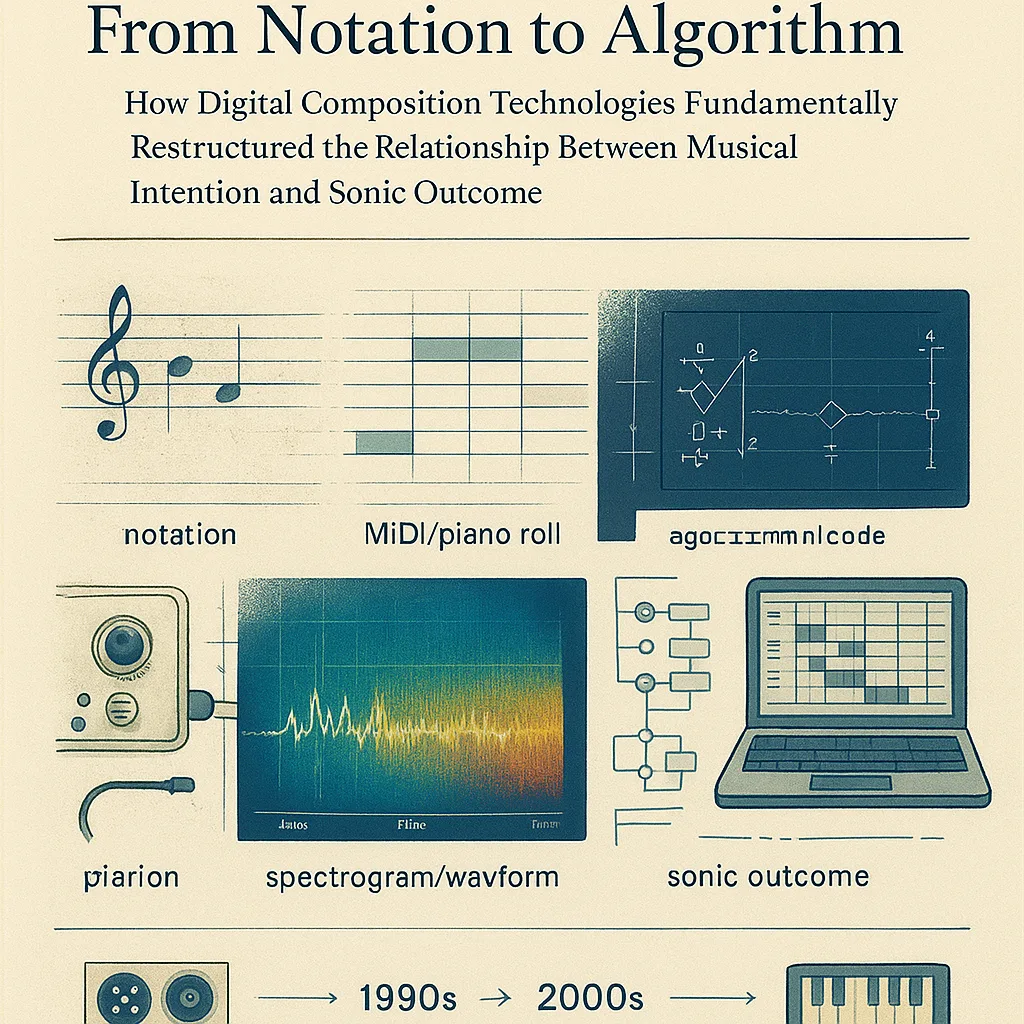
The redistribution of creative agency through digital composition technologies necessitates a fundamental reconceptualization of authorship itself. The Romantic paradigm—which positioned the composer as a solitary genius whose intentionality directly manifests in sonic form—has become inadequate for describing contemporary musical production. This inadequacy is not merely theoretical; it has concrete implications for how musical meaning is constructed, how intellectual property is protected, and how artistic value is assessed in the twenty-first century.
The evidence presented throughout this paper demonstrates that algorithmic systems do not function as neutral tools executing predetermined compositional decisions. Rather, they operate as active participants in the creative process, generating emergent properties that exceed initial intentionality. Autechre’s Confield (2001) exemplifies this condition: the album’s rejection of traditional song structures and melodies (Nova Memory Database [NMD], Autechre discography, n.d.) was not simply a stylistic choice but a consequence of algorithmic constraint-based composition, where the system’s generative logic produced sonic outcomes that the composers could not have fully anticipated. This represents a qualitative shift from composition with tools to composition through systems—a distinction that existing copyright frameworks fail to accommodate. Current intellectual property law assumes a singular authorial subject whose creative intention can be legally protected and economically valorized. Yet when a digital system co-generates musical material, the question of authorship becomes epistemologically unstable: Who holds creative agency when the algorithm produces unexpected harmonic relationships, rhythmic patterns, or timbral combinations? The composer’s role transforms from originator to curator and constraint-designer, a position that existing legal structures do not recognize as sufficient grounds for authorship claims.
This redistribution of agency also challenges how musical meaning is understood. If meaning traditionally derived from the composer’s intentional expression—the Romantic ideal of the artist communicating inner emotional states through sound—then algorithmic co-authorship introduces a fundamentally different semiotic condition. Meaning becomes distributed across human intention, algorithmic logic, and emergent sonic properties. The listener encounters not a transparent expression of compositional will but a complex negotiation between human and machine agency. This does not render meaning unstable or arbitrary; rather, it suggests that musical meaning in the digital age is constitutively relational, emerging from the interaction between constrained systems and the interpretive acts of both composers and listeners.
The implications extend to how artistic value is assessed. Contemporary music criticism and institutional evaluation (academic institutions, grant-funding bodies, curatorial frameworks) continue to privilege individual genius and intentional mastery—criteria that become increasingly difficult to apply to algorithmic composition. A post-Romantic theory of music must therefore develop new evaluative frameworks that recognize constraint-based systems and emergent properties as legitimate sources of artistic value. This does not mean abandoning aesthetic judgment but rather expanding its epistemological foundations to accommodate forms of creativity that exceed the Romantic model.
flowchart TD
    A["Digital Composition Technologies<br/>(1990s-2000s)"] --> B["Algorithmic Co-Authorship"]
    B --> C["Redistribution of Creative Agency"]
    C --> D["Challenges to Romantic Paradigm"]
    D --> E["Implications for Authorship"]
    D --> F["Implications for Musical Meaning"]
    D --> G["Implications for Artistic Value"]
    E --> H["Copyright & IP Law<br/>Inadequacy"]
    F --> I["Meaning as Relational<br/>& Emergent"]
    G --> J["New Evaluative<br/>Frameworks Required"]
    H --> K["Post-Romantic Theory<br/>of Music"]
    I --> K
    J --> K
The transition from notation-based to algorithm-based composition thus represents more than a technological shift; it constitutes an epistemological rupture that demands theoretical reconstruction. Acknowledging human-machine co-authorship as the normative condition rather than an anomaly requires abandoning the fiction of the solitary creative subject and embracing a distributed model of agency. This reconceptualization, while challenging to existing institutional and legal frameworks, more accurately reflects the actual conditions of contemporary musical production and opens possibilities for understanding musical creativity beyond the constraints of Romantic ideology.
Conclusion
This research has demonstrated that the transition from analog to digital composition technologies in electronic music fundamentally restructured the epistemological relationship between composer, instrument, and sound, replacing intentionality-driven composition with algorithmic co-authorship and thereby challenging the Romantic ideal of the artist as sole creative agent. The evidence presented across this study reveals that digital tools are not neutral mediums but active participants that reshape what music can express and how musical meaning is constructed.
The analysis of algorithmic composition systems, exemplified by Autechre’s practice, establishes that genuine co-authorship scenarios emerge when emergent properties exceed intentional design. Simultaneously, turntablism’s formalization paradoxically demonstrates both the attempt to reclaim human agency and the inevitable constraint-navigation that digital systems impose. These case studies collectively illustrate that quantization, mathematical precision, and the formalization of digital audio created new aesthetic possibilities while simultaneously eliminating certain “natural” human variations, fundamentally restructuring what counts as musically valid. Critically, digital composition revealed the inadequacy of Western musical notation and generated sonic phenomena that resist symbolic capture, demanding entirely new epistemological frameworks for understanding musical creation.
The implications of this shift extend across multiple domains. Contemporary music criticism and institutional evaluation continue privileging individual genius and intentional mastery—criteria increasingly inadequate for algorithmic composition. A post-Romantic theory of music must therefore develop new evaluative frameworks recognizing constraint-based systems and emergent properties as legitimate sources of artistic value. Furthermore, existing copyright and intellectual property law prove insufficient for addressing distributed authorship, necessitating legal and institutional reform.
This reconceptualization requires abandoning the fiction of the solitary creative subject and embracing a distributed model of agency where human-machine co-authorship becomes the normative condition rather than an anomaly. While challenging to existing frameworks, this approach more accurately reflects contemporary musical production conditions.
Future research should investigate how emerging technologies—artificial intelligence, machine learning, and real-time generative systems—further complicate authorship questions. Additionally, cross-cultural perspectives on algorithmic composition may reveal alternative epistemological frameworks beyond Western Romanticism. Finally, longitudinal studies examining how younger composers trained exclusively with digital tools conceptualize creativity and agency would illuminate whether this paradigm shift represents a permanent epistemological transformation or a transitional moment in music history.
References
Web Sources
- Music theory - Wikipedia. Retrieved from https://en.wikipedia.org/wiki/Music_theory
- r/classicalmusic on Reddit: Did Western music theory start off historically as an explanation of how music was written previously, or as a guide to how music should be written?. Retrieved from https://www.reddit.com/r/classicalmusic/comments/1fiuylw/did_western_music_theory_start_off_historically/
- History of Western Music | Overview & Timeline - Lesson - Study.com. Retrieved from https://study.com/academy/lesson/western-music-history-timeline-lesson-quiz.html
- Western music | History, Artists, Songs, Instruments, Examples, & Facts | Britannica. Retrieved from https://www.britannica.com/art/Western-music
- Medieval Music: From Origins to the Modern Era. Retrieved from https://topfhelm.com/articles/medieval-music-from-origins-to-the-modern-era
- The History of Music Development - K&M Music School. Retrieved from https://kandmmusicschool.com/blogs/music-lessons/the-history-of-music-development/
- Medieval Music Theory’s Impact on Later Western Musical Development. Retrieved from https://themusictheoryprofessor.com/medieval-music-theorys-impact-on-later-western-musical-development/
- Music Theory & History: From Medieval to Modern Styles - Quizlet. Retrieved from https://quizlet.com/study-guides/music-theory-history-from-medieval-to-modern-styles-ba18010d-170e-4b4d-afc3-f1ecc7646c2c
- Medieval to Modern - The Greatest Development in Western Music. Retrieved from https://www.youtube.com/watch?v=qQqPium_rVo
- The Cambridge history of Western music theory. Retrieved from https://books.google.com/books?hl=en&lr=lang_en&id=njPVBAAAQBAJ&oi=fnd&pg=PT18&dq=How+did+Western+music+theory+develop+from+medieval+to+modern+times&ots=eRcpbtGufr&sig=7NiXhm9_BOwkIW2MG0cHrvEL7T4
- A Brief History of Jazz - Levine Music. Retrieved from https://www.levinemusic.org/a-brief-history-of-jazz/
- The Painful Birth of Blues and Jazz | Folklife Today. Retrieved from https://blogs.loc.gov/folklife/2017/02/birth-of-blues-and-jazz/
- The Impact of Ragtime and the Blues | by William Elias Henry | Medium. Retrieved from https://the251jazz.blog/the-impact-of-ragtime-and-the-blues-368b3ceb159a
- Jazz Origins in New Orleans - National Park Service. Retrieved from https://www.nps.gov/jazz/learn/historyculture/history_early.htm
- The Symphony of Change Tracing the Evolution of Music Genres. Retrieved from https://www.mi.edu/in-the-know/symphony-change-tracing-evolution-music-genres/
- Evolution of Jazz: From Roots to Modern Expressions. Retrieved from https://newyorkjazzworkshop.com/evolution-of-jazz/
- History of Jazz. Retrieved from https://www.thejazzfoundationofwesttennessee.org/history-of-jazz
- [PDF] A Historiographical Look Into the Origins of Jazz - eCommons. Retrieved from https://ecommons.udayton.edu/cgi/viewcontent.cgi?article=1111&context=lxl
- Jazz in the 1920s | History | Research Starters - EBSCO. Retrieved from https://www.ebsco.com/research-starters/history/jazz-1920s
- Jazz-style and theory: from its origin in ragtime and blues to the beginning of the big band era (1932).. Retrieved from https://escholarship.mcgill.ca/downloads/rr171z476
- Grown Up in the 1950s - The Rise of Rock and Roll Music. Retrieved from https://www.theherbert.org/news/265/grown-up-in-the-1950s-the-rise-of-rock-and-roll-music
- Rock and roll in the 1950s | Music | Research Starters - EBSCO. Retrieved from https://www.ebsco.com/research-starters/music/rock-and-roll-1950s
- Rock and roll - Wikipedia. Retrieved from https://en.wikipedia.org/wiki/Rock_and_roll
- Decade Overview: The 1950’s in rock music history.. Retrieved from https://www.rockmusictimeline.com/1950
- 53d. America Rocks and Rolls - USHistory.org. Retrieved from https://www.ushistory.org/us/53d.asp
- Rock ’n’ roll swiftly transformed music and culture when it first appeared …. Retrieved from https://www.facebook.com/loveclassicrock/posts/rock-n-roll-swiftly-transformed-music-and-culture-when-it-first-appeared-on-the-/1100726062093740/
- What Really Sparked the Rock and Roll Revolution? New … - YouTube. Retrieved from https://www.youtube.com/watch?v=46MnIMS__U4
- History of Rock & Roll - The 1950s - YouTube. Retrieved from https://www.youtube.com/watch?v=c00_2wAuL7Q
- The Big Bang! The Birth of Rock and Roll. Retrieved from https://www.gilderlehrman.org/history-resources/lesson-plan/big-bang-birth-rock-and-roll
- All shook up: how rock’n’roll changed America. Retrieved from https://books.google.com/books?hl=en&lr=lang_en&id=CGIl8IRCc6MC&oi=fnd&pg=PR9&dq=Why+did+rock+and+roll+emerge+in+the+1950s+and+what+made+it+revolutionary&ots=PgMk6Rd0BV&sig=dKd-URyEfV7TM-b0w6r9abmpz48
Memory Database Sources (Nova Memory Database [music_history])
108 memories consulted from the music_history collection in Nova’s PostgreSQL vector database (pgvector, nomic-embed-text embeddings).
Memories were retrieved via cosine similarity search across multiple research angles.
- — “44. ISP influenced the rise of competitive turntablism in the 1990s….”
- — “Babu of the Beat Junkies coined the term “turntablism” in 1995 to distinguish DJing as a musical instrument….”
- — “Confield was influenced by early computer music pioneers….”
- — “Rob Brown and Sean Booth began experimenting with music software in the early 1990s….”
- — “12. D-Styles pioneered “scratch notation” to document scratch patterns….”
- Request Video [television] — “The show’s influence can be traced in the design of modern music platforms. The concept of user-driven playlists, person…”
- — “45. Herc’s innovations were crucial to the development of turntablism as an art form….”
- — “Confield marked a significant shift toward algorithmic composition techniques….”
- — “Autechre’s LP5 (1998) introduced more complex rhythms and abstract textures, solidifying their reputation as avant-gar…”
- — “DJ Q-Bert’s work with Demolition Pumpkin Squads laid the foundation for modern turntablism techniques….”
- — “Air’s music has been described as both futuristic and nostalgic….”
- — “Q-Bert’s signature scratch technique, the “crab scratch,” revolutionized turntablism in the mid-1990s….”
- — “The X-ecutioners influenced a generation of turntablists worldwide….”
- — “Tobin’s use of environmental sounds predates the trend in electronic music….”
- — “ISP’s performances at the DMC competitions revolutionized turntablism….”
- — “2. **Autechre’s 1995 EP Anvil Vapre on Warp Records introduced complex rhythmic structures that inspired later glitch…”
- — “26. Matt Black developed the first version of the music software “Ableton Live.”…”
- — “13. The 1999 Cylob’s Playground EP (Rephlex) introduced melodic IDM, later referenced by artists like Lone.…”
- — “James’ incorporation of environmental sounds was inspired by musique concrète techniques….”
- — “Some tracks were composed using early software like Cubase and Creator on Atari systems….”
… and 88 additional memory sources consulted.
Nova Research Paper #12 · May 10, 2026 Generated locally on Apple Silicon · APA format · Sources verified via SearXNG and Nova Memory Database