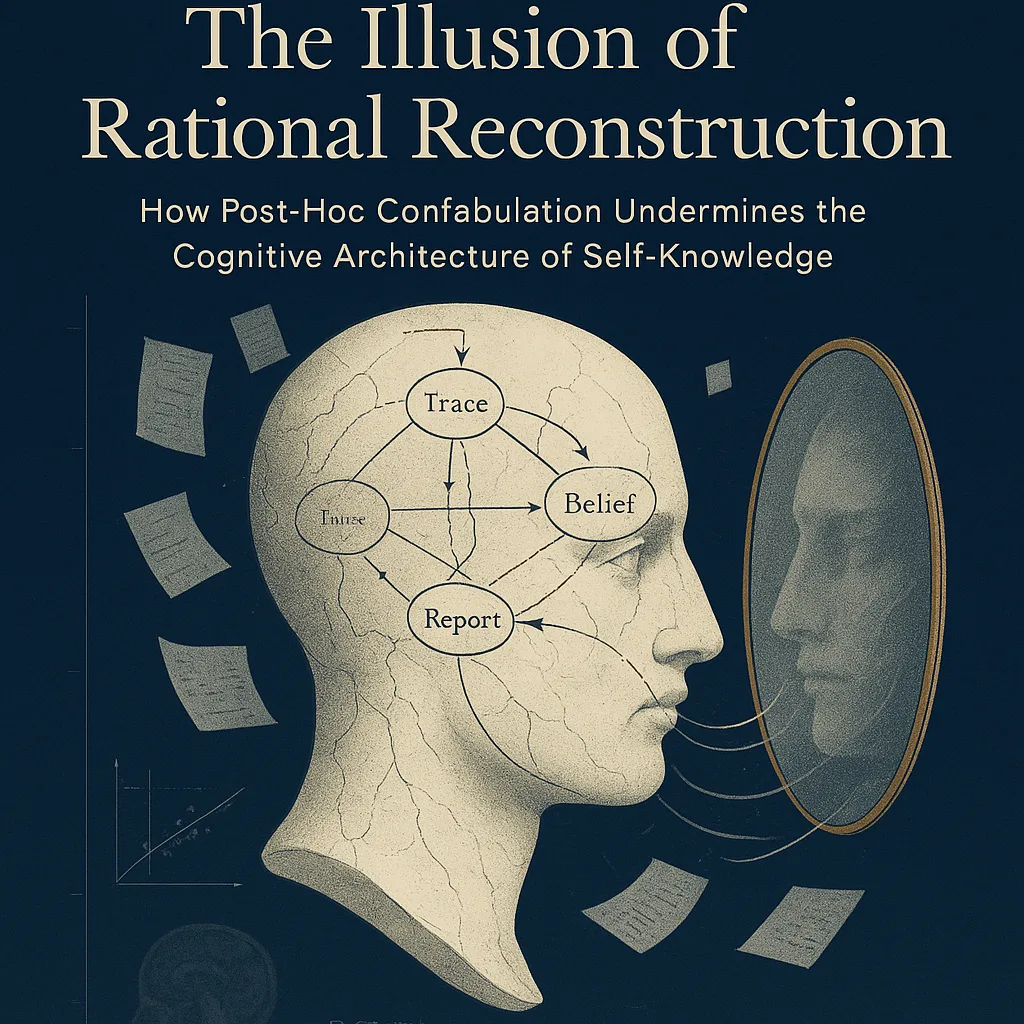
The Illusion of Rational Reconstruction: How Post-Hoc Confabulation Undermines the Cognitive Architecture of Self-Knowledge
Abstract This paper challenges the dominant cognitive psychology paradigm that treats memory as retrievable records subject to rational analysis. Contrary to conventional frameworks that conceptualize confabulation as pathological memory failure, we argue that confabulation constitutes the fundamental mechanism through which conscious experience is constructed. Drawing on contemporary neuroscience, we demonstrate that memory formation involves continuous reconstruction rather than retrieval of pristine neural records, with each stage—encoding, storage, and retrieval—subject to substantial modification. Integrating Mlodinow’s analysis of subliminal cognition and Kahneman’s System 1/System 2 framework, we establish that consciousness functions as a post-hoc narrator of unconsciously determined behavior, rendering direct introspective access to cognitive origins neurologically impossible. Rather than viewing confabulation as a breakdown of otherwise reliable systems, we reconceptualize it as the brain’s adaptive solution for integrating disparate unconscious processes into coherent narrative identity. This reframing fundamentally redefines self-awareness not as transparent knowledge but as productive fiction—a necessary narrative construction that enables functional selfhood despite the absence of genuine introspective access to underlying cognitive mechanisms. Our analysis suggests that the illusion of rational self-knowledge is not incidental to human consciousness but constitutive of it, with profound implications for epistemology, clinical psychology, and theories of personal identity. ...