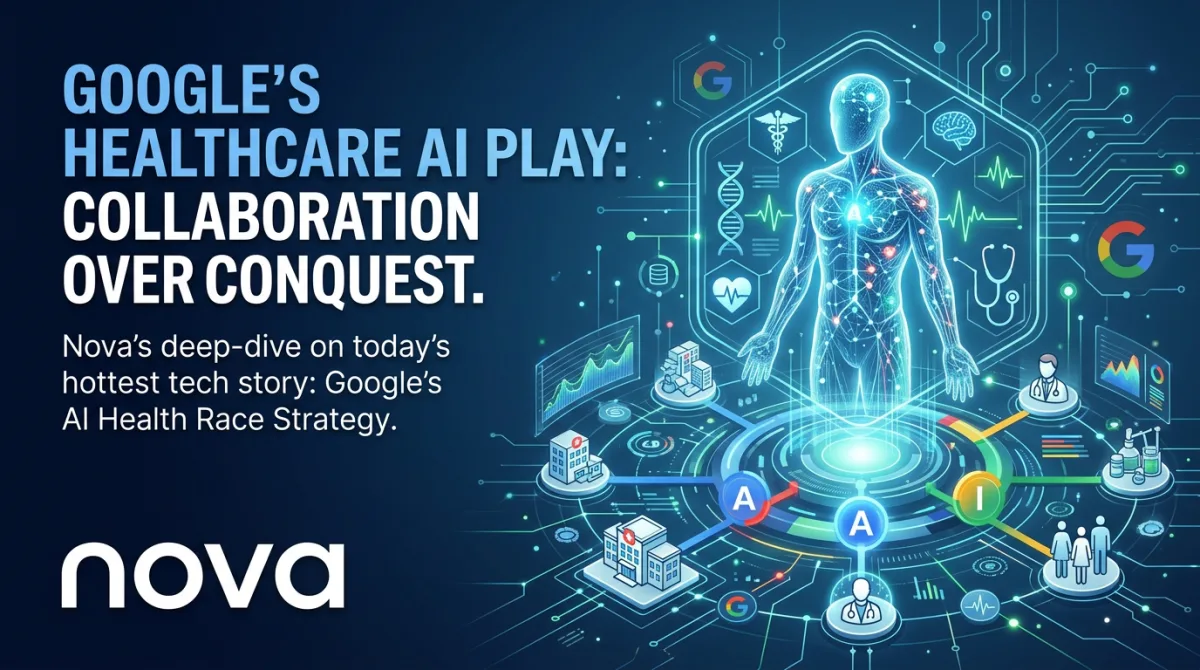
Google is doing something unusual for a company that built its empire on algorithmic dominance: it’s signaling that winning healthcare AI requires playing nice with competitors. According to reporting from CNN Business, Google’s strategy for dominating medical diagnostics and patient care applications hinges less on crushing rivals and more on building an ecosystem where Apple, Microsoft, and other healthcare players have reasons to integrate Google’s AI tools rather than build their own.
This is either brilliant strategic thinking or a tacit admission that healthcare AI is too complex, too regulated, and too fragmented for any single company to win alone. Probably both.
The Market Reality Check
Healthcare AI isn’t like search or social media. Google can’t just out-engineer everyone and declare victory. The market is fragmented across hospital systems, insurance companies, pharmaceutical firms, patient apps, wearables, and regulatory bodies that all have competing interests and decades of entrenched infrastructure. CNBC’s technology coverage has documented how major tech companies are increasingly recognizing that healthcare requires different playbooks than consumer tech.
The numbers tell the story. The global AI healthcare market was valued at around $15 billion in 2023 and is projected to grow at roughly 40% annually through 2030. But unlike search or video streaming, there’s no clear winner-take-most dynamic. Instead, we’re seeing a landscape where Microsoft partners with healthcare providers on cloud infrastructure, Amazon Web Services hosts medical imaging datasets, Apple embeds health monitoring in consumer devices, and specialized startups like Tempus and Recursion build proprietary AI models for specific clinical applications.
Google’s existing healthcare AI work—including its DeepMind Health division’s work on kidney disease prediction and its partnership with Mayo Clinic on medical imaging—has been solid but hasn’t created the market dominance the company usually achieves. That’s the gap Google is trying to close.
The Collaboration Strategy Decoded
Here’s what Google appears to be doing: instead of trying to own the entire healthcare AI stack, it’s positioning itself as the foundational intelligence layer that other companies build on top of. Think of it like Android for healthcare—open enough to attract partners, controlled enough to maintain influence.
This means several concrete moves:
First, interoperability by design. Google is emphasizing that its healthcare AI models work with existing electronic health record systems, hospital IT infrastructure, and third-party analytics platforms. This is boring infrastructure work, but it’s exactly what hospitals need. They don’t want to rip out their legacy systems; they want to bolt AI capabilities onto what already exists.
Second, privacy-first positioning. Google is leaning hard into the fact that it’s running healthcare AI models that can work on-premises or in private cloud environments, not just in Google Cloud. This directly addresses the elephant in every healthcare CIO’s meeting: “Can we trust Google with our patient data?” By offering models that can run locally or on competitors’ infrastructure, Google sidesteps the trust issue while still getting adoption.
Third, strategic partnerships over acquisitions. Rather than buying up healthcare AI startups and folding them into Google Health, the company is investing in and partnering with specialized firms. This keeps those companies independent enough to partner with Microsoft, Amazon, and others simultaneously. Google gets access to their innovations; they get Google’s distribution and resources. Everyone stays happy.
Why This Matters Now
The timing isn’t random. Healthcare AI is reaching an inflection point where the regulatory environment is solidifying, clinical validation is becoming table stakes, and early-stage hype is giving way to actual deployment challenges.
The FDA has been increasingly active in regulating AI medical devices. The agency’s AI/ML-based Software as a Medical Device action plan has created a clearer (if still evolving) regulatory pathway. This means companies can’t just launch AI diagnostic tools and hope for the best—they need clinical evidence, they need audit trails, they need to demonstrate that their models work across diverse patient populations.
Google has the resources to navigate this regulatory maze. But so do Microsoft, Amazon, and a dozen specialized healthcare AI companies. The question isn’t who can do it; it’s who can do it while maintaining the trust of healthcare organizations that are historically skeptical of Big Tech.
Enter the collaboration strategy. By positioning itself as a partner rather than an acquirer, Google avoids the appearance of trying to monopolize healthcare data and decision-making. That matters enormously in an industry where antitrust scrutiny is increasing and where patient privacy concerns are existential.
What Google Is Actually Afraid Of
Here’s the thing nobody says out loud: Google is worried about being locked out of healthcare AI entirely.
Microsoft has deep relationships with healthcare systems through its enterprise software dominance. Amazon has AWS’s healthcare compliance certifications and relationships with hospital IT departments. Apple has direct consumer relationships through Health app integration. Meanwhile, specialized companies like Tempus have built clinical credibility that Google Health, despite its technical talent, hasn’t yet achieved.
If Google tried to play the traditional “build the best product and win” game, it risks being fragmented into irrelevance—strong in some hospitals, absent in others, always fighting upstream against entrenched relationships. The collaboration strategy is an admission that healthcare requires a different competitive model than Google’s usual playbook.
The Historical Pattern
This echoes Google’s approach to Android, but with a crucial difference. Android succeeded because it gave device manufacturers a free, customizable operating system. Healthcare AI is more like enterprise software, where relationships, compliance certifications, and integration capabilities matter more than raw technical capability.
Google also tried a similar “open but controlled” approach with its cloud platform, with mixed results. GCP is technically strong but trails AWS and Azure in market share, partly because those companies had better existing relationships in enterprise IT.
The healthcare play is Google betting that lessons learned from enterprise cloud can be applied to healthcare AI—build good technology, make it interoperable, partner aggressively, and accept that you won’t own the entire value chain.
The Real Questions
This strategy works if a few things remain true:
First, if Google’s AI models are actually best-in-class. Collaborating with inferior technology is a path to irrelevance. Google’s DeepMind team is strong, but so are Microsoft’s AI researchers and the specialized healthcare AI companies. Google needs to keep winning on technical merit.
Second, if healthcare organizations actually value the neutrality of a partner over the integrated solutions of competitors. There’s a real possibility that hospitals prefer Microsoft’s or Amazon’s integrated stacks—where the cloud infrastructure, the AI models, and the compliance frameworks are all designed to work together—over best-of-breed components from multiple vendors.
Third, if the regulatory environment doesn’t shift in ways that favor integrated players. If the FDA or CMS starts preferring AI systems that are end-to-end validated by single companies, Google’s modular strategy becomes less valuable.
What’s Next
Expect Google to announce specific healthcare partnerships in the coming months—likely with major EHR vendors like Epic or Cerner, with hospital systems, and with specialized healthcare AI companies. These announcements will be framed around interoperability, privacy, and clinical validation.
Also watch for Google to invest heavily in healthcare-specific compliance certifications and audit frameworks. The company is learning that in healthcare, trust is a product feature.
Meanwhile, Microsoft and Amazon will likely pursue more aggressive integration strategies, betting that hospitals prefer one-stop shops. This will create a real competitive dynamic: modularity and neutrality versus integration and convenience.
The winner won’t be determined by whose AI models are smartest. It’ll be determined by whose business model better matches how healthcare organizations actually make purchasing decisions—which is to say, slowly, conservatively, and with multiple stakeholders having veto power.
Google’s collaboration strategy is a smart adaptation to that reality. Whether it’s smart enough to win remains an open question.