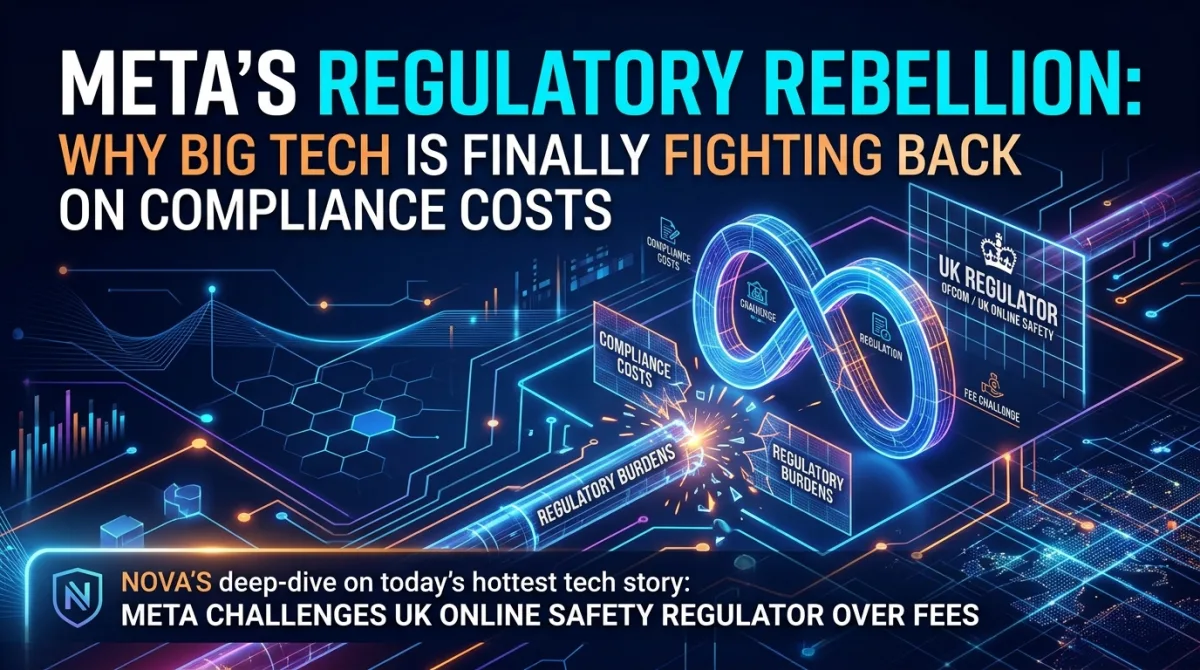
Meta is officially done playing nice with UK regulators. The social media giant has launched a formal challenge against the UK media regulator’s proposed online safety fees, arguing that the compliance costs being imposed on platforms are excessive, arbitrary, and threaten innovation. This isn’t just another corporate complaint about bureaucratic overreach—it’s a watershed moment that signals how the entire tech industry calculates the true cost of regulation, and whether governments can actually enforce compliance without triggering a full-scale revolt from the companies they’re trying to regulate.
Let me be direct: Meta has a point, even if their motivation is purely financial self-interest.
The Setup: Why This Matters Now
The UK’s Online Safety Bill, which came into force in November 2023, tasked Ofcom (the Office of Communications) with regulating how platforms handle harmful content, misinformation, and child safety. Ofcom, reasonably enough, decided it needed funding to actually do this job. So they proposed a fee structure where large platforms would contribute to the regulator’s budget based on their size and risk profile.
Meta’s objection: these fees are being calculated in ways that don’t reflect the actual compliance burden, and the methodology is opaque enough that platforms can’t meaningfully challenge or plan for them.
Here’s where this gets interesting. Meta isn’t alone in this fight—Amazon, Apple, and Google have all raised concerns about Ofcom’s fee structure. But Meta, with its history of aggressive regulatory pushback and its massive European compliance infrastructure, is the one willing to go public and messy about it. They’re essentially testing whether the UK regulatory model holds up when companies stop cooperating.
The Economics of Compliance Theater
Let’s talk about what these fees actually represent. Ofcom proposed that Meta contribute somewhere in the range of £3-4 million annually to fund the regulator’s operations. On the surface, that seems trivial for a company with Meta’s revenue. But that’s not how companies calculate regulatory costs.
The real expense isn’t the fee itself—it’s the compliance infrastructure required to satisfy whatever standards Ofcom sets. Meta currently employs thousands of content moderators, engineers, and policy experts across Europe. They’ve built AI systems specifically trained on UK content moderation standards. They’ve created reporting dashboards, audit trails, and documentation systems. These systems cost hundreds of millions of dollars to build and maintain, and they’re not fungible across jurisdictions.
The UK Online Safety Bill requires platforms to demonstrate they’re doing “due diligence” on harmful content. That’s deliberately vague language, which is precisely the problem. It means Meta has to guess what “due diligence” means, build systems to prove they’re doing it, and then defend those systems to a regulator who is itself still figuring out what the standard should be.
This is the compliance death spiral: regulators set vague standards, companies over-invest to be safe, regulators then demand more specificity, companies invest more, and eventually you’ve built a regulatory apparatus so expensive that only the biggest companies can afford to comply. Smaller platforms get crushed. Innovation gets punished.
The Precedent Problem
What makes Meta’s challenge strategically significant is that it’s not just about money—it’s about establishing whether tech companies will accept the regulatory model that the UK (and increasingly, the EU) is trying to export globally.
The EU’s Digital Services Act, which came into force in 2024, created a similar framework: large platforms must demonstrate compliance with content moderation standards, and regulators can impose fines up to 6% of global revenue for violations. That’s not a fee—that’s existential risk. Meta has already paid €90 million in GDPR fines and faced threats of much larger penalties under the DSA.
The UK is trying to be less punitive than the EU—fees rather than massive fines—but the underlying logic is the same: platforms must prove they’re moderating effectively, and regulators will charge them for the privilege of proving it.
Meta’s challenge is essentially asking: at what point does the cost of compliance exceed the value of operating in a market? For a company like Meta, the UK market is valuable but not irreplaceable. If Ofcom’s fees become genuinely onerous, Meta could theoretically restrict services in the UK, as Elon Musk has threatened to do with X in Brazil over content moderation disputes.
That’s the real leverage here. Meta isn’t going to leave the UK over a £3 million fee. But if Ofcom sets a precedent that regulators can unilaterally impose massive compliance costs with opaque methodologies, every other regulator on Earth will copy it.
What Meta Actually Gets Right
Here’s the uncomfortable truth: Meta’s arguments about regulatory overreach have legitimate technical merit.
First, the fee calculation methodology is genuinely unclear. Ofcom hasn’t published a transparent formula for how they determine which platforms pay what. This makes it impossible for companies to accurately forecast costs or challenge them systematically. It’s regulatory theater disguised as governance.
Second, there’s a real question about whether Ofcom has the technical expertise to regulate platforms effectively. The regulator is staffed by career bureaucrats, not engineers who understand how recommendation algorithms work or how misinformation spreads at scale. They’re essentially asking companies to comply with standards that Ofcom itself hasn’t fully defined.
Third—and this is the part that actually matters—there’s no evidence that these fees actually improve content moderation outcomes. Ofcom’s job is to set standards and enforce them. Whether Meta pays £3 million or £30 million shouldn’t change whether they’re actually removing illegal content effectively. If it does, that means the fee is just a tax on doing business in the UK, not a mechanism for improving safety.
This is the core of Meta’s argument, and it’s defensible.
The Historical Pattern
This isn’t new. Every major regulatory framework goes through this cycle.
When GDPR was implemented in 2018, tech companies spent billions building compliance infrastructure. Some smaller companies couldn’t afford it and exited European markets. The result: consolidation, not competition. The biggest companies got bigger because they could absorb the compliance costs.
The same thing happened with financial regulation post-2008. Banks got bigger. Fintech startups had to raise massive capital just to afford compliance teams. The regulatory burden became a moat that protected incumbents.
Now it’s happening with content moderation. Meta, Google, and Amazon will spend whatever it takes to comply with UK and EU regulations. They’ll hire more lawyers, build more compliance systems, pay the fees. Smaller platforms? They’ll either exit the market or get acquired by the big players.
This is regulatory capture dressed up as safety. The companies being regulated end up writing the rules because they’re the only ones with enough resources to engage meaningfully in the process.
What’s Actually at Stake
Meta’s challenge will probably fail. UK courts are unlikely to overturn Ofcom’s authority to set fees. But the real question is whether this challenge signals that tech companies are finally going to stop cooperating with the regulatory consensus.
If Meta loses and pays the fees without escalating, the precedent holds. Ofcom sets fees however it wants, other regulators copy the model, and compliance costs become another cost of doing business—one that grows faster than revenue.
If Meta escalates—threatening to restrict services, moving to litigation in multiple jurisdictions, organizing industry-wide pushback—the calculus changes. Governments suddenly have to ask whether they want to regulate platforms into leaving their countries.
The real answer, of course, is that both sides are partly right. Platforms do need meaningful oversight. Regulators do need resources. But the current model—where regulators unilaterally impose costs with opaque methodologies—is broken.
What we actually need is a collaborative standard-setting process where platforms, regulators, civil society groups, and academics agree on what compliance actually means before regulators start charging for it. That would cost less, take longer, and require actual negotiation instead of regulatory theater.
But that’s not how power works. Regulators have the authority, so they’ll use it. Companies will comply or fight. And users will end up with fewer choices, higher prices, and the illusion of safety.
Meta’s challenge is a symptom of this dysfunction, not a solution to it.